Related Research Articles

BlueScope Steel Limited is an Australian flat product steel producer that was spun-off from BHP Billiton in 2002.

Port Kembla is a suburb of Wollongong 10 km south of the CBD and part of the Illawarra region of New South Wales. The suburb comprises a seaport, industrial complex, a small harbour foreshore nature reserve, and a small commercial sector. It is situated on the tip of Red Point: its first European sighting was by Captain James Cook in 1770. The name "Kembla" is an Aboriginal word meaning "plenty [of] wild fowl".

Anti-discrimination law or non-discrimination law refers to legislation designed to prevent discrimination against particular groups of people; these groups are often referred to as protected groups or protected classes. Anti-discrimination laws vary by jurisdiction with regard to the types of discrimination that are prohibited, and also the groups that are protected by that legislation. Commonly, these types of legislation are designed to prevent discrimination in employment, housing, education, and other areas of social life, such as public accommodations. Anti-discrimination law may include protections for groups based on sex, age, race, ethnicity, nationality, disability, mental illness or ability, sexual orientation, gender, gender identity/expression, sex characteristics, religion, creed, or individual political opinions.
Pregnancy discrimination is a type of employment discrimination that occurs when expectant women are fired, not hired, or otherwise discriminated against due to their pregnancy or intention to become pregnant. Common forms of pregnancy discrimination include not being hired due to visible pregnancy or likelihood of becoming pregnant, being fired after informing an employer of one's pregnancy, being fired after maternity leave, and receiving a pay dock due to pregnancy. Pregnancy discrimination may also take the form of denying reasonable accommodations to workers based on pregnancy, childbirth, and related medical conditions. Pregnancy discrimination has also been examined to have an indirect relationship with the decline of a mother's physical and mental health. Convention on the Elimination of All Forms of Discrimination against Women prohibits dismissal on the grounds of maternity or pregnancy and ensures right to maternity leave or comparable social benefits. The Maternity Protection Convention C 183 proclaims adequate protection for pregnancy as well. Though women have some protection in the United States because of the Pregnancy Discrimination Act of 1978, it has not completely curbed the incidence of pregnancy discrimination. The Equal Rights Amendment could ensure more robust sex equality ensuring that women and men could both work and have children at the same time.
Disparate impact in United States labor law refers to practices in employment, housing, and other areas that adversely affect one group of people of a protected characteristic more than another, even though rules applied by employers or landlords are formally neutral. Although the protected classes vary by statute, most federal civil rights laws consider race, color, religion, national origin, and sex to be protected characteristics, and some laws include disability status and other traits as well.

Cringila is an intercity train station located in Cringila, Australia, on the South Coast railway line's Port Kembla branch. The station serves NSW TrainLink trains travelling south to Port Kembla and north to Wollongong and Sydney.

Port Kembla North is a single-platform intercity train station located in Port Kembla, Australia, on the South Coast railway line's Port Kembla branch. The station serves NSW TrainLink trains traveling south to Port Kembla Station and north to Wollongong and Sydney. The station was one of 23 on the metropolitan rail network to record an average of fewer than one passenger per day in 2014.

Port Kembla is a single-platform intercity train terminal located in Port Kembla, Australia, on the South Coast railway line's Port Kembla branch. The station serves NSW TrainLink trains traveling north to Wollongong and Sydney. The station also serves as a stabling location for South Coast line trains.
Lysaght was founded in 1880 by John Lysaght as a subsidiary to the company John Lysaght and Co. The company pioneered modern steel coating technologies (galvanization). Its coated steel building products were sold under the 'ORB' brand and contributed to Australian architectural style.
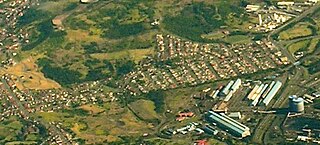
Cringila is a southern suburb of the city of Wollongong, New South Wales, Australia. The suburb is bounded by Berkeley, Unanderra, Lake Heights and Warrawong.

nib Group is an Australian health care fund. It was established in the NSW Hunter Region in 1952 to provide health insurance for workers at the BHP Steelworks, and has since grown into a national and international operation. As of 2017, nib held an 8.3% share of the Australian private health cover market.
A marriage bar is the practice of restricting the employment of married women. Common in Western countries from the late 19th century to the 1970s, the practice often called for the termination of the employment of a woman on her marriage, especially in teaching and clerical occupations. Further, widowed women with children were still considered to be married at times, preventing them from being hired, as well.
Phillips v. Martin Marietta Corp., 400 U.S. 542 (1971), was a United States Supreme Court landmark case in which the Court held that under Title VII of the Civil Rights Act of 1964, an employer may not, in the absence of business necessity, refuse to hire women with pre-school-age children while hiring men with such children. It was the first sex discrimination case under Title VII to reach the Court.

The Whyalla Steelworks is a fully integrated steelworks and the only manufacturer of rail in Australia. Iron ore is mined in the Middleback Range to feed the steelworks, resulting in the distribution of finished steel products of over 90 different grades. It occupies a 1,000 ha site on the shore of False Bay, Spencer Gulf and is the largest employer in Whyalla, South Australia.
Price Waterhouse v. Hopkins, 490 U.S. 228 (1989), was a landmark decision of the US Supreme Court on the issues of prescriptive sex discrimination and employer liability for sex discrimination. The employee, Ann Hopkins, sued her former employer, the accounting firm Price Waterhouse. She argued that the firm denied her partnership because she did not fit the partners' idea of what a female employee should look and act like. The employer failed to prove that it would have denied her partnership anyway, and the Court held that constituted sex discrimination under Title VII of the Civil Rights Act of 1964. The significance of the Supreme Court's ruling was twofold. First, it established that gender stereotyping is actionable as sex discrimination. Second, it established the mixed-motive framework that enables employees to prove discrimination when other, lawful reasons for the adverse employment action exist alongside discriminatory motivations or reasons.
The D1 class were a class of diesel locomotives built by Commonwealth Engineering, Granville with English Electric traction equipment for Australian Iron & Steel's, Port Kembla steelworks in 1950-1951.
The D9 class were a class of diesel locomotives built by English Electric, Rocklea for Australian Iron & Steel's, Port Kembla steelworks between 1956 and 1960.

Charles Henry Hoskins (1851-1926) was an Australian industrialist, who was significant in the development of the iron and steel industry in Australia.
Australian Iron & Steel was an Australian iron and steel manufacturer.

Sir Cecil Harold Hoskins (1889–1971) was an Australian industrialist associated with the iron and steel industry. He is notable mainly for the establishment of the steel industry at Port Kembla, the company Australian Iron & Steel, and its subsequent merger with BHP in 1935. He was also on the board of the Australian Mutual Provident Society for many years and was its chairman from 1947 to 1962. He is less well known for his involvement in centre-right political organisations and the scouting movement, and his interest in landscape gardens.
References
- ↑ Refractory Girl. Refractory Girl Collective. 1987.
- ↑ "Jobs for Women Campaigns - Event - the Australian Women's Register".
- ↑ Covell, Diana; Refshauge, Chloe (1986). "Discriminatory Safety Practices at BHP". Legal Service Bulletin. 11 (48).
- 1 2 3 "Jobs fight turns tide for women of steel". 20 June 2015.
- 1 2 3 4 5 6 Tonkin, Liza (2000). "Women of Steel: Constructing and Contesting New Gendered Geographies of Work in the Australian Steel Industry". Antipode. 32 (2): 115–134. doi:10.1111/1467-8330.00124. ISSN 1467-8330.
- ↑ "The 'Jobs for Women Campaign' at BHP, Port Kembla, 1980-94". Australian Society for the Study of Labour History. Retrieved 16 March 2020.
- 1 2 "Sex discrimination, Port Kembla Steelworks | Public Interest Advocacy Centre".
- ↑ "Factories, Shops and Industries Act 1962 No 43".
{{cite web}}: CS1 maint: url-status (link) - ↑ 'Protective Legislation at Work. A case study of the 'weight limit' on manual handling'. A report of the President of the Anti-Discrimination Board, April 1984. ISBN 0 7305 0145 0
- ↑ "Walpole, Susan (1942-) - People and organisations". Trove. Retrieved 16 March 2020.
- ↑ "Women of Steel – Resistance Books".