
Frederick, Prince of Wales,, was the eldest son and heir apparent of King George II of Great Britain. He grew estranged from his parents, King George and Caroline of Ansbach. Frederick was the father of King George III.
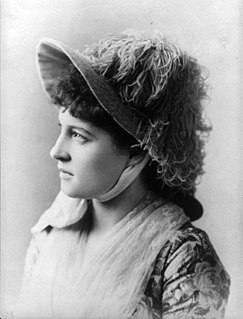
Emilie Charlotte Langtry, known as LillieLangtry and nicknamed "The Jersey Lily", was a British socialite, stage actress and producer.

Prince Henry, Duke of Cumberland and Strathearn was the sixth child and fourth son of Frederick, Prince of Wales, and Princess Augusta of Saxe-Gotha, and a younger brother of George III. His 1771 marriage to a commoner against the King's wishes prompted the Royal Marriages Act of 1772.
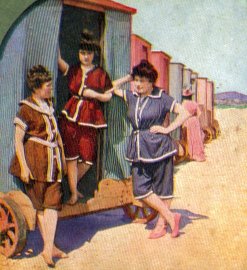
The bathing machine was a device, popular from the 18th century until the early 20th century, to allow people to change out of their usual clothes, change into swimwear, and wade in the ocean at beaches. Bathing machines were roofed and walled wooden carts rolled into the sea. Some had solid wooden walls, others canvas walls over a wooden frame, and commonly walls at the sides and curtained doors at each end.

Bathing is the washing of the body with a liquid, usually water or an aqueous solution, or the immersion of the body in water. It may be practiced for personal hygiene, religious ritual or therapeutic purposes. By analogy, especially as a recreational activity, the term is also applied to sun bathing and sea bathing.
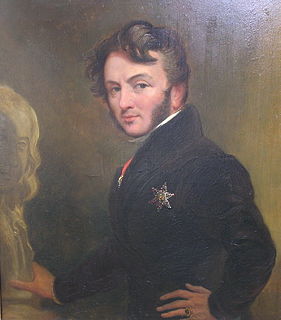
Sir George Hayter was a notable English painter, specialising in portraits and large works involving in some cases several hundred individual portraits. Queen Victoria appreciated his merits and appointed Hayter her Principal Painter in Ordinary and also awarded him a Knighthood 1841.
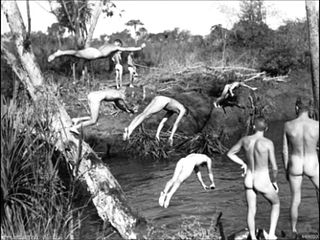
Nude swimming, or skinny dipping, is the practice of swimming or bathing naked, whether in natural bodies of water or in swimming pools.

Richard Russell was an 18th-century British physician who encouraged his patients to use a form of water therapy that involved the submersion or bathing in, and drinking of, seawater. The contemporary equivalent of this is thalassotherapy, although the practice of drinking seawater has largely discontinued.

Sea bathing is swimming in the sea or in sea water and a sea bath is a protective enclosure for sea bathing. Unlike bathing in a swimming pool, which is generally done for pleasure or exercise purposes, sea bathing was once thought to have curative or therapeutic value. It arose from the medieval practice of visiting spas for the beneficial effects of the waters. The practice of sea bathing dates back to the 17th century but became popular in the late 18th century. The development of the first swimsuits dates from the period as does the development of the bathing machine.

George Washington Thomas Lambert was an Australian artist, known principally for portrait painting and as a war artist during the First World War.
The history of Brighton is that of an ancient fishing village which emerged as a health resort in the 18th century and grew into one of the largest towns in England by the 20th century.

Martha Gunn (1726–1815) was possibly the most famous of the "dippers", certainly the most famous in Brighton. She lived at 36 East Street, Brighton, in a house that still stands. Her grave stone stands in St Nicholas' churchyard in Brighton.

The Church of Saint Nicholas of Myra, usually known as St. Nicholas Church, is an Anglican church in Brighton, England. It is both the original parish church of Brighton and, after St Helen's Church, Hangleton and St Peter's Church in Preston village, the third oldest surviving building in the city of Brighton and Hove. It is located on high ground at the junction of Church Street and Dyke Road in the city centre, very close to the main shopping areas. Due to its architectural significance the church is a Grade II* listed building.

The Lanes are a collection of narrow lanes in Brighton, in the city of Brighton and Hove famous for their small shops and narrow alleyways.

Royal Crescent is a crescent-shaped terrace of houses on the seafront in Brighton, part of the English city of Brighton and Hove. Built in the late 18th and early 19th century as a speculative development on the open cliffs east of Brighton by a wealthy merchant, the 14 lodging houses formed the town's eastern boundary until about 1820. It was the seaside resort's first planned architectural composition, and the first built intentionally to face the sea. The variety of building materials used include black glazed mathematical tiles—a characteristic feature of Brighton's 18th-century architecture. English Heritage has listed the crescent at Grade II* for its architectural and historical importance. An adjacent five-storey building, formerly the Royal Crescent Hotel but now converted into flats with the name Royal Crescent Mansions, is listed separately at Grade II.

The Clock Tower is a free-standing clock tower in the centre of Brighton, part of the English city of Brighton and Hove. Built in 1888 in commemoration of Queen Victoria's Golden Jubilee, the distinctive structure included innovative structural features and became a landmark in the popular and fashionable seaside resort. The city's residents "retain a nostalgic affection" for it, even though opinion is sharply divided as to the tower's architectural merit. English Heritage has listed the clock tower at Grade II for its architectural and historical importance.

The Brighton Fishing Museum is a registered independent museum established in co-operation with the local fishing community in 1994. This museum is dedicated to Brighton's fishing and seaside history. It is located a short distance to the west of Brighton Pier within an area known as the Fishing Quarter, occupying two of the arches on the Kings' Road, which runs along Brighton's beachfront. Admission is free and donations appreciated.

The Old Steine Gardens in Brighton, Brighton and Hove, East Sussex, England, adjacent to the Old Steine thoroughfare, are the site of several monuments of national historic significance.
Sir Matthew John Tierney, Bart. was an Irish surgeon who became Physician-in-Ordinary to Kings George IV and William IV of the United Kingdom. He gained a reputation for his study of vaccination.

The Royal Pavilion Tavern, commonly known as the Pavilion Tavern or Pav Tav, was for nearly 200 years a pub in the centre of Brighton, part of the English coastal city of Brighton and Hove. Converted from a house into the Royal Pavilion Hotel in the early 19th century, its original role soon changed from a hotel to a pub, in which guise it remained until its closure in September 2019. The building was also used as a court for several years early in its history, and prominent local architect Amon Henry Wilds was responsible for its redesign as a hotel and inn. English Heritage has listed the building at Grade II for its architectural and historical importance, and it stands within a conservation area.
