Related Research Articles
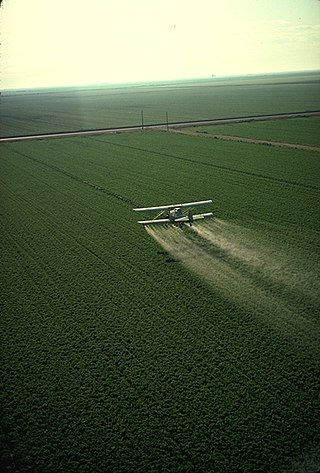
Pesticides are substances that are meant to control pests. This includes herbicide, insecticide, nematicide, molluscicide, piscicide, avicide, rodenticide, bactericide, insect repellent, animal repellent, microbicide, fungicide, and lampricide. The most common of these are herbicides, which account for approximately 50% of all pesticide use globally. Most pesticides are intended to serve as plant protection products, which in general, protect plants from weeds, fungi, or insects. As an example, the fungus Alternaria solani is used to combat the aquatic weed Salvinia.

Daminozide—also known as aminozide, Alar, Kylar, SADH, B-995, B-nine, and DMASA,—is a plant growth regulator, a chemical sprayed on fruit to regulate growth, make harvest easier, and keep apples from falling off the trees before they ripen so they are red and firm for storage. It was produced in the U.S. by the Uniroyal Chemical Company, Inc,, which registered daminozide for use on fruits intended for human consumption in 1963. In addition to apples and ornamental plants, they also registered it for use on cherries, peaches, pears, Concord grapes, tomato transplants, and peanut vines. Alar was first approved for use in the U.S. in 1963. It was primarily used on apples until 1989, when the manufacturer voluntarily withdrew it after the U.S. Environmental Protection Agency proposed banning it based on concerns about cancer risks to consumers.

The Environmental Protection Agency (EPA) is an independent executive agency of the United States federal government tasked with environmental protection matters. President Richard Nixon proposed the establishment of EPA on July 9, 1970; it began operation on December 2, 1970, after Nixon signed an executive order. The order establishing the EPA was ratified by committee hearings in the House and Senate. The agency is led by its administrator, who is appointed by the president and approved by the Senate. The current administrator is Michael S. Regan. The EPA is not a Cabinet department, but the administrator is normally given cabinet rank. The EPA has its headquarters in Washington, D.C., regional offices for each of the agency's ten regions, and 27 laboratories. The agency conducts environmental assessment, research, and education. It has the responsibility of maintaining and enforcing national standards under a variety of environmental laws, in consultation with state, tribal, and local governments. It delegates some permitting, monitoring, and enforcement responsibility to U.S. states and the federally recognized tribes. EPA enforcement powers include fines, sanctions, and other measures. The agency also works with industries and all levels of government in a wide variety of voluntary pollution prevention programs and energy conservation efforts. The agency's budgeted employee level in 2023 is 16,204.1 full-time equivalent (FTE). More than half of EPA's employees are engineers, scientists, and environmental protection specialists; other employees include legal, public affairs, financial, and information technologists. Many public health and environmental groups advocate for the agency and believe that it is creating a better world. Other critics believe that the agency commits government overreach by adding unnecessary regulations on business and property owners.

Toxicity is the degree to which a chemical substance or a particular mixture of substances can damage an organism. Toxicity can refer to the effect on a whole organism, such as an animal, bacterium, or plant, as well as the effect on a substructure of the organism, such as a cell (cytotoxicity) or an organ such as the liver (hepatotoxicity). By extension, the word may be metaphorically used to describe toxic effects on larger and more complex groups, such as the family unit or society at large. Sometimes the word is more or less synonymous with poisoning in everyday usage.

Toxic waste is any unwanted material in all forms that can cause harm. Mostly generated by industry, consumer products like televisions, computers, and phones contain toxic chemicals that can pollute the air and contaminate soil and water. Disposing of such waste is a major public health issue.
Chlordane, or chlordan, is an organochlorine compound that was used as a pesticide. It is a white solid. In the United States, chlordane was used for termite-treatment of approximately 30 million homes until it was banned in 1988. Chlordane was banned 10 years earlier for food crops like corn and citrus, and on lawns and domestic gardens.
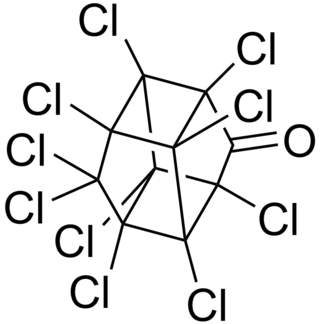
Chlordecone, better known in the United States under the brand name Kepone, is an organochlorine compound and a colourless solid. It is an obsolete insecticide, now prohibited in the western world, but only after many thousands of tonnes had been produced and used. Chlordecone is a known persistent organic pollutant (POP) that was banned globally by the Stockholm Convention on Persistent Organic Pollutants in 2009.

Lindane, also known as gamma-hexachlorocyclohexane (γ-HCH), gammaxene, Gammallin and benzene hexachloride (BHC), is an organochlorine chemical and an isomer of hexachlorocyclohexane that has been used both as an agricultural insecticide and as a pharmaceutical treatment for lice and scabies.
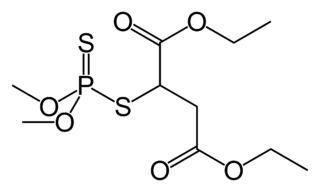
Malathion is an organophosphate insecticide which acts as an acetylcholinesterase inhibitor. In the USSR, it was known as carbophos, in New Zealand and Australia as maldison and in South Africa as mercaptothion.

Chlorpyrifos (CPS), also known as Chlorpyrifos ethyl, is an organophosphate pesticide that has been used on crops, animals, and buildings, and in other settings, to kill several pests, including insects and worms. It acts on the nervous systems of insects by inhibiting the acetylcholinesterase enzyme. Chlorpyrifos was patented in 1966 by Dow Chemical Company.

The Toxic Substances Control Act (TSCA) is a United States law, passed by the 94th United States Congress in 1976 and administered by the United States Environmental Protection Agency (EPA), that regulates chemicals not regulated by other U.S. federal statutes, including chemicals already in commerce and the introduction of new chemicals. When the TSCA was put into place, all existing chemicals were considered to be safe for use and subsequently grandfathered in. Its three main objectives are to assess and regulate new commercial chemicals before they enter the market, to regulate chemicals already existing in 1976 that posed an "unreasonable risk of injury to health or the environment", as for example PCBs, lead, mercury and radon, and to regulate these chemicals' distribution and use.

Atrazine is a chlorinated herbicide of the triazine class. It is used to prevent pre-emergence broadleaf weeds in crops such as maize (corn), soybean and sugarcane and on turf, such as golf courses and residential lawns. Atrazine's primary manufacturer is Syngenta and it is one of the most widely used herbicides in the United States, Canadian, and Australian agriculture. Its use was banned in the European Union in 2004, when the EU found groundwater levels exceeding the limits set by regulators, and Syngenta could not show that this could be prevented nor that these levels were safe.

Anne Irene McGill Gorsuch Burford, also known as Anne M. Gorsuch, was an American attorney and politician. Between 1981 and 1983, while known as Anne M. Gorsuch, she served under President Ronald Reagan as the first female Administrator of the Environmental Protection Agency (EPA). Her son is sitting Associate Justice of the Supreme Court of the United States Neil Gorsuch.
A Biopesticide is a biological substance or organism that damages, kills, or repels organisms seen as pests. Biological pest management intervention involves predatory, parasitic, or chemical relationships.

Endosulfan is an off-patent organochlorine insecticide and acaricide that is being phased out globally. It became a highly controversial agrichemical due to its acute toxicity, potential for bioaccumulation, and role as an endocrine disruptor. Because of its threats to human health and the environment, a global ban on the manufacture and use of endosulfan was negotiated under the Stockholm Convention in April 2011. The ban has taken effect in mid-2012, with certain uses exempted for five additional years. More than 80 countries, including the European Union, Australia, New Zealand, several West African nations, the United States, Brazil, and Canada had already banned it or announced phase-outs by the time the Stockholm Convention ban was agreed upon. It is still used extensively in India and China despite laws against its use. It is also used in a few other countries. It is produced by the Israeli firm Makhteshim Agan and several manufacturers in India and China. On 13.05.2011, the India Supreme Court ordered a ban on the production and sale of endosulfan in India, pending further notice.
The Food Quality Protection Act (FQPA), or H.R.1627, was passed unanimously by Congress in 1996 and was signed into law by President Bill Clinton on August 3, 1996. The FQPA standardized the way the Environmental Protection Agency (EPA) would manage the use of pesticides and amended the Federal Insecticide, Fungicide, and Rodenticide Act and the Federal Food Drug and Cosmetic Act. It mandated a health-based standard for pesticides used in foods, provided special protections for babies and infants, streamlined the approval of safe pesticides, established incentives for the creation of safer pesticides, and required that pesticide registrations remain current.
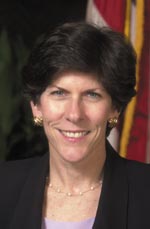
Linda Jane Fisher was a Vice President Safety, Health and Environment and Chief Sustainability Officer of DuPont.

Clothianidin is an insecticide developed by Takeda Chemical Industries and Bayer AG. Similar to thiamethoxam and imidacloprid, it is a neonicotinoid. Neonicotinoids are a class of insecticides that are chemically similar to nicotine, which has been used as a pesticide since the late 1700s. Clothianidin and other neonicotinoids act on the central nervous system of insects as an agonist of nAChR, the same receptor as acetylcholine, the neurotransmitter that stimulates and activating post-synaptic acetylcholine receptors but not inhibiting AChE. Clothianidin and other neonicotinoids were developed to last longer than nicotine, which is more toxic and which breaks down too quickly in the environment. However, studies published in 2012 show that neonicotinoid dust released at planting time may persist in nearby fields for several years and be taken up into non-target plants, which are then foraged by bees, caterpillars, and other insects.

The Office of Environmental Health Hazard Assessment, commonly referred to as OEHHA, is a specialized department within the cabinet-level California Environmental Protection Agency (CalEPA) with responsibility for evaluating health risks from environmental chemical contaminants.
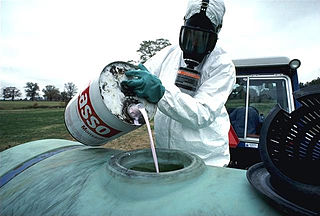
Pesticide regulation in the United States is primarily a responsibility of the Environmental Protection Agency (EPA). In America, it was not till the 1950s that pesticides were regulated in terms of their safety. The Pesticides Control Amendment (PCA) of 1954 was the first time Congress passed guidance regarding the establishment of safe limits for pesticide residues on food. It authorized the Food and Drug Administration (FDA) to ban pesticides they determined to be unsafe if they were sprayed directly on food. The Food Additives Amendment, which included the Delaney Clause, prohibited the pesticide residues from any carcinogenic pesticides in processed food. In 1959, pesticides were required to be registered.
References
- ↑ Reagan press release. Announcement of nomination to be an Assistant Administrator for Toxic Substances of the EPA
- ↑ Shabecoff, Philip. U.S. Officials Faulted for Talks Over Pesticide Ban. New York Times, January 31, 1984, p. A19.
- ↑ Shabecoff, Philip. Administration Drafting New Policy on Regulating Cancer-Causing Agents. New York Times, December 4, 1982, p. 32.
- ↑ "Delay in proposal to ban chemical laid to Ex-E.P.A. official". New York Times, September 26, 1983, p. B11.
- ↑ EPA. Partial List of Biopesticide Regulatory Consultants
