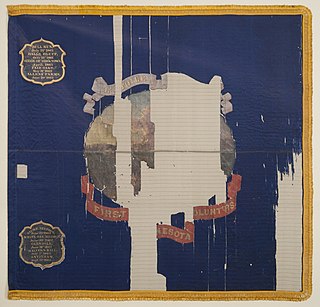
The 1st Minnesota Infantry Regiment was a Union infantry regiment active during the American Civil War. The 1st Minnesota participated in the battles of First Bull Run, Antietam and the Battle of Gettysburg. The regiment's most famous action occurred on the second day of the Battle of Gettysburg when Major General Winfield Scott Hancock ordered the 1st Minnesota to charge into a brigade of 1,200 Confederate soldiers. This action blunted the Confederate attack and helped preserve the Union's precarious position on Cemetery Ridge.

Fort Ridgely was a frontier United States Army outpost from 1851 to 1867, built 1853–1854 in Minnesota Territory. The Sioux called it Esa Tonka. It was located overlooking the Minnesota River southwest of Fairfax, Minnesota. Half of the fort's land was part of the south reservation in the Minnesota river valley for the Mdewakanton and Wahpekute tribes. Fort Ridgely had no defensive wall, palisade, or guard towers. The Army referred to the fort as the "New Post on the Upper Minnesota" until it was named for two Maryland Army Officers named Ridgely, who died during the Mexican–American War.

The 5th New York Infantry Regiment, also known as Duryée's Zouaves, was a volunteer infantry regiment that served in the U.S. Army during the American Civil War. Modeled, like other Union and Confederate infantry regiments, on the French Zouaves of Crimean War fame, its tactics and uniforms were different from those of the standard infantry.

Asa Peabody Blunt was an officer in the Union Army during the American Civil War. He remained on active duty after the war. In recognition of his service during the Civil War, he was appointed to the grade of brevet brigadier general of volunteers. Blunt was notable as commander of the 2nd Vermont Brigade and the United States Disciplinary Barracks at Fort Leavenworth, Kansas.
The 6th New Jersey Infantry Regiment was regiment of infantry from New Jersey that served in the Army of the Potomac during the American Civil War.

Eli Long was a general in the Union Army during the American Civil War.
The 12th Wisconsin Infantry Regiment was a volunteer infantry regiment that served in the Union Army during the American Civil War. They served primarily in the western theatre of the war, participating in battles and campaigns including the Siege of Vicksburg, the Jackson expedition, the Atlanta campaign, and Sherman's March to the Sea.
The 2nd Wisconsin Cavalry Regiment was a volunteer cavalry regiment that served in the Union Army in the western theater of the American Civil War.

The 5th Michigan Infantry Regiment was an infantry regiment from Michigan that served in the Union Army during the American Civil War. The regiment was mustered into federal service in August 1861 and served in the Eastern Theater. It fought in all the major battles of the Army of the Potomac, including Seven Pines, the Seven Days Battles, Second Bull Run, Chantilly, Antietam, Fredericksburg, Chancellorsville, Gettysburg, the Wilderness, Spotsylvania, Cold Harbor, Petersburg, and Appomattox. The regiment was mustered out in June 1865.
The 1st New York Infantry Regiment was an infantry regiment that served in the Union Army during the American Civil War.

John Milton Brannan was an American military officer who served with distinction in the Mexican–American War as a United States Army artillery officer and as a Union Army brigadier general of United States Volunteers in the American Civil War. Brannan held command of the Department of Key West at Fort Zachary Taylor, Florida, part of the Union effort to hold federal installations within Confederate territories early in the war. Later, and most notably, he served as a division commander of the Union XIV Corps at the Battle of Chickamauga in 1863.
The 39th New York Infantry Regiment, known as the "Garibaldi Guard" after the Italian revolutionary, Giuseppe Garibaldi, was an infantry regiment that served in the Union Army during the American Civil War.

Charles Candy was a career soldier in the United States Army who served as an officer in the volunteer Union Army during the American Civil War. He commanded an Ohio regiment and, frequently, a brigade, during the war, and played a role in the defense of Culp's Hill during the July 1863 Battle of Gettysburg.
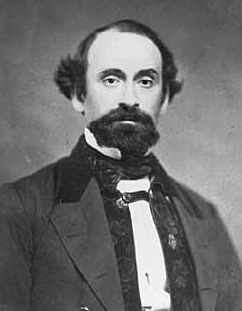
John Benjamin Sanborn was a lawyer, politician, and soldier from the state of New Hampshire who served as a general in the Union Army during the American Civil War. He was also a key member of the reconstruction era Congressional-appointed Indian Peace Commission, which negotiated and signed several important treaties with native American tribes.

The Choctaw in the American Civil War participated in two major arenas—the Trans-Mississippi and Western Theaters. The Trans-Mississippi had the Choctaw Nation. The Western had the Mississippi Choctaw. The Choctaw Nation had been mostly removed west prior to the War, but the Mississippi Choctaw had remained in the east. Both the Choctaw Nation and the Mississippi Choctaw would ultimately side with the Confederate States of America.

Isaac Fitzgerald Shepard was a colonel in the Union Army during the American Civil War. His appointment as a brigadier general of volunteers was not confirmed by the United States Senate and expired on July 4, 1864.
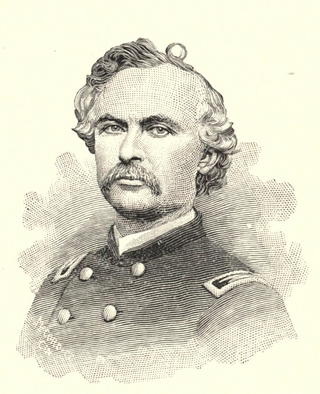
John Azor Kellogg was an American lawyer, Republican politician, and Wisconsin pioneer. He served as a Union Army officer through the entire American Civil War, serving with the famed Iron Brigade of the Army of the Potomac; he received an honorary brevet to brigadier general after the war. He was a prisoner of war for several months in 1864, and later wrote an account of his escape from captivity and his war service, called Capture and Escape: A Narrative of Army and Prison Life. He later served in the Wisconsin Senate, representing the 21st Senate district from 1879 to 1881.
The 37th New York Infantry Regiment or the Irish Rifles was formed accepted by the State on May 25, 1861, and organized in New York City. The regiment mustered in the service of the United States on June 6 and 7, 1861 for two years of service to June 22, 1863.
The 12th New York Infantry Regiment was an infantry regiment in the Union Army during the American Civil War.
 Captain