Related Research Articles

The Harvard Crimson is the nickname of the intercollegiate athletic teams of Harvard College. The school's teams compete in NCAA Division I. As of 2013, there were 42 Division I intercollegiate varsity sports teams for women and men at Harvard, more than at any other NCAA Division I college in the country. Like the other Ivy League colleges, Harvard does not offer athletic scholarships.
The Harvard–Yale football rivalry is renewed annually with The Game, an American college football match between the Crimson football team of Harvard University and the Bulldogs football team of Yale University.

Arthur Albert Irwin, nicknamed "Doc", "Sandy", "Cutrate" or "Foxy", was a Canadian-American shortstop and manager in Major League Baseball (MLB) during the late nineteenth century. He played regularly in the major leagues for eleven years, spending two of those seasons as a player-manager. He played on the 1884 Providence Grays team which won the first interleague series to decide the world champions of baseball. Irwin then served as a major league manager for several years.
John Mack may refer to:

John Riegel DeWitt was an American athlete. He played college football for Princeton from 1901 to 1903 and was selected as an All-American in 1902 and 1903. He also competed in the hammer throw, setting the world record in 1903 and winning the silver medal at the 1904 Summer Olympics.
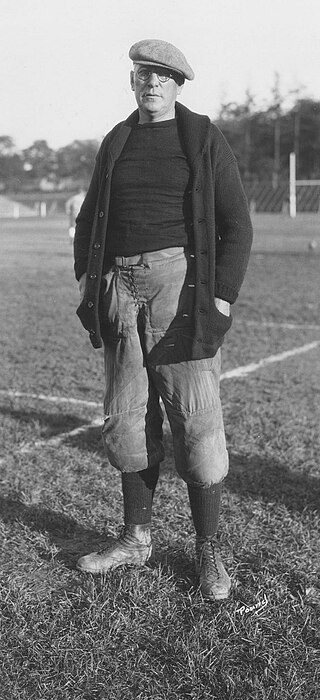
George Foster "Sandy" Sanford was an American college football player and coach. He served as the head coach at Cornell University (1896), Columbia University (1899–1901), the University of Virginia (1904), and Rutgers University (1913–1923), compiling a career coaching record of 89–49–7. Sanford was inducted into the College Football Hall of Fame as a coach in 1971.

Gustavius A. "Gus" Welch was an American football player, track and field athlete, coach of football and lacrosse, and college athletics administrator.
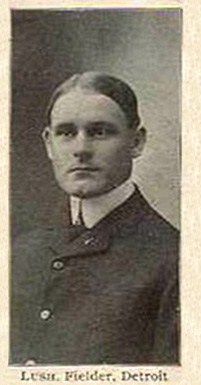
William Lucas Lush was an American baseball player and college athletics coach and administrator. He played seven seasons of Major League Baseball from 1895 to 1904, including three with the Washington Senators. He later worked as a college athletics coach at Yale University, Columbia University, Fordham University, the United States Naval Academy, St. John's University, the University of Baltimore and Trinity College, Hartford. He also held athletic director positions at Fordham and the Naval Academy. In the 1930s, he coached athletic teams at Sing Sing prison in Ossining, New York.

Thomas Leonard Shevlin was an American college football player and coach at Yale University and a businessman. He was a consensus All-American for three of his four years, selected a first-team All-American by some selector in all. He was inducted into the College Football Hall of Fame in 1954.

Edward North "Robbie" Robinson was an American football and baseball coach. He served as the head football coach at University of Nebraska–Lincoln, Brown University, University of Maine, and Tufts College—now known as Tufts University, and co-head football coach at Boston University. He also coached for the Providence Steam Roller of the National Football League (NFL). He was inducted into the College Football Hall of Fame in 1955.
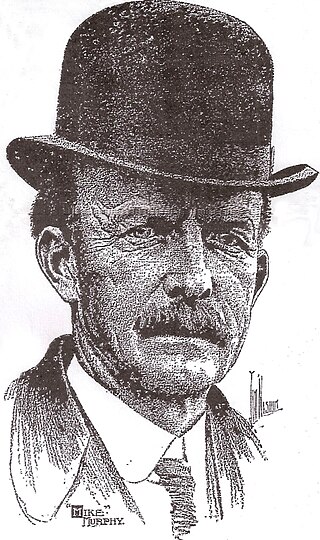
Michael Charles Murphy was an American athletic trainer and coach at Yale University, Detroit Athletic Club (1889–1892), University of Michigan (1891), Villanova University (1894), University of Pennsylvania, and the New York Athletic Club (1890–1900). He coached the American track athletes at the Summer Olympics in 1900, 1908, and 1912. He spent a year in approximately 1884 as the trainer of heavyweight boxing champion John L. Sullivan.

Dennis Keene Fitzpatrick was an American track coach, athletic trainer, professor of physical training and gymnasium director for 42 years at Yale University, the University of Michigan, and Princeton University (1910–1932). He was considered "one of the pioneers of intercollegiate sport".

Stephen J. Farrell was an American professional track athlete, circus performer and track coach.

John Kenneth Doherty was an American decathlon champion, college track and field coach, author and longtime director of the Penn Relays. While a student at the University of Michigan, Doherty won the American decathlon championship in 1928 and 1929 and won the bronze medal in the event at the 1928 Summer Olympics in Amsterdam. He later served as a track coach at Princeton University (1929–1930), the University of Michigan (1930–1948), and the University of Pennsylvania (1948–1957). He was also the meet director for the Penn Relays from 1956 to 1969 and of the first dual track meet between the United States and the Soviet Union in 1959. He was also a published author of works on track coaching, and his Track & Field Omnibook was regarded as "the track coach's bible" from the 1970s through the 1990s. Doherty has been inducted into at least six athletic halls of fame, including the National Track and Field Hall of Fame and athletic halls of fame at the University of Pennsylvania, University of Michigan, and Wayne State University.

Albert Hayes Sharpe was an All-American football player, coach and athletic director and medical doctor. He played football for Yale University and was selected as a halfback for the 1899 College Football All-America Team. Sharpe was also a star basketball player in the early years of the college game. Sharpe also excelled in baseball, gymnastics, rowing and track. In 1915, Sharpe was selected by one sporting expert as the greatest living athlete in the United States. He later served as a coach and administrator at Cornell University, Yale, the Ithaca School of Physical Education and Washington University in St. Louis.
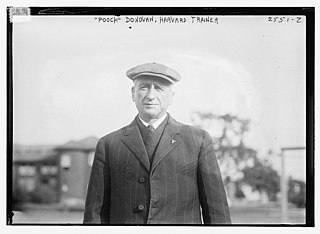
William Francis "Pooch" Donovan Sr. was an American athletic trainer and coach. He was head coach of the Harvard Crimson track team from 1908 to 1921 and 1925 to 1928, trainer of the Harvard Crimson football team from 1907 to 1925, head coach of the football team in 1918, and trainer for the Harvard Crimson baseball team from 1907 to 1928.

The early history of American football can be traced to early versions of rugby football and association football. Both games have their origin in varieties of football played in Britain in the mid–19th century, in which a football is kicked at a goal or run over a line, which in turn were based on the varieties of English public school football games.

Charles Crawford "Doc" Stroud was an American football, basketball, and baseball coach and college athletics administrator.
William Charles Mackie was an American college football player and coach. He was an All-American guard at Harvard University and served as the head football coach at Bowdoin College. After football, Mackie practiced medicine and served as medical examiner for Norfolk County, Massachusetts.
References
- 1 2 "John J. Mack, Yale Trainer, Dies of Pneumonia at 53". Courier-News . Boston. August 30, 1923. p. 10. Retrieved March 11, 2020– via Newspapers.com.
- ↑ "Johnny Mack Dies Suddenly In Boston. Veteran Yale Coach Passes Away From Pneumonia Contracted on Camping Trip". New York Times . August 30, 1923. Retrieved April 28, 2011.
John J. Mack, Yale University track coach and athletic trainer for the past eighteen years, died tonight at the home of his mother-in-law, Mrs. Annie Desmond, 37 Calumet Street, from a severe attack of pneumonia contracted a week ago while on a camping trip in the White Mountains with Pooch Donovan of Harvard and Keene Fitzpatrick of Princeton.