Dr. John Ruan erected a small residence in Frankford in 1794. After paying taxes on this, he built a Late Georgian mansion beside it in 1796, possibly converting the first house into the mansion's kitchen and servants' quarters. Ryan suffered financial losses in 1822, and the house was sold to a merchant. It changed ownership several times in the nineteenth century, before it was converted into a kindergarten in 1890.[4][3]
The Knights of Columbus acquired the building in 1921, and used it for meetings and social events. It was acquired by the Philadelphia Camp Corporation in 1958, which converted it into the Grand Army of the Republic Civil War Museum and Library.[4]
Due to rising maintenance costs, the museum relocated to 8110 Frankford Avenue in 2021, and the house was purchased by a private owner.[5][6]
Composition
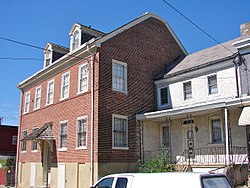
John Ruan House, from the southeast
The brick mansion is two-and-a-half-stories above a high basement, with a 5-bay symmetrical facade, semi-hipped roof, twin gathered chimneys with a semi-lune window on the third story of the west facade, and two ornate dormers. Unusual is its brick banding below the second story windows, which may have originally continued around all four walls. The house is the oldest of its size and stature surviving in Frankford.[1][4] Some of its ornamentation is reminiscent of German-born architect Robert Wellford, however, the date of construction makes it unlikely that he had a part in designing it.[7]
This page is based on this Wikipedia article Text is available under the CC BY-SA 4.0 license; additional terms may apply. Images, videos and audio are available under their respective licenses.