
Samuel Pepys was an English diarist and naval administrator. He served as administrator of the Royal Navy and Member of Parliament and is most famous for the diary he kept for a decade. Pepys had no maritime experience, but he rose to be the Chief Secretary to the Admiralty under both King Charles II and King James II through patronage, diligence, and his talent for administration. His influence and reforms at the Admiralty were important in the early professionalisation of the Royal Navy.
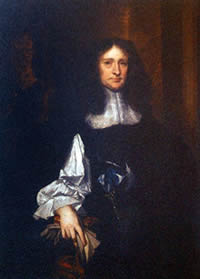
Vice-Admiral Sir George Carteret, 1st Baronet was a royalist statesman in Jersey and England, who served in the Clarendon Ministry as Treasurer of the Navy. He was also one of the original lords proprietor of the former British colony of Carolina and New Jersey. Carteret, New Jersey, as well as Carteret County, North Carolina, both in the United States, are named after him. He acquired the manor of Haynes, Bedfordshire, in about 1667.

Pall Mall is a street in the St James's area of the City of Westminster, Central London. It connects St James's Street to Trafalgar Square and is a section of the regional A4 road. The street's name is derived from pall-mall, a ball game played there during the 17th century, which in turn is derived from the Italian pallamaglio, literally "ball-mallet".

St Olave's Church, Hart Street, is a Church of England church in the City of London, located on the corner of Hart Street and Seething Lane near Fenchurch Street railway station.

Sir William Penn was an English admiral and politician who sat in the House of Commons from 1660 to 1670. He was the father of William Penn, founder of the colonial Province of Pennsylvania, which is now the US state of Pennsylvania.

Edward Montagu, 1st Earl of Sandwich, 27 July 1625 to 28 May 1672, was an English military officer, politician and diplomat from Barnwell, Northamptonshire. During the First English Civil War, he served with the Parliamentarian army, and was an Member of Parliament at various times between 1645 and 1660. Under The Protectorate, he was also a member of the English Council of State and General at sea.
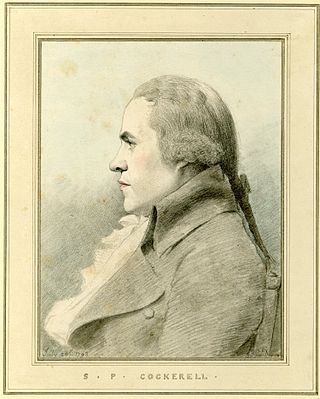
Samuel Pepys Cockerell was an English architect.

HMY Bezan was a Royal Yacht of the Royal Navy of England. The Bezan was a Dutch pleasure yacht built in 1630 and presented to Charles II by the Dutch East India Company. The Bezan was about 15 feet long with a single mast and carried a crew of two, and was the precursor of modern leisure yachts.

Sezincote House is the centre of a country estate in the civil parish of Sezincote, in the county of Gloucestershire, England. The house was designed by Samuel Pepys Cockerell, built in 1805, and is a notable example of Neo-Mughal architecture, a 19th-century reinterpretation of 16th and 17th-century architecture from the Mughal Empire. At the time of its construction, British India was becoming the "jewel in the crown" of the world's largest empire.

William Hewer, sometimes known as Will Hewer, was one of Samuel Pepys' manservants, and later Pepys's clerk, before embarking on an administrative career of his own. Hewer is mentioned several times in Pepys' diary and was ultimately the executor of Pepys' will.

Sir Richard Levett was an English merchant, politician and slave trader who served as Lord Mayor of London in 1699. Born in Ashwell, Rutland, he moved to London and established a pioneering mercantile career, becoming involved with the Bank of England and the East India Company. Levett was acquainted with many prominent individuals during his time in London, among them Samuel Pepys, John Houblon, William Gore, Sir John Holt, Robert Hooke, and Charles Eyre. He acquired several properties in Kew and Cripplegate.
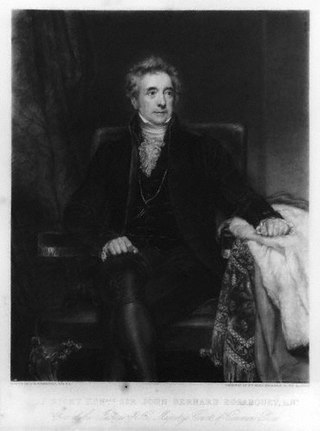
Sir John Bernard Bosanquet KS PC was a British judge.
John Bence was an English merchant and politician who sat in the House of Commons at various times between 1659 and 1688.

Sir James Houblon was an influential merchant and Member of Parliament for the City of London.
Sir Charles Cockerell, 1st Baronet was a Somerset-born Englishman who prospered as an official of the East India Company (EIC) and became a politician. He sat in the House of Commons for most of the period between 1802 and 1837, sitting for five different constituencies.
Johannes Rothé, or Jan Rothe, de Rothe of Rode, also Mr Roder, Lord of Oud-Wulven and Wayen in the Netherlands, was a prophetic preacher and Fifth Monarchist.

Henry Greenhill was a British mariner, Governor of the Gold Coast, commissioner of the navy and Member of Parliament.

The Battle of Ronas Voe was a naval engagement between the English Royal Navy and the Dutch East India ship Wapen van Rotterdam on 14 March 1674 in Ronas Voe, Shetland as part of the Third Anglo-Dutch War. Having occurred 23 days after the signing of the Treaty of Westminster, it is likely to have been the final battle of the Third Anglo-Dutch War.

Seething Lane is a street in the City of London. It connects All Hallows-by-the-Tower, Byward Street, with St Olave's Church, Hart Street. The street is named after an Old English expression meaning "full of chaff", which was derived from the nearby corn market in Fenchurch Street. Samuel Pepys lived there and is buried in St Olave's Church at the junction with Hart Street. A bust of Pepys, created by Karin Jonzen, sits in the public garden at the south end of the street.

William Castle or Castell of Rotherhithe (c.1615–1681) was a shipbuilder for the Royal Navy and occasionally for the East India Company. He is mentioned more than once in the Diary of Samuel Pepys.

