Cleveland is a city in northeast Ohio, United States.
Bristol is a city and county in the South-west of England.
Three ships of the United States Navy have been named USS Juneau, after the city of Juneau, Alaska:

USS Juneau (CL-52) was a United States Navy Atlanta-class light cruiser torpedoed and sunk at the Naval Battle of Guadalcanal on 13 November 1942. In total, 687 officers and sailors, including the five Sullivan brothers, were killed in action as a result of her sinking. Only 10 survivors were rescued after eight days in the water. To honor the five Sullivan brothers and Juneau, the U.S. Navy has since commissioned two ships named USS The Sullivans and two ships named USS Juneau. On 17 March 2018, Paul Allen's research crew on board RV Petrel located the wreck of Juneau at a depth of about 4,200 m (13,800 ft) off the Solomon Islands.

The Alaska class were six very large cruisers ordered before World War II for the United States Navy, of which only two were completed and saw service late in the war. The US Navy designation for the ships of this class was 'large cruiser' (CB) and the majority of leading reference works consider them as such. However, various other works have alternately described these ships as battlecruisers despite the US Navy having never classified them as such. The Alaskas were all named after territories or insular areas of the United States, signifying their intermediate status between larger battleships and smaller heavy and light cruisers.

The New York Shipbuilding Corporation was an American shipbuilding company that operated from 1899 to 1968, ultimately completing more than 500 vessels for the U.S. Navy, the United States Merchant Marine, the United States Coast Guard, and other maritime concerns. At its peak during World War II, NYSB was the largest and most productive shipyard in the world. Its best-known vessels include the destroyer USS Reuben James (DD-245), the cruiser USS Indianapolis (CA-35), the aircraft carrier USS Kitty Hawk (CV-63), the nuclear-powered cargo ship NS Savannah, and a quartet of cargo-passenger liners nicknamed the 4 Aces.

The second USS Fresno (CL-121) was a United States Navy Juneau-class light cruiser launched on 5 March 1946 by Federal Shipbuilding and Dry Dock Company of Kearny, New Jersey, sponsored by Mrs. Ruth R. Martin; and commissioned on 27 November 1946, with Captain Elliott Bowman Strauss in command. She was reclassified CLAA-121 on 18 March 1949.

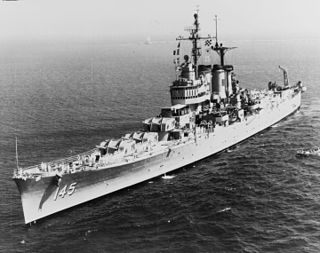
The second USS Juneau (CL-119/CLAA-119) was the lead ship of the United States Navy Juneau-class cruisers.

The Atlanta-class cruisers were eight United States Navy light cruisers which were designed as fast scout cruisers or flotilla leaders but which proved to be effective anti-aircraft cruisers during World War II. They were also known as the Atlanta-Oakland class. The Atlanta class originally had 16 x 5-inch (127 mm)/38 caliber guns in eight two-gun turrets, arranged with three superfiring turrets forward, three more superfiring aft and two waist mounts, one port and one starboard, giving the first four Atlanta-class cruisers the heaviest anti-aircraft armament of any cruiser of World War II. The last four ships of the class, starting with Oakland, had a slightly revised armament with a reduced main gun battery - the waist turrets being deleted - as they were further optimized for anti-aircraft fire in light of war experience.
Alaska is a state of the United States of America.

The Sullivan brothers were five brothers from Waterloo, Iowa who served together on the light cruiser USS Juneau. They were all killed in action during and shortly after its sinking around November 13, 1942.
Five ships in the United States Navy have been named USS Milwaukee for the city in Wisconsin.

The Oregon City class was a class of heavy cruisers of the United States Navy. Although ten ships of this class were planned, only four were completed – one of those as a command ship. The three ships completed as cruisers were in commission from 1946 to 1980, one having been converted to a guided missile cruiser (CG).
United States ship naming conventions for the U.S. Navy were established by congressional action at least as early as 1862. Title 13, section 1531, of the U.S. Code, enacted in that year, reads, in part,
The vessels of the Navy shall be named by the Secretary of the Navy under direction of the President according to the following rule: Sailing-vessels of the first class shall be named after the States of the Union, those of the second class after the rivers, those of the third class after the principal cities and towns and those of the fourth class as the President may direct.
The Worcester class was a class of light cruisers used by the United States Navy, laid down in 1945 and commissioned in 1948–49. They and their contemporaries, the Des Moines-class heavy cruisers, were the last all-gun cruisers built for the U.S. Navy. Ten ships were planned for this class, but only two were completed.
Neptune is a planet in the Solar System.
The Juneau-class cruisers were United States Navy light cruisers that were modified version of the Atlanta-class cruiser design. The ships had the same dual-purpose main armament as USS Oakland with a much heavier secondary antiaircraft battery, while the anti-submarine depth charge tracks and torpedo tubes were removed along with a redesigned superstructure to reduce weight and increase stability. Three ships were ordered and built, all completed shortly after World War II, but only Juneau remained active long enough to see action during the Korean War.

The CL-154 class of 5-inch (127 mm) gun light cruisers was a United States Navy project from the last two years of World War II, with antecedents reaching back to 1938 and earlier. The CL-154 class was contemporary to the 6-inch (152 mm) gun Worcester-class light cruisers and the 8-inch (203 mm) gun Des Moines-class cruisers: like them the CL-154 design incorporated the lessons learned of World War II combat. The Navy allocated six hull numbers to the CL-154 class for the planned construction, but unlike the Worcester and Des Moines classes the CL-154 class would be cancelled with no units named or constructed. Had these ships been built, they would have been given the hull classification CLAA on 18 March 1949.
This page is based on this
Wikipedia article Text is available under the
CC BY-SA 4.0 license; additional terms may apply.
Images, videos and audio are available under their respective licenses.
