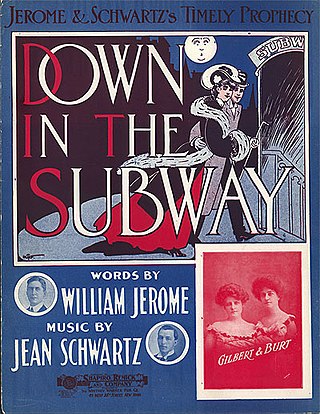
Jean Schwartz was a Hungarian-born American songwriter.
The Waitresses were an American new wave band from Akron, Ohio, best known for their singles "I Know What Boys Like" and "Christmas Wrapping." They released two albums, Wasn't Tomorrow Wonderful? and Bruiseology, and one EP, I Could Rule the World If I Could Only Get the Parts.

"K-K-K-Katy" is a World War I-era song written by Canadian American composer Geoffrey O'Hara in 1917 and published in 1918. The sheet music advertised it as "The Sensational Stammering Song Success Sung by the Soldiers and Sailors", as well as "The Sensational New Stammering Song" The song was first played at a garden party fund-raiser for the Red Cross in Collins Bay on Lake Ontario. O'Hara was from Chatham, Ontario, and taught music at several universities.

John Frederick Coots was an American songwriter. He composed over 700 popular songs and over a dozen Broadway shows. In 1934, Coots wrote the melody with his then chief collaborator, lyricist Haven Gillespie, for the biggest hit of either man's career, "Santa Claus Is Comin' to Town." The song became one of the biggest sellers in American history.
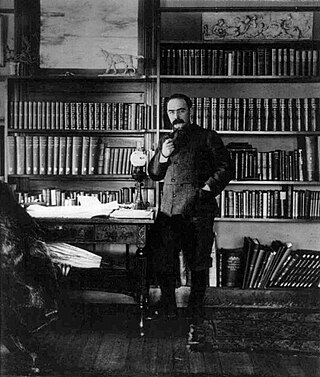
"The Absent-Minded Beggar" is an 1899 poem by Rudyard Kipling, set to music by Sir Arthur Sullivan and often accompanied by an illustration of a wounded but defiant British soldier, "A Gentleman in Kharki", by Richard Caton Woodville. The song was written as part of an appeal by the Daily Mail to raise money for soldiers fighting in the Second Boer War and their families. The fund was the first such charitable effort for a war.
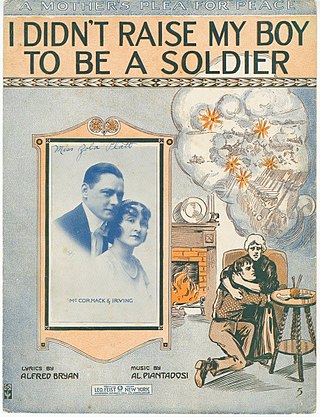
"I Didn't Raise My Boy to Be a Soldier" is an American anti-war song that was influential within the pacifist movement that existed in the United States before it entered World War I. It is one of the first anti-war songs. Lyricist Alfred Bryan collaborated with composer Al Piantadosi in writing the song, which inspired a sequel, some imitations, but also a number of scornful parodies. It was recorded by The Peerless Quartet in December 1914 and was a hit in 1915, selling 650,000 copies. Its expression of popular pacifist sentiment "helped make the pacifist movement a hard, quantifiable political reality to be reckoned with."

"I've Got My Captain Working for Me Now" is a popular song written in 1919 by Irving Berlin. It was published by Music Publishers Inc. in New York, New York.
The music of World War I is the music which was composed during the war or which is associated with the war.

"They Were All Out of Step But Jim" is an American World War I war song written by Irving Berlin. It rose to popularity in 1918 when released by Billy Murray, charting at No. 3 in the United States.

Just a Baby's Prayer at Twilight (For Her Daddy Over There) is a 1918 song composed by M.K. Jerome, with lyrics written by Sam M. Lewis and Joe Young. The song was published by Waterson, Berlin & Snyder Co. The song was performed by Henry Burr and reached number one on the top 100 US songs of 1918. Burr's recording sold a million copies in sheet music and sales.

"Just Like Washington Crossed the Delaware, General Pershing Will Cross the Rhine" is a 1918 song composed by George W. Meyer, with lyrics written by Howard Johnson and published by Leo Feist, Inc.
The Call of the U.S.A. is a World War I era song released in 1918. Lyrics and music were written by John J. Donahue. The song was published in Lawrence, Massachusetts by Donahue. On the cover of the sheet music, there is an officer riding on horseback, alongside marching soldiers. The sheet music can be found at the Library of Congress and Pritzker Military Museum & Library.

"When a Blue Service Star Turns to Gold" is a World War I era song released in 1918. Caspar Nathan wrote the lyrics. Theodore Morse composed the music. Leo Feist, Inc. of New York, New York published the song. Featured prominently on the sheet music cover is a service star. Beneath it are soldiers charging with artillery, a tank, and a plane. It was written for both voice and piano.
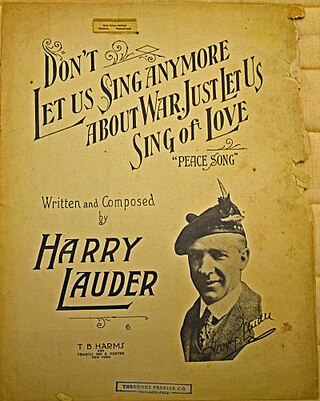
"Don't Let Us Sing Anymore About War, Just Let Us Sing of Love " is a World War I era song released in 1918. Lyrics and music were written by Harry Lauder. It was published by T.B. Harms and Francis, Day & Hunter, Music Co. of New York, New York. The sheet music cover features a photo of Lauder with his autograph. The song was written for both voice and piano.

"For Your Country and My Country" is a World War I era song released in 1917. Lyrics and music were written by Irving Berlin. The song was published by Waterson, Berlin & Snyder, Co. of New York, New York. Artist Albert Wilfred Barbelle designed the sheet music cover. It features Uncle Sam playing a snare drum with an eagle on his shoulder. In the background are ships sailing, and below are troops marching. Above the title, it reads, "The Official Recruiting Song." The song was written for voice and piano, along with chords for guitar, ukulele, and banjo.

Dear Old Pal of Mine is a World War I song written by Harold Robe and Gitz Rice. The song was first published in 1916 by G. Ricordi & Co. in New York, NY.

When the Clouds of War Roll By is a World War I song composed by Earl Haubrich with lyrics by Nat Binns. It was published in 1917 by Ted Browne Music Co. in Chicago, Illinois.
"Lafayette " is a World War I song written and composed by Mary Earl, which was a pseudonym of Robert A. King. It was published in New York, New York by Shapiro, Bernstein, & Co. in 1918. The sheet music cover, illustrated by Albert Barbelle, depicts soldiers marching with fixed bayonets below a statue of Lafayette in silhouette.
Salvation Lassie Of Mine is a World War I song written by Jack Caddigan and Chick Story. The song was first published in 1919 by Leo Feist, Inc. in New York, NY. The sheet music cover features a photo of a Salvation Army nurse with soldiers entering a Salvation Army hut. This song was in the top 20 charts in March and April 1919, reaching number 18 in April.

Let's All Be Americans Now is a World War I song written and composed by Irving Berlin, Edgar Leslie, and George W. Meyer. The song was first published in 1917 by Waterson, Berlin & Snyder Co., in New York, NY.The sheet music cover depicts a soldier with his rifle and silhouetted marching soldiers in the background. A popular recording in 1917 was made by the American Quartet.

