Related Research Articles

Calico is a heavy plain-woven textile made from unbleached, and often not fully processed, cotton. It may also contain unseparated husk parts. The fabric is far coarser than muslin, but less coarse and thick than canvas or denim. However, it is still very cheap owing to its unfinished and undyed appearance.

Muslin is a cotton fabric of plain weave. It is made in a wide range of weights from delicate sheers to coarse sheeting. It is commonly believed that it gets its name from the city of Mosul, Iraq, however, originally it comes from Dhaki.

Double cloth or double weave is a kind of woven textile in which two or more sets of warps and one or more sets of weft or filling yarns are interconnected to form a two-layered cloth. The movement of threads between the layers allows complex patterns and surface textures to be created.

Jamdani is a fine muslin textile produced for centuries in South Rupshi of Narayanganj district in Bangladesh on the bank of Shitalakhwa river.

Paithani is a variety of sari, named after the Paithan town in Aurangabad district from state of Maharashtra in India where the sari was first made by hand. Present day Yeola town in Nashik, Maharashtra is the largest manufacturer of Paithani.

Silk In India, about 97% of the raw mulberry silk is produced in the Indian states of Karnataka, Andhra Pradesh, Tamil Nadu and West Bengal. Mysore and North Bangalore, the upcoming site of a US$20 million "Silk City", contribute to a majority of silk production. Another emerging silk producer is Tamil Nadu in the place in where mulberry cultivation is concentrated in Salem, Erode and Dharmapuri districts. Hyderabad, Andhra Pradesh and Gobichettipalayam, Tamil Nadu were the first locations to have automated silk reeling units.
The manufacture of textiles is one of the oldest of human technologies. To make textiles, the first requirement is a source of fiber from which a yarn can be made, primarily by spinning. The yarn is processed by knitting or weaving, which turns it into cloth. The machine used for weaving is the loom. For decoration, the process of colouring yarn or the finished material is dyeing. For more information of the various steps, see textile manufacturing.
Khasa was a high-quality variety of calico cloth that was manufactured and used for clothing in the Mughal Empire.
Muqayyash is an ancient craft of brocade embroidery work with silver yarn on silk cloth from Gujarat, India. The silk is ornamented with a silver stripe pattern. Muqayyash is one of the Mughal period silk cloth, and it is recorded in Ain-i-Akbari. The muqayyash was one of the fine brocades of Gujrat among a tus, daraibaf, kurtahwar. It was one of the expensive cloths of that time, priced at 2-50 gold Muhr.

Mughal karkhanas were the manufacturing houses and workshops for craftsmen, established by the Mughals in their empire. Karkhana is a Hindustani language word that means factory. These karkhanas were small manufacturing units for various arts and crafts as well as for the emperor's household and military needs. karkhanas were named and classified based on the nature of the job. For example, 'Rangkhana' and 'Chhapakhana' were for textile dyeing and printing work. The term 'tushak-khana' was used to describe workshops that made shawls and embellished them with embroidery or needlework. Imperial or Royal Karkhanas were for luxury goods and weapons. The karkhanas were the place for various production activities and also for the exploration of new techniques and innovations. Some operations such as weaving, embroidery work, and brocade work were often done under one roof, resembling an integrated assembly line.
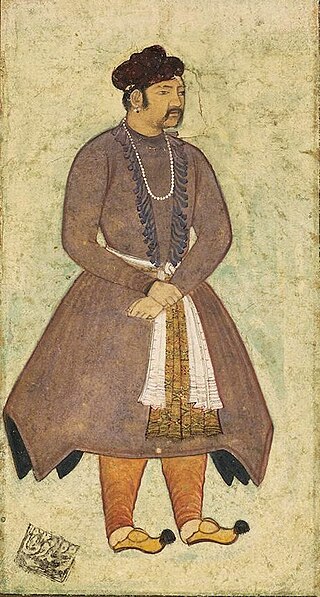
Katzeb was an article of dress encircling the body, at the waist with ends hanging in the front. It was a kind of sash also called patka.
Chautar or Chaotaer is an old cotton fabric of the Mughal period. The chautar was a mulmul variety, and the finest mulmul was termed as "Mulmul Shahi" in Hindi and Persian languages. It was produced in Eastern India. Way back, Chittagong was exporting this cloth. Conceivably then cloths were produced in smaller pieces only since the Chautar is described as a piece good. It has been recorded with specific dimensions, i.e., length 12.44 meters and width 77.75 centimeters. Chautar was compared with sansuo, which was a three shuttle cloth, type of fine cotton variety produced at Songjiang.
Qutni(cuttanee, couthnys, Koetnies, Kutni) is an old silk and cotton mix cloth with a striped pattern. Qutni is a satin weave structure with silk in warp and cotton in the weft. It was made In Gujarat, India. Qutni was also produced at Damascus, Aleppo, Hama.

Panchtoliya was an old cotton cloth of the Mughal period. The Panchtoliya was very light in weight and used for the veil. It was weighing only 2-5 tola per piece. The credit of Panchtoliya goes to the Mughal empress Nur Jahan. She was very fashion enthusiastic, encouraged, and introduced many styles and varieties of cloths of her interest. Few examples are Panchtoliya, badla, kinari, and Dudami weighing just two dams. Nur Jahan is also credited for specific dresses. For instance, nurmahali for the wedding is one of them.
Peshwaj was a ladies outfit similar to a gown or jama coat with front open, tied around the waist, having full sleeves, and the length was full neck to heels. Peshwaj was one of the magnificent costumes of the mughal court ladies. The material was used to be sheer and fine muslins with decorated borders of zari and lacework.
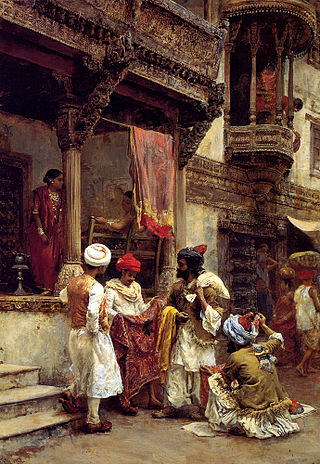
Mashru is a woven cloth that is a blend of silk and cotton. It was historically a hand-woven satin silk fabric variety found in the Indian subcontinent, and its proper use is described in the 16th-century Ain-i-Akbari.
Khazz silk was a blended silk cloth made of silk and wool. The Persian qazz or Arabic khazz, refers to silk or silk products. In medieval Arabic القزّ al-qazz meant "silk".
Mahmudi, or Maḥmūdī, was a fine cotton variety cloth produced in India.
Delaine was a kind of mixed cloth with cotton warp and wool in the weft. Delaines have many variations such as made of undyed yarns, and also printed or piece dyed. Delaine was a type of cloth used to manufacture women's dresses that was traded in the nineteenth century under many names to suit importers and traders. Moreover, it appeared that the plaintiffs' goods differed from delaines in various other respects.
Tissue is a thin, transparent, and lightweight material. Tissue fabric is a suitable material for designing various types of garments, including saris. Tissue is characterized by the use of metallic yarns for decorative purposes. The tissue sari is composed of silk threads in the warp and zari in the weft.
References
- ↑ Sonwalkar, Tammanna N. (1993). Hand Book of Silk Technology. Taylor & Francis. p. 296. ISBN 978-81-224-0495-1.
- ↑ Mohanty, Bijoy Chandra (1984). Brocaded Fabrics of India. Calico Museum of Textiles. p. 18.
- ↑ '' 'Katan' was another costly dress material. It was actually very fine muslin, so thin, that it at once wore out when moonshined on it '' Page 66 https://www.google.co.in/books/edition/Muslim_Women_in_Medieval_India/TogbAAAAIAAJ?hl=en&gbpv=1&bsq=katan+silk+muslin&dq=katan+silk+muslin&printsec=frontcover
- ↑ Amir Khusrau: Memorial Volume. Publications Division, Ministry of Information and Broadcasting, Government of India. 1975. p. 150.
- ↑ Jain, Simmi (2003). Encyclopaedia of Indian Women Through the Ages: The middle ages. Gyan Publishing House. p. 198. ISBN 978-81-7835-173-5.
- ↑ Mubārak, Abū al-Faz̤l ibn (1902). The Akbarnāma of Abuʻl Fazl: History of the Reign of Akbar Including an Account of His Predecessors. Asiatic Society. p. 8. ISBN 978-81-7536-427-1.
- ↑ Mohanty, Bijoy Chandra (1984). Brocaded Fabrics of India. Calico Museum of Textiles. p. 29.
- ↑ Mubārak, Abū al-Faz̤l ibn (1873). The Ain i Akbari. Asiatic Society of Bengal. p. 94.
 | This article about textiles is a stub. You can help Wikipedia by expanding it. |