Related Research Articles

Barisal Division is one of the eight administrative divisions of Bangladesh. Located in the south-central part of the country, it has an area of 13,225 km2 (5,106 sq mi), and a population of 93,25,825 at the 2022 Census. It is the least populous Division in Bangladesh. It is bounded by Dhaka Division on the north, the Bay of Bengal on the south, Chittagong Division on the east and Khulna Division on the west. The administrative capital, Barisal city, lies in the Padma River delta on an offshoot of the Arial Khan River. Barisal division is criss-crossed by numerous rivers that earned it the nickname Dhan-Nodi-Khal, Ei tin-e Borishal.

The Bangladesh Liberation War, also known as the Bangladesh War of Independence, or simply the Liberation War in Bangladesh, was a revolution and armed conflict sparked by the rise of the Bengali nationalist and self-determination movement in East Pakistan, which resulted in the independence of Bangladesh. The war began when the Pakistani military junta based in West Pakistan—under the orders of Yahya Khan—launched Operation Searchlight against the people of East Pakistan on the night of 25 March 1971, initiating the Bangladesh genocide.

Ghulam Azam was a Bangladeshi Islamist politician. He was the former leader of Bangladesh Jamaat-e-Islami, the largest Islamist political party in Bangladesh.
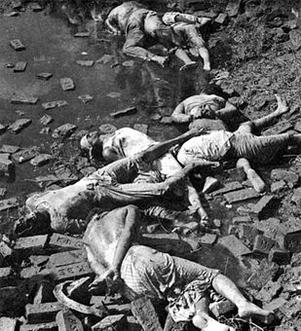
The Bangladesh genocide was the ethnic cleansing of Bengalis, especially Bengali Hindus, residing in East Pakistan during the Bangladesh Liberation War, perpetrated by the Pakistan Armed Forces and the Razakars. It began on 25 March 1971, as Operation Searchlight was launched by West Pakistan to militarily subdue the Bengali population of East Pakistan; the Bengalis comprised the demographic majority and had been calling for independence from the Pakistani state. Seeking to curtail the Bengali self-determination movement, erstwhile Pakistani president Yahya Khan approved a large-scale military deployment, and in the nine-month-long conflict that ensued, Pakistani soldiers and local pro-Pakistan militias killed between 300,000 and 3,000,000 Bengalis and raped between 200,000 and 400,000 Bengali women in a systematic campaign of mass murder and genocidal sexual violence. In their investigation of the genocide, the Geneva-based International Commission of Jurists concluded that Pakistan's campaign involved the attempt to exterminate or forcibly remove a significant portion of the country's Hindu populace.
Awards and decorations of the Bangladesh Liberation War were decorations which were bestowed by the major warring parties during the years of the Bangladesh Liberation War. Bangladesh, India and Pakistan all issued awards and decorations during the conflict.

Syed Mujtaba Ali was a Bengali writer, journalist, travel enthusiast, academic, scholar and linguist. He lived in Bangladesh, India, Germany, Afghanistan and Egypt.
Altaf Mahmud was a musician, cultural activist, and martyred freedom fighter of the Bangladesh Liberation War. He was also a language activist of the Language Movement and composer of "Amar Bhaier Rokte Rangano", the famous song written to commemorate the event.

Banaripara is an Upazila of Barishal District in the Division of Barishal in southern-central Bangladesh.
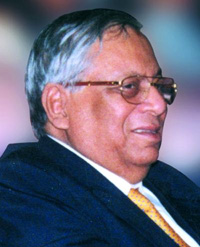
Humayun Rasheed Choudhury was a Bangladeshi career diplomat and Speaker of the Bangladesh National Parliament from 1996 to 2001. He was elected president of the 41st session of the UN General Assembly in 1986. He was awarded Independence Day Award in 2018 posthumously by the Government of Bangladesh.

Bangladesh Jamaat-e-Islami, previously known as Jamaat-e-Islami Bangladesh, or Jamaat for short, is the largest Islamist political party in Bangladesh. On 1 August 2013, the Bangladesh Supreme Court cancelled the registration of the Jamaat-e-Islami, ruling that the party is unfit to contest national elections.
Swadesh Ranjan Bose was a Bengali language movement activist and an economist. For his contributions to the field of economics he was posthumously given the Independence Day Award, Bangladesh's highest state award.

ʿAzīz al-Ḥaqq ibn Irshād ʿAlī ad-Dākawī, simply known as Azizul Haque or by his epithet Shaykh al-Hadith was a Bangladeshi Islamic scholar, politician, writer, and translator. He is the founder of Khelafat Majlish and first Bangali translator of Sahih al-Bukhari. He was vice chancellor of Jamia Rahmania Arabia Dhaka.

The Mukti Bahini, also known as the Bangladesh Forces, was the guerrilla resistance movement consisting of the Bangladeshi military, paramilitary and civilians during the Bangladesh Liberation War that transformed East Pakistan into Bangladesh in 1971. They were initially called the Mukti Fauj.
Maulana Abul Kalam Muhammad Yusuf was a Bangladeshi religious scholar, writer, activist and politician. Yusuf was a specialist in the study of Hadith : he earned the title "Mumtaz al-Muhaddethin" for his advanced degree in hadith sciences, and has also published books widely in the field.

Joyjatra is a Bangladeshi film directed by Tauquir Ahmed and produced by Azam Faruk, featuring Mahfuz Ahmed, Bipasha Hayat, Azizul Hakim, Ahsan Habib Nasim, and others. The film is set in the period of the Bangladesh Liberation War.
Ferdous Ahmed Qureshi was a Bangladeshi politician and chairman of the Progressive Democratic Party.
Syed Azizul Huq, also known by his daak naam Nanna Mia, was a Bangladeshi politician and former member of parliament for Barisal-2 in the 1986 and 1988 Bangladeshi general elections. He was a member of the Provincial Council of East Pakistan, minister of commerce and minister of industry.

Abu Zafar Mohammad Saleh, popularly known as the Pir of Sarsina, was a Bangladeshi Islamic scholar. He was said to have contributed to the establishment of 3000 educational institutions. Saleh had also pushed for the establishment of the Islamic Arabic University and ibtedayi madrasas in Bangladesh. Despite being a recipient of the Independence Day Award, he has been accused of collaborating with the Pakistan Army and committing war crimes during the Bangladesh Liberation war.
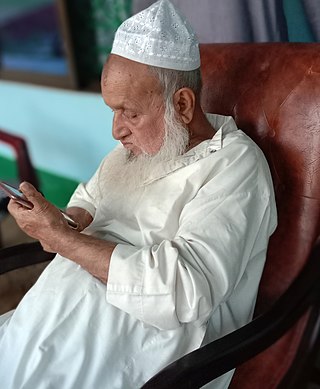
Shah Mohammad Muhibbullah Babunagari is a Bangladeshi Deobandi Islamic scholar, Politician and Academician. He is the current and 3rd Amir of Hefazat-e-Islam Bangladesh, Rector of Al-Jamiatul Islamiah Azizul Uloom Babunagar. He also held leading positions in Islami Oikya Jote, Befaqul Madarisil Arabia Bangladesh and Al-Haiatul Ulya Lil-Jamiatil Qawmia Bangladesh. He is considered one of the pioneers of Deoband movement in Bangladesh.
References
- ↑ "10 get Swadhinata Puroskar". The Daily Star. 26 March 2014. Retrieved 15 July 2020.
- 1 2 Ghosh, Sushanta (16 December 2014). "Memories of martyred Azizul preserved finally". The Daily Star. Retrieved 15 July 2020.
 | This Bangladeshi biographical article is a stub. You can help Wikipedia by expanding it. |
 | This Pakistani biographical article is a stub. You can help Wikipedia by expanding it. |