Kenneth S. M. Davidson

Last updated
Kenneth Seymour Moorhead Davidson
Nationality American
Awards Davidson Medal [1]
Scientific career
Institutions Stevens Institute of Technology

Kenneth S. M. Davidson was a Mechanical Engineering professor at Stevens Institute of Technology who helped create the Davidson Towing Tank at the institution. In 1918 he served as a pilot in the Army Air Service. Davidson was a sailor. He raced in many boat races, one in 1935 to Norway, and the America’s Cup defender, the Ranger, in 1937.

Contents

Time at the Institute

1929-1935

Kenneth Seymour Moorhead Davidson joined Stevens Institute of Technology in 1929 as an Assistant Professor of Mechanical Engineering. In the fall of 1932 asked Olin J. Stephens II for help in locating a high quality model yacht for experiments. Olin gave him a model of the yacht Natka, which measured six meters long. Davidson wanted to run small scale tests, but knew that they were unreliable. Many small scale test were run, but the full scale yacht did not have the same performance. Another problem with the large scale models was they were expensive for small yacht designers to afford. Davidson believed that experiments could help break down complex problems in smaller problems that were more manageable to solve.[ citation needed ] Davidson also held the belief that only small model could provide cost effectiveness to study all boats. To prove that small crafts could be made in a way that provided good information on craft dynamics he started testing in the swimming pool at Stevens in May 1931. He created a small, portable testing device that he could use after the pool closed at night. The summer of 1931 gave Davidson results that made him take his studies to the next level. Davidson and two assistants constructed a dynamometer and a towing apparatus for more detailed and quantitative work. Since the pool was so short in length and the model they were testing so small, the slow towing speeds. The slow speeds meant that the resistances that the model experienced were also small. This led to many problems. If they were going to use these tests, they had to make sure the speed was very controlled. To meet this requirement, Davidson designed a gear box that would do just this. Early in 1932 Davidson and two students performed tests to see if scaling would be a problem. Since the tests did not produce turbulent flow it was hard to determine anything. He decided to add strips to make up the resistance. Tests with in 1932 with their small scale models and test results from large scale models proved their testing methods. In 1933 Davidson had the opportunity to test his testing methods. The tests turned out to be successful that Davidson began designing a full sized tank for testing. Davidson received the funding necessary to build his full size test pool. The pool opened on June 4, 1935. The tank measured 101 feet in length and 9 feet across and 4.5 feet deep. The tank was fitted with state of the art sensors and measuring equipment.

1935-1940

The early tests in this tank, Tank 1, were focused on how to properly model windward performance of yachts. There were two main goals from these test: to determine the relationship between the wind speed and the force on the sails, and determine the lift/drag ratio of the rig. Davidson released his results from these test in his 1936 paper "Some Experimental Studies of the Sailing Yacht". Not all of the work in Tank 1 was done on yachts. They did some tests on a steamship, which showed they had confidence in their methods. In April 1936, Davidson began testing the Ranger for the America's Cup. The yacht was designed and tested in the tank and Davidson navigated the Ranger to victory in the America's Cup. The success of this and other tests brought recognition to Davidson and his team. By 1939 they started to test many different types of boats. Davidson was then approached in 1939 to run tests on the turning of boats. Since his tank was not able to deal with turns he went back to the Stevens pool after hours. Since the pool was not suitable enough, Davidson contacted Columbia where they let him use their pool on the weekends.

1942-1945

During World War II, the entirety of the work going on in the tanks was for the war effort. The size of his team grew to 63, and Davidson hired women to help build the models. The tank was being used for almost 16 hours a day, every day. Since Davidson wanted his own tank instead of having to go to Columbia on the weekends to run tests, he submitted a proposal for another tank. In 1942 the plan was approved and construction began on Tank 2. Tank 2 was a 75-foot square with a depth of 4.5 feet. Once the tank opened it was the world's first indoor maneuvering basin. This meant that Davidson did not have to go to Columbia to run tests on the turning abilities of boats. Like Tank 1, Tank 2 had state of the art sensors and measuring equipment. In November 1942, Davidson started to run test on seaplane hulls for the Bureau of Aeronautics. The problem was that neither of the two existing tanks were suitable for the tests needed, so a proposal for another tank was submitted. Tank 3 opened in November 1944. This tank was designed for high speed towing. Tank 3 had a length of 313 feet, was 12 feet wide, and 6 feet deep. This tank was able to tow models at speeds of up to 60 ft/sec. A wave maker was also installed to make waves of up to 8 inches tall. Once the tank opened it was flooded with tests on seaplane hulls. By 1944 45% of all the work being done in the lab was on seaplane hulls. [2] [3]

Related Research Articles

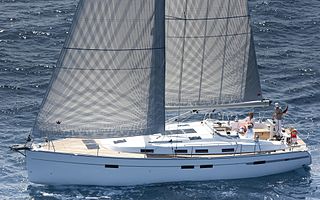
<span class="mw-page-title-main">Yacht</span> Recreational boat or ship

A yacht is a sailing or power vessel used for pleasure, cruising, or racing. There is no standard definition, though the term generally applies to vessels with a cabin intended for overnight use. To be termed a yacht, as opposed to a boat, such a pleasure vessel is likely to be at least 33 feet (10 m) in length and may have been judged to have good aesthetic qualities.
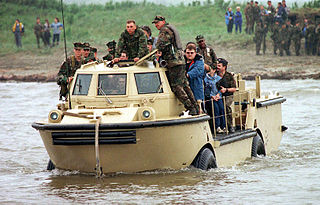
<span class="mw-page-title-main">Amphibious vehicle</span> Vehicle capable of transport on both land and over/under water

An amphibious vehicle, is a vehicle that is a means of transport viable on land as well as on or under water. Amphibious vehicles include amphibious bicycles, ATVs, cars, buses, trucks, railway vehicles, combat vehicles and hovercraft.

<span class="mw-page-title-main">Catamaran</span> Watercraft with two parallel hulls of equal size

A catamaran is a multi-hulled watercraft featuring two parallel hulls of equal size. It is a geometry-stabilized craft, deriving its stability from its wide beam, rather than from a ballasted keel as with a monohull boat. Catamarans typically have less hull volume, smaller displacement, and shallower draft (draught) than monohulls of comparable length. The two hulls combined also often have a smaller hydrodynamic resistance than comparable monohulls, requiring less propulsive power from either sails or motors. The catamaran's wider stance on the water can reduce both heeling and wave-induced motion, as compared with a monohull, and can give reduced wakes.
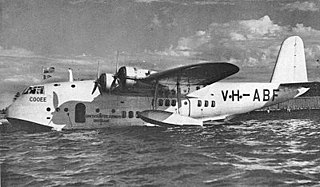
<span class="mw-page-title-main">Flying boat</span> Aircraft equipped with a boat hull for operation from water

A flying boat is a type of fixed-winged seaplane with a hull, allowing it to land on water. It differs from a floatplane in having a fuselage that is purpose-designed for floatation, while floatplanes rely on fuselage-mounted floats for buoyancy. It differs from an amphibious aircraft by lacking wheels, skis, or skids to land on a solid surface rather than water.

<span class="mw-page-title-main">Seaplane</span> Aircraft with an undercarriage capable of operating from water surfaces

A seaplane is a powered fixed-wing aircraft capable of taking off and landing (alighting) on water. Seaplanes are usually divided into two categories based on their technological characteristics: floatplanes and flying boats; the latter are generally far larger and can carry far more. Seaplanes that can also take off and land on airfields are in a subclass called amphibious aircraft, or amphibians. Seaplanes were sometimes called hydroplanes, but currently this term applies instead to motor-powered watercraft that use the technique of hydrodynamic lift to skim the surface of water when running at speed.

<span class="mw-page-title-main">Ship model basin</span> Water tank used to carry out hydrodynamic tests

A ship model basin is a basin or tank used to carry out hydrodynamic tests with ship models, for the purpose of designing a new ship, or refining the design of a ship to improve the ship's performance at sea. It can also refer to the organization that owns and operates such a facility.

<span class="mw-page-title-main">David W. Taylor</span>

David Watson Taylor was a U.S. naval architect and an engineer of the United States Navy. He served during World War I as Chief Constructor of the Navy, and Chief of the Bureau of Construction and Repair. Taylor is best known as the man who constructed the first experimental towing tank ever built in the United States.

<span class="mw-page-title-main">Caproni Ca.60</span> Type of aircraft

The Caproni Ca.60 Transaereo, often referred to as the Noviplano (nine-wing) or Capronissimo, was the prototype of a large nine-wing flying boat intended to become a 100-passenger transatlantic airliner. It featured eight engines and three sets of triple wings.

<span class="mw-page-title-main">MacGregor Yacht Corporation</span>

The MacGregor Yacht Corporation was a manufacturer of sailing yachts, located in Costa Mesa, California.

<span class="mw-page-title-main">Sailing yacht</span> Private sailing vessel with overnight accommodations

A sailing yacht, is a leisure craft that uses sails as its primary means of propulsion. A yacht may be a sail or power vessel used for pleasure, cruising, or racing. There is no standard definition, so the term applies here to sailing vessels that have a cabin with amenities that accommodate overnight use. To be termed a "yacht", as opposed to a "boat", such a vessel is likely to be at least 33 feet (10 m) in length and have been judged to have good aesthetic qualities. Sailboats that do not accommodate overnight use or are smaller than 30 feet (9.1 m) are not universally called yachts. Sailing yachts in excess of 130 feet (40 m) are generally considered to be superyachts.

<span class="mw-page-title-main">Supermarine Air Yacht</span> Former luxury flying boat

The Supermarine Air Yacht was a British luxury passenger-carrying flying boat. It was designed by Supermarine's chief designer R. J. Mitchell and built in Woolston, Southampton in 1929. It was commissioned by the brewing magnate Ernest Guinness, and was the first British flying yacht built to the order of a private owner. Only one machine was built.

<span class="mw-page-title-main">Loening Model 23</span> 1920s American flying boat airliner

The Loening S-1 Flying Yacht, also called the Loening Model 23, was an early light monoplane flying boat designed in the United States by Grover Loening in the early 1920s. The aircraft won the 1921 Collier Trophy.

Welfreighter British midget submarine of the Second World War

The Welfreighter was a Second World War British midget submarine developed by the Special Operations Executive (SOE) for the purpose of landing and supplying agents behind enemy lines. It only saw action once and was not particularly successful.

Huckins Yacht Corporation is one of the oldest boat builders in the United States. The company is located on the Ortega River in Jacksonville, Florida, and is run by its third-generation owners, Cindy and Buddy Purcell. Huckins manufactures custom yachts ranging from 40 to 90 feet that combine classic design and traditional workmanship with modern technology and amenities. It has built a total of 457 yachts during its 80 years of operation, crafting vessels one at a time.

The Aeromarine EO was a light sport flying boat that was built in the mid-1920s.

Britton Chance Jr. or Britt Chance was an American naval architect who developed core elements of three yachts that won the America's Cup and won the World Championship six times. The New York Times said he "was known for having a mathematician's precision and a renegade's willingness to experiment". Professional Boatbuilder called him "one of the brightest minds in yacht design".

The Ranger 33 is an American sailboat, that was designed by Gary Mull and first built in 1969. The design is out of production.

<span class="mw-page-title-main">Nonsuch 22</span> Sailboat class

The Nonsuch 22 is a Canadian trailerable sailboat, the smallest of the series of Nonsuch sailboats. It was designed by Mark Ellis Design and first built in 1984.

The Buccaneer 240 and Buccaneer 245 are a family of American trailerable sailboats that were both designed as cruisers and first built in 1975.

The Ericson 25, also called the Ericson 25 Mark I is an American trailerable sailboat that was designed by Bruce King as a cruiser and first built in 1973.

References

  1. "Davidson Medal - Society of Naval Architects and Marine Engineers". Sname.org. Retrieved 2013-06-12.
  2. http://archive.stevens.edu/ses/cms/fileadmin/cms/pdf/Davidson_Laboratory_and_the_Experimental_Towing_Tank_The_Hist.pdf%5B%5D
  3. History of Stevens Institute of Technology: A Record of Broad Bases Curricula and Technogenesis 1870-2000 by Geoffrey W. Clarck