Æthelberht was King of Kent from about 589 until his death. The eighth-century monk Bede, in his Ecclesiastical History of the English People, lists him as the third king to hold imperium over other Anglo-Saxon kingdoms. In the late ninth century Anglo-Saxon Chronicle, he is referred to as a bretwalda, or "Britain-ruler". He was the first English king to convert to Christianity.

The Jutes, Iuti, or Iutæ were one of the Germanic tribes who settled in Great Britain after the departure of the Romans. According to Bede, they were one of the three most powerful Germanic nations, along with the Angles and the Saxons:
Those who came over were of the three most powerful nations of Germany—Saxons, Angles, and Jutes. From the Jutes are descended the people of Kent, and of the Isle of Wight, and those also in the province of the West Saxons who are to this day called Jutes, seated opposite to the Isle of Wight.

Kent is a county in South East England and one of the home counties. It borders Greater London to the northwest, Surrey to the west and East Sussex to the southwest, and Essex to the north across the estuary of the River Thames; it faces the French department of Pas-de-Calais across the Strait of Dover. The county town is Maidstone. It is the fifth most populous county in England, the most populous non-metropolitan county and the most populous of the home counties.
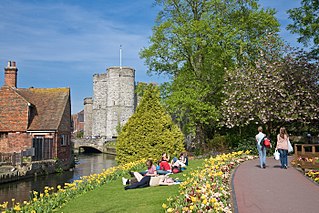
Canterbury is a city and UNESCO World Heritage Site, in the county of Kent, England; it was until 1974 a county borough. It lies on the River Stour. The city has a mild oceanic climate.

Ardashir II, was the Sasanian King of Kings of Iran from 379 to 383. He was the brother of his predecessor, Shapur II, under whom he had served as vassal king of Adiabene, where he fought alongside his brother against the Romans. Ardashir II was appointed as his brother's successor to rule interimly till the latter's son Shapur III reached adulthood. Ardashir II's short reign was largely uneventful, with the Sasanians unsuccessfully trying to maintain rule over Armenia.
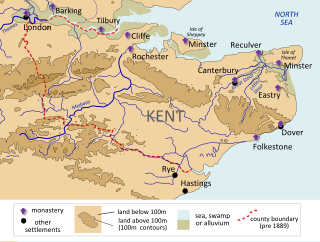
The Kingdom of the Kentish, today referred to as the Kingdom of Kent, was an early medieval kingdom in what is now South East England. It existed from either the fifth or the sixth century AD until it was fully absorbed into the Kingdom of Wessex in the late 9th century and later into the Kingdom of England in the early 10th century.

Florian was a Christian holy man and the patron saint of chimney sweeps; soapmakers, and firefighters. His feast day is 4 May. Florian is also the patron saint of Poland, the city of Linz, Austria, and Upper Austria, jointly with Leopold III, Margrave of Austria.

Hawkhurst is village and civil parish in the borough of Tunbridge Wells in Kent, England. The village is located close to the border with East Sussex, around 12 miles (19 km) south-east of Royal Tunbridge Wells and within the High Weald Area of Outstanding Natural Beauty.

Kent is a traditional county in South East England with long-established human occupation.

William Roper was an English lawyer and member of Parliament. The son of a Kentish gentleman, he married Margaret, daughter of Sir Thomas More. He wrote a highly regarded biography of his father-in-law.

The Roman Catholic Archdiocese of Southwark is a Latin Church archdiocese of the Catholic Church in England. It is led by the Archbishop of Southwark. The archdiocese is part of the Metropolitan Province of Southwark, which covers the South of England. The Southwark archdiocese also makes up part of the Catholic Association Pilgrimage.

Rag-stone is a name given by some architectural writers to work done with stones that are quarried in thin pieces, such as Horsham Stone, sandstone, Yorkshire stone, and the slate stones, but this is more properly flag or slab work. Near London, "rag-stone" often means Kentish ragstone, a material from the neighbourhood of Maidstone.

Bapchild is a village and civil parish in the Swale district of Kent, England, about two miles inside of Sittingbourne. It lies on the old Roman road now the A2, and according to the 2001 census, the parish had a population of 1,068, including Tonge, increasing to 1,141 at the 2011 Census.
Saint Eormenhild is a 7th-century Anglo-Saxon saint venerated in the Eastern Orthodox and Roman Catholic churches.

Halling is a village on the North Downs in the northern part of Kent, England. Consisting of Lower Halling, Upper Halling and North Halling, it is scattered over some 3 miles (5 km) along the River Medway parallel to the Pilgrims' Way which runs through Kent.

George William Finch-Hatton, 10th Earl of Winchilsea, 5th Earl of Nottingham was an English politician known for duelling with the then Prime Minister, Arthur Wellesley, 1st Duke of Wellington.

Swingate Mill is a Grade II listed tower mill in Guston, Kent, England that was built in 1849.
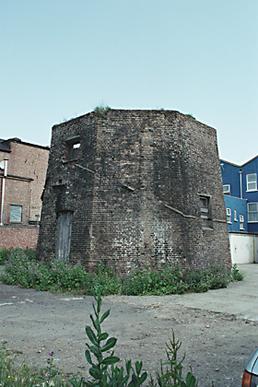
Great Mill or Ride's Mill is a Grade II listed smock mill just off the High Street in Sheerness, Kent, England, that was demolished in 1924, leaving the brick base standing. It now has a new smock tower built on it as residential accommodation.
The Kentish Express is a weekly newspaper serving southern Kent. It is published in four editions - Ashford, Folkestone, Hythe and the Romney Marsh, and Tenterden. It is owned by the KM Group and is published on Thursdays.

The National Shrine of Saint Jude, adjoining the Roman Catholic parish Church of Our Lady of Mount Carmel in Faversham Kent, England, is a shrine to Saint Jude and a place of pilgrimage and prayer for Catholics and other Christians since 1955 when it was erected. It comes under the Roman Catholic Archdiocese of Southwark. It is located on Tanners Street, to the west of the town centre. The shrine was founded by the Order of Carmelites and it lies within the Faversham Conservation Area.


