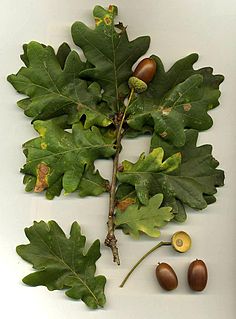
Quercus robur, commonly known as common oak, pedunculate oak, European oak or English oak, is a species of flowering plant in the beech and oak family, Fagaceae. It is native to most of Europe west of the Caucasus. The tree is widely cultivated in temperate regions and has escaped into the wild in scattered parts of China and North America.

Quercus petraea, commonly known as the sessile oak, Cornish oak, Irish Oak or durmast oak, is a species of oak tree native to most of Europe and into Anatolia and Iran. The sessile oak is the national tree of the Republic of Ireland, and an unofficial emblem in Wales and Cornwall.

County Offaly is a county in Ireland. It is part of the Midlands Region and is also located in the province of Leinster. It is named after the ancient Kingdom of Uí Failghe. It was formerly known as King's County. Offaly County Council is the local authority for the county. The county population was 77,961 at the 2016 census.

The Major Oak is a large English oak near the village of Edwinstowe in the midst of Sherwood Forest, Nottinghamshire, England. According to local folklore, it was Robin Hood's shelter where he and his merry men slept. It weighs an estimated 23 tons, has a girth of 33 feet, a canopy of 92 feet, and is about 800–1000 years old. In 2014, it was voted 'England's Tree of the Year' by a public poll by the Woodland Trust, receiving 18% of the votes. Its name originates from Major Hayman Rooke's description of it in 1790.

Tullamore is the county town of County Offaly, in Ireland. Located in the centre of the county, it is the fourth most populous town in the midlands region with a population of 14,607 in the 2016 census.
Earl of Charleville was a title that was created twice in the Peerage of Ireland. The first creation came in 1758 when Charles Moore, 2nd Baron Moore, was made Earl of Charleville, in the King's County. The title Baron Moore, of Tullamore in the King's County, was created in the Peerage of Ireland in 1715 for his father John Moore, who had previously represented King's County in the Irish House of Commons. Lord Charleville was childless and the titles became extinct on his death in 1764.
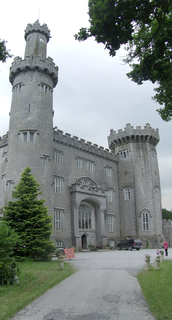
Charleville Castle is a Gothic-style castle located in County Offaly, Ireland, bordering the town of Tullamore, near the River Clodiagh. It is considered one of the finest of its type in the country.

Savernake Forest stands on a Cretaceous chalk plateau between Marlborough and Great Bedwyn in Wiltshire, England. Its area is approximately 4,500 acres.

Quercus dentata, also called Japanese emperor oak or daimyo oak is a species of oak native to East Asia. The name of the tree is often translated as "sweet oak" in English to distinguish it from Western varieties.

The Stelmužė Oak is an English (Pedunculate) oak tree which grows in the former Stelmužė Manor park by Stelmužė [stεɫˈmʊʒeː] village, Lithuania.

The Knightwood Oak is a pedunculate oak and the largest, and perhaps most famous, oak tree in the New Forest, in southern England. It is also known as the Queen of the Forest. It is over 500 years old and has a girth of 7.38 metres (24.2 ft). The tree is still growing. It was pollarded when about 200 years old and is thought to have been last pollarded in the mid 19th century.
The High Sheriff of King's County was the British Crown's judicial representative in King's County, Ireland from 1556, when King's County was created, until 1922, when the office was abolished in the new Free State and replaced by the office of Offaly County Sheriff. The sheriff had judicial, electoral, ceremonial and administrative functions and executed High Court Writs. In 1908, an Order in Council made the Lord-Lieutenant the Sovereign's prime representative in a county and reduced the High Sheriff's precedence. However the sheriff retained his responsibilities for the preservation of law and order in the county. The usual procedure for appointing the sheriff from 1660 onwards was that three persons were nominated at the beginning of each year from the county and the Lord Lieutenant then appointed his choice as High Sheriff for the remainder of the year. Often the other nominees were appointed as under-sheriffs. Sometimes a sheriff did not fulfil his entire term through death or other event and another sheriff was then appointed for the remainder of the year. The dates given hereunder are the dates of appointment. All addresses are in King's County unless stated otherwise.
Charles William Bury, 1st Earl of Charleville FRS, FSA, known as The Lord Tullamore between 1797 and 1800 and as The Viscount Charleville between 1800 and 1806, was an Irish landowner, antiquarian and politician.

The Tullamore Show is a one-day agricultural and livestock show held on second Sunday of August each year near the town of Tullamore, County Offaly, Ireland. The programme of Tullamore Show events incorporates many elements including cultural, commercial trade exhibitions and competitive interests, ranging from livestock, equestrian, home industries, inventions, vintage, fashion, style, cookery, crafts and performing arts. Competitions include Irish livestock competing for the coveted Gold Medal and displays of the very best in Irish traditions and culture. Agriculture was originally the show's main focus, but this has broadened considerably over the years to adapt to Irelands changing culture, with entertainment, food, crafts, lifestyle including 700 trade stands, food and refreshments, fashion and entertainment. The Tullamore Show attracts a large attendance, with an average of 62,000 visitors from across Ireland and other countries.

Mucklagh is a townland and village in County Offaly, Ireland. It is located 5 km southwest of Tullamore. As of the 2016 census, the population of Mucklagh was 826 people.
The Buttington Oak was a tree near to Offa's Dyke at Buttington, Wales, said to have been planted to mark the site of the Battle of Buttington between the Vikings and a Mercian, Wessex and Welsh force in 893. It had been cyclically pollarded for timber until around 150 years ago. The oak tree was rediscovered in 2009. In 2017 it was badly damaged by storms, finally collapsing in February 2018.
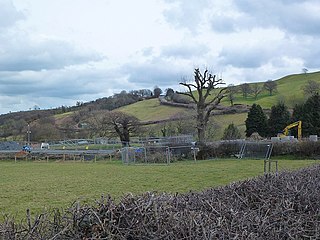
The Brimmon Oak is a veteran tree in Newtown, Powys, Wales. An English oak, it is thought to be around 500 years old and has been on land farmed by the same family since the 1600s. The tree was scheduled to be felled as part of the construction of the A483 Newtown Bypass in 2015 but was saved as the result of a petition. The tree was named both Welsh and British Tree of the Year for 2016 and was runner up in the European Tree of the Year awards of 2017.
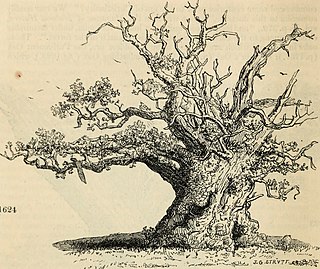
The Cowthorpe Oak was an oak tree in Cowthorpe, North Yorkshire, England. Renowned for its age and size it was sketched by the artist J. M. W. Turner. At its greatest extent its canopy was said to cover 0.5 acres (2,000 m2) of land. The tree declined in the late 18th century and lost several of its leading branches. By 1822 many of its branches were almost completely rotten and it had been supported with wooden props. The tree fell in 1950, apparently after having been struck by lightning.

The Newland Oak was a veteran oak tree in Newland, Gloucestershire in England. Originally part of the ancient woodland of the Forest of Dean, it survived clearances that created the settlement of Newland and was afterwards pollarded for timber. Its large size was often remarked upon through the years and it was considered a rival to the Cowthorpe Oak as the largest oak tree in Great Britain. Much of the tree fell during heavy snow in 1955 but a single branch of the tree survived until 1970 when it was killed during an arson attack. A replacement tree grown from one of the Newland Oak's acorns had been planted in 1964.

Minchenden Oak Garden is a public park in Southgate, London owned by the London Borough of Enfield.
