
A big band or jazz orchestra is a type of musical ensemble of jazz music that usually consists of ten or more musicians with four sections: saxophones, trumpets, trombones, and a rhythm section. Big bands originated during the early 1910s and dominated jazz in the early 1940s when swing was most popular. The term "big band" is also used to describe a genre of music, although this was not the only style of music played by big bands.

William James "Count" Basie was an American jazz pianist, organist, bandleader, and composer. In 1935, he formed the Count Basie Orchestra, and in 1936 took them to Chicago for a long engagement and their first recording. He led the group for almost 50 years, creating innovations like the use of two "split" tenor saxophones, emphasizing the rhythm section, riffing with a big band, using arrangers to broaden their sound, his minimalist piano style, and others.
Swing music is a style of jazz that developed in the United States during the late 1920s and early 1930s. It became nationally popular from the mid-1930s. Swing bands usually featured soloists who would improvise on the melody over the arrangement. The danceable swing style of big bands and bandleaders such as Benny Goodman was the dominant form of American popular music from 1935 to 1946, known as the swing era, when people were dancing the Lindy Hop. The verb "to swing" is also used as a term of praise for playing that has a strong groove or drive. Musicians of the swing era include Duke Ellington, Benny Goodman, Count Basie, Cab Calloway, Benny Carter, Jimmy Dorsey, Tommy Dorsey, Woody Herman, Earl Hines, Bunny Berigan, Harry James, Lionel Hampton, Glenn Miller, Artie Shaw, Jimmie Lunceford, and Django Reinhardt.

Dire Straits were a English rock band formed in London in 1977 by Mark Knopfler, David Knopfler, John Illsley and Pick Withers. The band was active from 1977 to 1988 and again from 1990 to 1995.

Dire Straits is the debut studio album by the British rock band Dire Straits, released on 9 June 1978 by Vertigo Records internationally, Warner Bros. Records in the United States and Mercury Records in Canada. The album features the hit single "Sultans of Swing", which reached number 4 on the Billboard Hot 100 chart and number 8 on the UK Singles Chart. The album reached the top of the album charts in Germany, Australia and France, number 2 in the United States and number 5 in the United Kingdom. Dire Straits was later certified double platinum in both the United States and the United Kingdom by the Recording Industry Association of America (RIAA) and the British Phonographic Industry (BPI) respectively.

Frank Wellington Wess was an American jazz saxophonist and flutist. He was renown for his extensive solo work; however, he was also remembered for his time playing with Count Basie's band during the early 1950s into the early 1960s. Critic Scott Yanow described him as one of the premier proteges of Lester Young, and a leading jazz flutist of his era—using the latter instrument to bring new colors to Basie's music.

"Sultans of Swing" is a song by British rock band Dire Straits, written by lead vocalist and guitarist Mark Knopfler. The demo of the song was recorded at Pathway Studios, North London, in July 1977 and quickly acquired a following after it was put in rotation on BBC Radio London. Its popularity soon reached record executives, and Dire Straits were offered a contract with Phonogram Records. The song was then re-recorded in February 1978 at Basing Street Studios for the band's eponymous debut album.

Thaddeus Joseph Jones was an American jazz trumpeter, composer and bandleader who has been called "one of the all-time greatest jazz trumpet soloists".
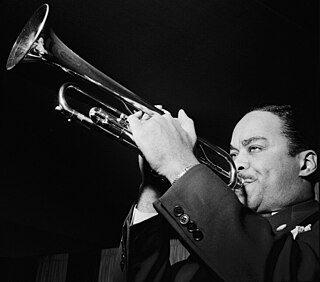
Wilbur Dorsey "Buck" Clayton was an American jazz trumpeter who was a member of Count Basie's orchestra. His principal influence was Louis Armstrong, first hearing the record "Confessin' that I Love You" as he passed by a shop window.

The Count Basie Orchestra is a 16- to 18-piece big band, one of the most prominent jazz performing groups of the swing era, founded by Count Basie in 1935 and recording regularly from 1936. Despite a brief disbandment at the beginning of the 1950s, the band survived long past the big band era itself and the death of Basie in 1984. It continues under the direction of trumpeter Scotty Barnhart.
Walter Sylvester Page was an American jazz multi-instrumentalist and bandleader, best known for his groundbreaking work as a double bass player with Walter Page's Blue Devils and the Count Basie Orchestra.

Frank Benjamin Foster III was an American tenor and soprano saxophonist, flautist, arranger, and composer. Foster collaborated frequently with Count Basie and worked as a bandleader from the early 1950s. In 1998, Howard University awarded Frank Foster with the Benny Golson Jazz Master Award.

Money for Nothing is a greatest hits album by British rock band Dire Straits released on 14 October 1988, featuring highlights from the band's first five albums. The vinyl edition omits the song "Telegraph Road" and has a different running order.

Sultans of Swing: The Very Best of Dire Straits is the second greatest hits compilation by the British rock band Dire Straits, released on 19 October 1998 by Mercury Records internationally, and by Warner Bros. Records in the United States. The album was originally released, featuring liner notes by Robert Sandall, as both a single CD and a limited edition double CD, with the second CD containing live recordings from Mark Knopfler's first solo tour in 1996. A DVD of the same name was also released, featuring the music videos of all the songs on the single CD version, in addition to short interviews with Mark Knopfler about each song. The album is named after the band's 1978 hit single of the same name. In 2002, a limited edition box set, comprising the two CDs and the DVD, was released as part of Universal's "Sight and Sound" series.

Grover Mitchell, born Grover Curry Mitchell was an American jazz trombonist who led the Count Basie Orchestra.
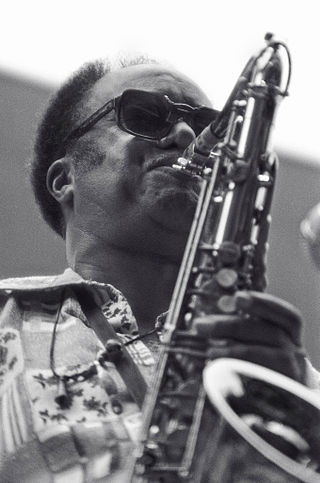
Ernest Brooks Wilkins Jr. was an American jazz saxophonist, conductor and arranger who spent several years with Count Basie. He also wrote for Tommy Dorsey, Harry James, and Dizzy Gillespie. He was musical director for albums by Cannonball Adderley, Dinah Washington, Oscar Peterson, and Buddy Rich.
William Henry Hughes was an American jazz trombonist and bandleader. He spent most of his career with the Count Basie Orchestra and was the director of that ensemble until September 2010.

This Time by Basie is an album released by pianist, composer and bandleader Count Basie featuring jazz versions of contemporary hits recorded in 1963 and originally released on the Reprise label.
"Love over Gold" is a song by British rock band Dire Straits. It is the fourth track and title track from the band's 1982 album. A shorter live version of the song, taken from the album Alchemy: Dire Straits Live, was released as a single.
