
The Holy Roman Empire, also known as the Holy Roman Empire of the German Nation after 1512, was a political entity in Western, Central, and Southern Europe that developed in the Early Middle Ages and continued until its dissolution in 1806 during the Napoleonic Wars.

Mantua is a city and comune in Lombardy, Italy, and capital of the province of the same name.

The Holy Roman Emperor, originally and officially the Emperor of the Romans during the Middle Ages, and also known as the Roman-German Emperor since the early modern period, was the ruler and head of state of the Holy Roman Empire. The title was held in conjunction with the title of king of Italy from the 8th to the 16th century, and, almost without interruption, with the title of king of Germany throughout the 12th to 18th centuries.

The Austrian Empire, officially known as the Empire of Austria, was a multinational European great power from 1804 to 1867, created by proclamation out of the realms of the Habsburgs. During its existence, it was the third most populous monarchy in Europe after the Russian Empire and the United Kingdom. Along with Prussia, it was one of the two major powers of the German Confederation. Geographically, it was the third-largest empire in Europe after the Russian Empire and the First French Empire.

King of Italy was the title given to the ruler of the Kingdom of Italy after the fall of the Western Roman Empire. The first to take the title was Odoacer, a barbarian military leader, in the late 5th century, followed by the Ostrogothic kings up to the mid-6th century. With the Frankish conquest of Italy in the 8th century, the Carolingians assumed the title, which was maintained by subsequent Holy Roman Emperors throughout the Middle Ages. The last Emperor to claim the title was Charles V in the 16th century. During this period, the holders of the title were crowned with the Iron Crown of Lombardy.

The Duchy of Milan was a state in northern Italy, created in 1395 by Gian Galeazzo Visconti, then the lord of Milan, and a member of the important Visconti family, which had been ruling the city since 1277.
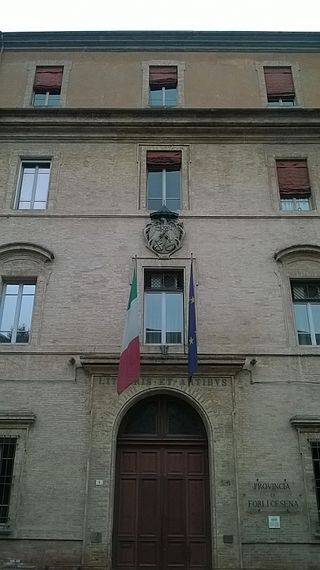
The province of Forlì-Cesena is a province in the Emilia–Romagna region of Italy. Its capital is the city of Forlì. The province has a population of 394,273 as of 2016 over an area of 2,378.4 square kilometres (918.3 sq mi). It contains 30 comuni and the provincial president is Davide Drei. Although located close to the independent Republic of San Marino, Forlì-Cesena does not share a land border with the sovereign state.
The Habsburg monarchy, also known as the Danubian monarchy, or Habsburg Empire, was the collection of empires, kingdoms, duchies, counties and other polities that were ruled by the House of Habsburg, especially the dynasty's Austrian branch.

The Austrian Crown Jewels are the regalia and vestments worn by the Holy Roman Emperor, and later by the Emperor of Austria, during the coronation ceremony and other state functions. The term refers to the following objects: the crowns, sceptres, orbs, swords, rings, crosses, holy relics and royal robes, as well as several other objects connected with the ceremony. The collection dates from the 10th to the 19th centuries, and it reflects more than a thousand years of European history. It is kept in the Imperial Treasury at the Hofburg Palace in Vienna, Austria.

Northern Italy is a geographical and cultural region in the northern part of Italy. It consists of eight administrative regions: Aosta Valley, Piedmont, Liguria, Lombardy, Emilia-Romagna, Veneto, Friuli-Venezia Giulia and Trentino-Alto Adige. As of 2014, its population was 27,801,460. Rhaeto-Romance and Gallo-Italic languages are spoken in the region, as opposed to the Italo-Dalmatian languages spoken in the rest of Italy. The Venetian language is sometimes considered to be part of the Italo-Dalmatian languages, but some major publications such as Ethnologue and Glottolog define it as Gallo-Italic.
The Kingdom of Italy, also called Imperial Italy, was one of the constituent kingdoms of the Holy Roman Empire, along with the kingdoms of Germany, Bohemia, and Burgundy. It originally comprised large parts of northern and central Italy. Its original capital was Pavia until the 11th century.

The March of Tuscany was a march of the Kingdom of Italy and the Holy Roman Empire during the Middle Ages. Located in northwestern central Italy, it bordered the Papal States to the south, the Ligurian Sea to the west and Lombardy to the north. It comprised a collection of counties, largely in the valley of the Arno River, originally centered on Lucca.

Anton Victor, Viceroy of Lombardy–Venetia was an Archduke of Austria and a Grand Master of the Teutonic Knights. He was also briefly the last Archbishop and Elector of Cologne and Prince-Bishop of Münster before those territories were secularised in 1803.
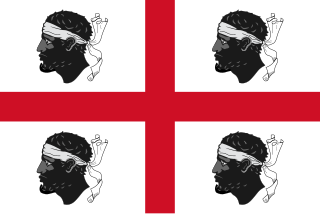
The Kingdom of Sardinia, also referred to as the Kingdom ofSardinia-Piedmont or Piedmont-Sardinia during the Savoyard period, was a state in Southern Europe from the late—13th until the mid—19th century.

The Treaty of Prüm, concluded on 19 September 855, was the second of the partition treaties of the Carolingian Empire. As Emperor Lothair I was approaching death, he divided his realm of Middle Francia among his three sons.

The monarchy of Italy was the system of government in which a hereditary constitutional monarch was the sovereign of the Kingdom of Italy from 1861 to 1946.
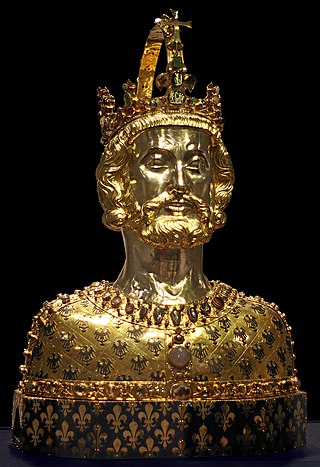
King is the title given to a male monarch in a variety of contexts. The female equivalent is queen regnant, although in some cases, the title of "King" is given to females such as Mary, Queen of Hungary, and Jadwiga of Poland in the 1380s.
