Related Research Articles
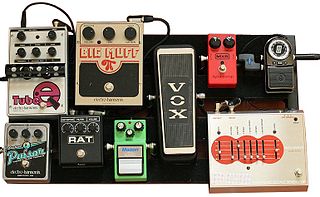
An effects unit or effects pedal is an electronic device that alters the sound of a musical instrument or other audio source through audio signal processing.
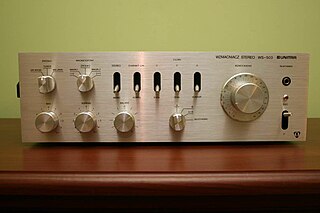
An audio power amplifier is an electronic amplifier that amplifies low-power electronic audio signals such as the signal from radio receiver or electric guitar pickup to a level that is high enough for driving loudspeakers or headphones. Audio power amplifiers are found in all manner of sound systems including sound reinforcement, public address and home audio systems and musical instrument amplifiers like guitar amplifiers. It is the final electronic stage in a typical audio playback chain before the signal is sent to the loudspeakers.

An instrument amplifier is an electronic device that converts the often barely audible or purely electronic signal of a musical instrument into a larger electronic signal to feed to a loudspeaker. An instrument amplifier is used with musical instruments such as an electric guitar, an electric bass, electric organ, synthesizers and drum machine to convert the signal from the pickup or other sound source into an electronic signal that has enough power, due to being routed through a power amplifier, capable of driving one or more loudspeaker that can be heard by the performers and audience.

A guitar amplifier is an electronic device or system that strengthens the weak electrical signal from a pickup on an electric guitar, bass guitar, or acoustic guitar so that it can produce sound through one or more loudspeakers, which are typically housed in a wooden cabinet. A guitar amplifier may be a standalone wood or metal cabinet that contains only the power amplifier circuits, requiring the use of a separate speaker cabinet–or it may be a "combo" amplifier, which contains both the amplifier and one or more speakers in a wooden cabinet. There is a wide range of sizes and power ratings for guitar amplifiers, from small, lightweight "practice amplifiers" with a single 6" speaker and a 10 watt amp to heavy combo amps with four 10” or four 12" speakers and a powerful 100 watt amplifier, which are loud enough to use in a nightclub or bar performance.

Marshall Amplification is a British company that designs and manufactures music amplifiers, speaker cabinets, brands personal headphones and earphones, a record label and, having acquired Natal Drums, drums and bongos. It was founded by drum shop owner and drummer Jim Marshall, and is now based in Bletchley, Milton Keynes, Buckinghamshire.
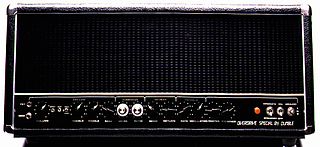
Dumble is a guitar amplifier manufacturer in Los Angeles, California.
Boutique amplifier is a catch-all descriptor for any type of instrument amplifier that is typically hand built with the intention of being much better than the mass-produced variety offered by large companies. In the majority of cases, this is reflected in the price. Sometimes they are clones of older designs, often with minor improvements or alterations in layout or circuit design; sometimes they are new designs altogether.
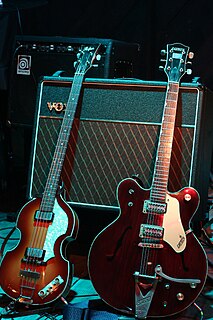
The Vox AC30 is a guitar amplifier manufactured by Vox. It was introduced in 1958 to meet the growing demand for louder amplifiers. Characterised by its "jangly" high-end sound it has become widely recognized by British musicians and others, such as George Harrison and John Lennon of The Beatles, Noel Gallagher of Oasis, Hank Marvin, The Rolling Stones, Dave Davies of the Kinks, and Brian May of Queen.

A bass amplifier or "bass amp" is a musical instrument electronic device that uses electrical power to make lower-pitched instruments such as the bass guitar or double bass loud enough to be heard by the performers and audience. Bass amps typically consist of a preamplifier, tone controls, a power amplifier and one or more loudspeakers ("drivers") in a cabinet.
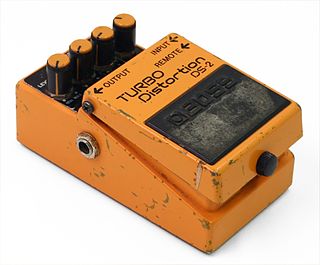
Distortion and overdrive are forms of audio signal processing used to alter the sound of amplified electric musical instruments, usually by increasing their gain, producing a "fuzzy", "growling", or "gritty" tone. Distortion is most commonly used with the electric guitar, but may also be used with other electric instruments such as electric bass, electric piano, and Hammond organ. Guitarists playing electric blues originally obtained an overdriven sound by turning up their vacuum tube-powered guitar amplifiers to high volumes, which caused the signal to distort. While overdriven tube amps are still used to obtain overdrive, especially in genres like blues and rockabilly, a number of other ways to produce distortion have been developed since the 1960s, such as distortion effect pedals. The growling tone of a distorted electric guitar is a key part of many genres, including blues and many rock music genres, notably hard rock, punk rock, hardcore punk, acid rock, and heavy metal music, while the use of distorted bass has been essential in a genre of hip hop music and alternative hip hop known as "SoundCloud rap".
Re-amping is a process often used in multitrack recording in which a recorded signal is routed back out of the editing environment and run through external processing using effects units and then into a guitar amplifier and a guitar speaker cabinet or a reverb chamber. Originally, the technique was used mostly for electric guitars: it facilitates a separation of guitar playing from guitar amplifier processing—a previously recorded audio program is played back and re-recorded at a later time for the purpose of adding effects, ambiance such as reverb or echo, and the tone shaping imbued by certain amps and cabinets. The technique has since evolved over the 2000s to include many other applications. Re-amping can also be applied to other instruments and program, such as recorded drums, synthesizers, and virtual instruments.
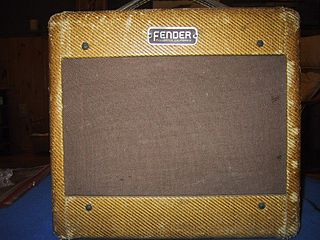
The Fender Champ was a guitar amplifier made by Fender. It was introduced in 1948 and discontinued in 1982. An updated version was introduced in 2006 as part of the "Vintage Modified" line.

Voodoo Amplification is a Lansing, New York company which designs and modifies guitar amplifiers.
Dr. Z Amplification is an American manufacturer of boutique guitar amplifiers.
Fryette Amplification of North Hollywood, California is a manufacturer of high-quality hand built electric guitar amplifiers, speaker cabinets, power amplifiers, sound effects pedals and pedalboard accessories. The company was founded as VHT Amplification in Studio City, Los Angeles, California by Steven Fryette in January 1989 and was the first to produce a true three-channel vacuum tube amplifier.
Trainwreck Circuits is an American company that manufactures boutique guitar amplifiers. The company was founded by Ken Fischer in 1985. Trainwreck amplifiers are made in Colonia, New Jersey and are among the most sought-after amplifiers on the market.

Traynor is a brand of bass amplifiers and guitar amplifiers, the first brand formed by Yorkville Sound. The Traynor brand, named for founder Peter Traynor, began in 1963 with the Dynabass bass amplifier, a rental product. Traynor first became popular in Canada by providing less expensive versions of the circuits used in Marshall and Fender amplifiers of the time. The revived brand now produces a wide range of electric, acoustic, and bass guitar amps.
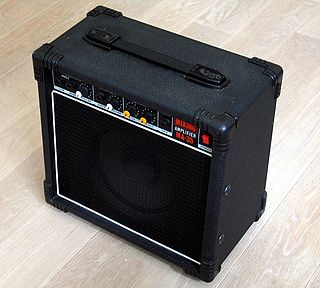
A keyboard amplifier is a powered electronic amplifier and loudspeaker in a wooden speaker cabinet used for amplification of electronic keyboard instruments. Keyboard amplifiers are distinct from other types of amplification systems such as guitar amplifiers due to the particular challenges associated with making keyboards sound louder on stage; namely, to provide solid low-frequency sound reproduction for the deep basslines which keyboards can play and crisp high-frequency sound for the high-register notes. Another difference between keyboard amplifiers and guitar/bass amplifiers is that keyboard amps are usually designed with a relatively flat frequency response and low distortion. In contrast, many guitar and bass amp designers purposely make their amplifiers modify the frequency response, typically to "roll off" very high frequencies, and most rock and blues guitar amps, and since the 1980s and 1990s, even many bass amps are designed to add distortion or overdrive to the instrument tone.
Multi-amp guitar rigs use two or more amplifiers to create a unique tone that could not be achieved with the use of only one amplifier. Guitar players such as James Valentine and Joh la’Mayær use multiple amplifiers simultaneously to achieve their tones. Session guitar players such as Brent Mason often bring four or more amplifiers to recording sessions. There are many different types of guitar amplifiers that have drastically different sounds. There are three classic guitar amplifier circuits that most amplifiers are based on that all use different power amplifier tubes: The EL84 powered class A circuits which comes from the Vox AC30 and AC15 amplifiers, The 6L6 and 6V6 powered class AB circuits which come from Fender amplifiers, and the EL34 powered class AB circuits which come from Marshall amplifiers. The sonic characteristics of these different amplifier configurations are extremely different and for a lot of guitar players it is important to have the tonal palette of all three. This is especially true for studio guitarists and is why a lot of high-end recording studios have multiple different types of guitar amplifiers in house. It is a common practice to use a 6L6 or 6V6 powered amplifier for a clear, clean tone in conjunction with an EL34 or EL84 powered amplifier for a more distorted tone. It is then a matter of blending the two amps' signals in order to achieve the desired amount of distortion.
The Falcon (GA-19RVT) was a guitar amplifier made by Gibson Guitar Corporation in 1961. With the Falcon and a few other models, Gibson was ahead of Fender in bringing an amplifier with reverb on the market. In addition, the Falcon also had tremolo.
References
- 1 2 Hunter, Dave. "Komet Aero 33". Guitar Player . pp. 120–21.
- ↑ Pittman, Aspen (2003). The Tube Amp Book. Hal Leonard. pp. 89–90. ISBN 978-0-87930-767-7 . Retrieved 7 January 2012.
- ↑ "Komet 19 Amp Head Review". Premier Guitar. 19 August 2009. Retrieved 6 May 2014.
- ↑ "2020 Riviera Maya". 21 February 2020.
