Related Research Articles

Conrad III of the Hohenstaufen dynasty was from 1116 to 1120 Duke of Franconia, from 1127 to 1135 anti-king of his predecessor Lothair III and from 1138 until his death in 1152 king in the Holy Roman Empire. He was the son of Duke Frederick I of Swabia and Agnes, a daughter of the Salian Emperor Henry IV.
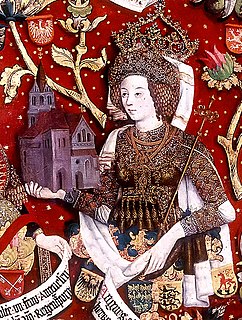
Agnes of Waiblingen, also known as Agnes of Germany, Agnes of Poitou and Agnes of Saarbrücken, was a member of the Salian imperial family. Through her first marriage, she was Duchess of Swabia; through her second marriage, she was Margravine of Austria.

The Prince-Bishopric of Würzburg was an ecclesiastical principality of the Holy Roman Empire located in Lower Franconia, west of the Prince-Bishopric of Bamberg. Würzburg had been a diocese since 743. As established by the Concordat of 1448, bishops in Germany were chosen by the canons of the cathedral chapter and their election was later confirmed by the pope. Following a common practice in Germany, the prince-bishops of Würzburg were frequently elected to other ecclesiastical principalities as well. The last few prince-bishops resided at the Würzburg Residence, which is one of the grandest Baroque palaces in Europe.

The Blessed Gamelbert was a Christian priest, who worked in the 8th century in the area of the present Deggendorf in Bavaria in Germany.

Regensburg Cathedral, also known as St. Peter's Cathedral, is an example of important Gothic architecture within the German state of Bavaria. It is a landmark for the city of Regensburg, Germany, and the seat of the Catholic Diocese of Regensburg.
The Prince-Bishopric of Regensburg was a small ecclesiastical principality of the Holy Roman Empire located near the Free Imperial City of Regensburg in Bavaria. It was elevated to the Archbishopric of Regensburg in 1803 after the dissolution of the Archbishopric of Mainz. The Prince-Bishopric of Regensburg must not be confused with the Roman Catholic Diocese of Regensburg, which was considerably larger.

The Prince-Bishopric of Osnabrück) was an ecclesiastical principality of the Holy Roman Empire from 1225 until 1803. It should not be confused with the Diocese of Osnabrück, which was larger and over which the prince-bishop exercised only the spiritual authority of an ordinary bishop. It was named after its capital, Osnabrück.

Sigmund Friedrich Fugger von Kirchberg und Weißenhorn was a German cleric of the Fugger family, most notable as bishop of Regensburg from 2 July 1598 to 1600.

Michael Buchberger was a Roman Catholic priest, notable as the seventy-fourth bishop of Regensburg since the diocese's foundation in 739.
FelicianoNinguarda was an Italian Roman Catholic prelate and one of the main movers of the Counter Reformation. He was bishop of Scala, bishop of Sant’Agata de’ Goti, bishop of Como, governor of the bishopric of Regensburg and apostolic nuncio to Upper Germany.

John III of the Palatinate was the 48th Archbishop of Regensburg. He reigned from 1507 until his death.
Heinrich II von Rotteneck was prince-bishop of Regensburg from 1277 to 1296.
Rupert of Palatinate-Mosbach was a German nobleman and clergyman. From 1457 to his death he was the forty-third bishop of Regensburg, as Rupert I.

Henry IV of Asberg was a nobleman of the Franconian House of Absberg and clergyman. From 1465 to his death he was bishop of Regensburg.
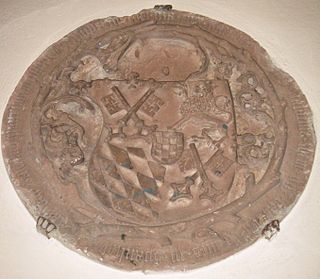
Rupert of Palatinate-Simmern was a German nobleman and clergyman of the house of Palatinate-Simmern. From 1492 until his death he was the forty-fifth bishop of Regensburg as Rupert II.

Reginbert of Hagenau also called Raimbert was 1130 provost of the Stift St. Pölten and in 1138 bishop of Passau.
Albert I Count of Pietengau was Bishop of Regensburg from 1246 to 1259.

Carl Josef Thiel was a German organist, church musician and professor of music.

Wolfram Menschick was a German Catholic church musician, composer and academic teacher. From 1969 to 2002 he was responsible for the church music at Eichstätt Cathedral, also serving the Diocese of Eichstätt as music director and organ expert. He was a bell expert, a member of a national council. From 1986 to 2000, he was a professor at the University of Music and Performing Arts Munich. His compositions, including 36 masses, are frequently performed.
References
- ↑ "Bishop Konrad von Laichling". Catholic-Hierarchy.org .
- ↑ Buchberger 1939, p. 32.
- ↑ Staber 1966, p. 37.
