Related Research Articles

A dictatorship is an autocratic form of government which is characterized by a leader, or a group of leaders, who hold governmental powers with few to no limitations. Politics in a dictatorship are controlled by a dictator, and they are facilitated through an inner circle of elites that includes advisers, generals, and other high-ranking officials. The dictator maintains control by influencing and appeasing the inner circle and repressing any opposition, which may include rival political parties, armed resistance, or disloyal members of the dictator's inner circle. Dictatorships can be formed by a military coup that overthrows the previous government through force or they can be formed by a self-coup in which elected leaders make their rule permanent. Dictatorships are authoritarian or totalitarian, and they can be classified as military dictatorships, one-party dictatorships, personalist dictatorships, or absolute monarchies.
Autocracy is a system of government in which absolute power is held by the ruler, known as an autocrat. It includes most forms of monarchy and dictatorship, while it is contrasted with democracy and feudalism. Various definitions of autocracy exist. They may restrict autocracy to cases where power is held by a single individual, or they may define autocracy in a way that includes a group of rulers who wield absolute power. The autocrat has total control over the exercise of civil liberties within the autocracy, choosing under what circumstances they may be exercised, if at all. Governments may also blend elements of autocracy and democracy, forming an anocracy. The concept of autocracy has been recognized in political philosophy since ancient times.
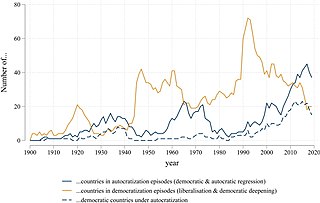
Democratization, or democratisation, is the structural government transition from an authoritarian government to a more democratic political regime, including substantive political changes moving in a democratic direction.

James Heartfield is a British lecturer and historian.

The Greek junta or Regime of the Colonels was a right-wing military dictatorship that ruled Greece from 1967 to 1974. On 21 April 1967, a group of colonels overthrew the caretaker government a month before scheduled elections which Georgios Papandreou's Centre Union was favoured to win.
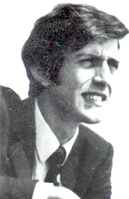
Kostas Georgakis was a Greek student studying geology in Italy. On 26 July 1970, while in Italy, he gave an interview denouncing the dictatorial regime of Georgios Papadopoulos. The junta retaliated by attacking him, pressuring his family, and rescinding his military exemption. In a final, fatal, protest in the early hours of 19 September 1970, Georgakis set himself ablaze in Matteotti square in Genoa. He died later that day, an estimated 1,500 people attended his 22 September funeral, with hundreds of anti-junta resistance members leading a demonstration. Melina Mercouri carried a bouquet for the hero of the anti-junta. After being briefly interred in Genoa his remains were transported by ship to Corfu, and on 18 January 1971 he was buried. After the junta collapsed the Government of Greece erected a monument and plaque in his home town of Corfu, another plaque was placed in Matteotti square, and multiple poems have been written in his honor.

Campus protest or student protest is a form of student activism that takes the form of protest at university campuses. Such protests encompass a wide range of activities that indicate student dissatisfaction with a given political or academics issue and mobilization to communicate this dissatisfaction to the authorities and society in general and hopefully remedy the problem. Protest forms include but are not limited to: sit-ins, occupations of university offices or buildings, strikes etc. More extreme forms include suicide such as the case of Jan Palach's, and Jan Zajíc's protests against the end of the Prague Spring and Kostas Georgakis' protest against the Greek junta of 1967–1974.
Anarchism in Greece traces its roots to ancient Greece but was formed as a political movement during the 19th century. It was in the ancient era that the first libertarian thoughts appeared when philosophers based on rationality questioned the fundamentals of tradition. Modern anarchism in Greece emerged in the 19th century, heavily influenced by the contemporary European classical anarchism. Because of the Bolshevik success in the Russian Revolution of 1917 and the rise of the Communist Party, anarchism faded after the first decades of the 20th century. The collapse of the military junta put an end to the monopoly of the political power from the Right, whereas the dissolution of the Soviet Union diminished the allure of the Communist Party of Greece allowing anarchist groups to gain pace in Athens and other cities.

The Athens Polytechnic uprising occurred in November 1973 as a massive student demonstration of popular rejection of the Greek military junta of 1967–1974. It began on 14 November 1973, escalated to an open anti-junta revolt, and ended in bloodshed in the early morning of 17 November after a series of events starting with a tank crashing through the gates of the Athens Polytechnic.
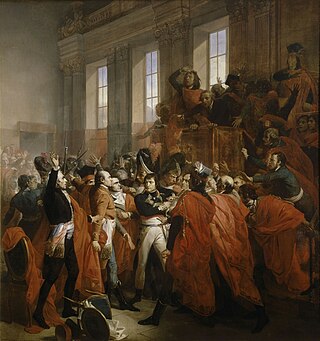
A coup d'état, or simply a coup, is typically an illegal and overt attempt by a military organization or other government elites to unseat an incumbent leadership. A self-coup is when a leader, having come to power through legal means, tries to stay in power through illegal means.
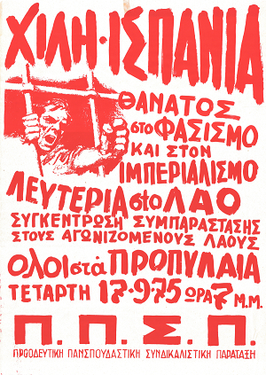
The Progressive All-Student Unionist Camp was a students movement in Greece.
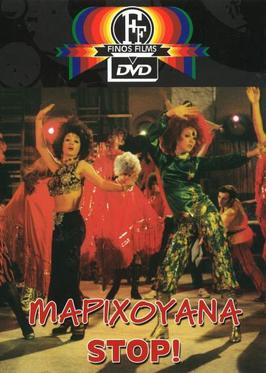
Marijuana Stop! is a 1971 film starring Zoe Laskari and Martha Karagianni.
Nevzat Soguk is a professor of political science at the University of Hawaiʻi at Mānoa, specializing in the areas of globalization, migration and critical international relations theory.
The Greek Communist Youth «Rigas Feraios» was a communist youth organization in Greece. The organization was baptized after Rigas Feraios, a national hero from the Greek War of Independence. EKON Rigas Feraios was the youth wing of the Communist Party of Greece (Interior) and formed the backbone of the party. Rather than being merely a front of the mother party, the Rigas Feraios youth organization exercised significant influence over the party. At its peak, EKON Rigas Feraios had some 15,000-17,000 members.
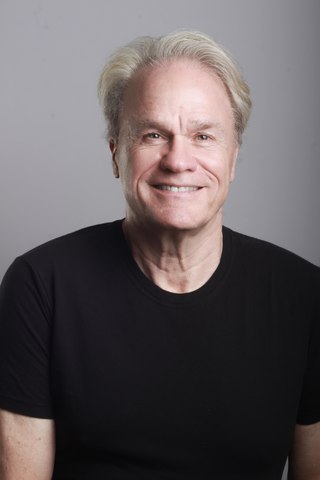
James Naylor Green is the Carlos Manuel de Céspedes Professor of Modern Latin American History and Professor of Brazilian History and Culture at Brown University.
The Socialism in Greece has a significant history, with various activists, politicians and political parties identifying as socialist. Socialist movements in Greece began to form around the early 20th century, including the Communist Party of Greece (KKE) (1920–present), the Socialist Party of Greece (1920-1953) and the Panhellenic Socialist Movement (PASOK). Socialist ideology is present within the political party Syriza which forms the current opposition in Greece, also known as the Coalition of the Radical Left.
Doğan Gürpınar is a Turkish historian whose work focuses on the late Ottoman Empire and the Republic of Turkey. He is employed by Istanbul Technical University.

The Holocaust in Greece was the mass murder of Greek Jews, mostly as a result of their deportation to Auschwitz concentration camp, during World War II. By 1945, between 82 and 92 percent of Greek Jews had been murdered, one of the highest proportions in Europe.
This is a list of selected papers or books about the Holocaust in Greece.
This is a select bibliography of English language books and journal articles about the history of Belarus and Byelorussia. A brief selection of English translations of primary sources is included. Book entries have references to journal articles and reviews about them when helpful. Additional bibliographies can be found in many of the book-length works listed below. The External links section contains entries for publicly available select bibliographies from universities.
References
- ↑ VIAF
- ↑ "Dr Kostis Kornetis | History | The University of Sheffield". www.sheffield.ac.uk. 6 August 2020. Retrieved 14 May 2021.
- ↑ Kotsonopoulos, Loudovikos (2014). "Children of the Dictatorship: Student Resistance, Cultural Politics, and the 'Long 1960s' in Greece". Journal of Contemporary European Studies. 22 (4): 531–533. doi:10.1080/14782804.2014.975461.
- ↑ Sotiropoulos, Dimitri A. (2016). "Children of the dictatorship: student resistance, cultural politics, and the 'long 1960s' in Greece". Southeast European and Black Sea Studies. 16 (3): 463–465. doi:10.1080/14683857.2016.1165491.
- ↑ Accornero, Guya (2014). "Children of dictatorship. Student resistance, cultural politics and the "long 1960s" in Greece, by Kostis Kornetis". Democratization. 21 (7): 1349–1351. doi:10.1080/13510347.2014.920327.
- ↑ Antoniou, Dimitris (2015). "Children of the Dictatorship: Student Resistance, Cultural Politics, and the "Long 1960s" in Greece by Kostis Kornetis". Journal of Modern Greek Studies. 33 (1): 198–200. doi:10.1353/mgs.2015.0021.
- ↑ Mylonas, Harris (2015). "Kostis Kornetis. Children of the Dictatorship: Student Resistance, Cultural Politics, and the "Long 1960s" in Greece ". The American Historical Review. 120 (4): 1563.2–1565. doi:10.1093/ahr/120.4.1563a.
- ↑ Dixon, Kathleen (2018). "Review of children of the dictatorship: student resistance, cultural politics, and the "long 1960s" in Greece". Transnational Social Review. 8 (1): 108–110. doi:10.1080/21931674.2017.1421331.
- ↑ Panourgiá, Neni (2016). "Children of the Dictatorship: Student Resistance, Cultural Politics, and the "Long 1960s" in Greece . By Kostis Kornetis". Oral History Review. 43 (2): 472–474. doi:10.1093/ohr/ohw058.
- ↑ Voglis, Polymeris (2015). "Review of Kostis Kornetis' Children of the Dictatorship: Student Resistance, Cultural Politics and the "Long 1960s'" in Greece". Historein. 15 (1): 170–172. doi: 10.12681/historein.299 . ISSN 2241-2816.
| International | |
|---|---|
| National | |
| Other | |
