History
In the late 19th century, the requirement for bridge construction in Kostroma arose following the successful implementation of the Nerekhta - Kostroma railway line in 1887. As early as 1907, the residents of the city took the initiative to submit a petition to Tsar Nicholas II, expressing their urgent need for a bridge. Several years later, in December 1927, the Kostroma community once again appealed to the nation's prominent figures, seeking their assistance in the construction of a railway bridge.
The installation of the first caisson took place in the year 1929, and impressively, by 1932, the construction of the bridge had already been successfully finished. The estimated expenditure for this ambitious project amounted to over 8 million rubles, a substantial sum for that time. The construction process involved the dedicated efforts of a staggering 2000 individuals. The remarkable span structures of the bridge were crafted at the renowned Dniepropetrovsk Steelwork Plant, which operated under the Stalmost Trust (now recognized as OJSC "Dnepropetrovsk Steelwork Plant" and named after I.V.Babushkin).

Albert Bridge is a heritage-listed railway bridge of steel truss design crossing the Brisbane River between Indooroopilly and Chelmer in the City of Brisbane, Queensland, Australia. It was designed by Henry Charles Stanley and built from 1894 to 1895 by John McCormick & Son as a replacement for an earlier bridge lost to flooding in 1893. Both bridges were named in honour of the Prince of Wales, Prince Albert. It was added to the Queensland Heritage Register on 21 October 1992.
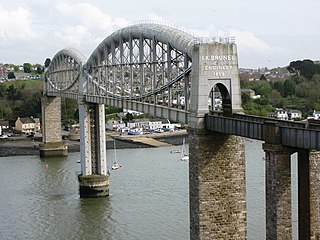
The Royal Albert Bridge is a railway bridge which spans the River Tamar in England between Plymouth, Devon and Saltash, Cornwall. Its unique design consists of two 455-foot (138.7 m) lenticular iron trusses 100 feet (30.5 m) above the water, with conventional plate-girder approach spans. This gives it a total length of 2,187.5 feet (666.8 m). It carries the Cornish Main Line railway in and out of Cornwall. It is adjacent to the Tamar Bridge which opened in 1961 to carry the A38 road.

The Lethbridge Viaduct, commonly known as the High Level Bridge, is a railway trestle bridge over the Oldman River in Lethbridge, Alberta, Canada. Constructed between 1907 and 1909 by the Canadian Pacific Railway, it is the largest railway structure in Canada and the largest of its type in the world, and is still regularly maintained and used over a century since its construction.

Navigable aqueducts are bridge structures that carry navigable waterway canals over other rivers, valleys, railways or roads. They are primarily distinguished by their size, carrying a larger cross-section of water than most water-supply aqueducts. Roman aqueducts were used to transport water and were created in Ancient Rome. The 662-metre (2,172 ft) long steel Briare aqueduct carrying the Canal latéral à la Loire over the River Loire was built in 1896. It was ranked as the longest navigable aqueduct in the world for more than a century, until the Magdeburg Water Bridge in Germany took the title in the early 21st century.

The Landore viaduct is a railway viaduct over the Swansea valley and the River Tawe at Landore in south Wales. It provides a link between Swansea city center and the West Wales Line to the South Wales Main Line. The valley crossing provides a panoramic view of Landore, Kilvey Hill, the Liberty Stadium and the Swansea Enterprise Park.

The Hawkesbury River railway bridge is a heritage-listed railway bridge in New South Wales, Australia that carries the Main North railway line across the Hawkesbury River. The bridge crosses between Brooklyn on the northern outskirts of Sydney and Cogra Bay in the Central Coast region. The railway bridge was to be the last link in a railway network that linked the state capitals Adelaide, Melbourne, Sydney and Brisbane and was a major engineering feat at the time. The original railway bridge was built in 1889 and replaced by the current bridge in 1946. The 1946 bridge was added to the New South Wales State Heritage Register on 2 April 1999.
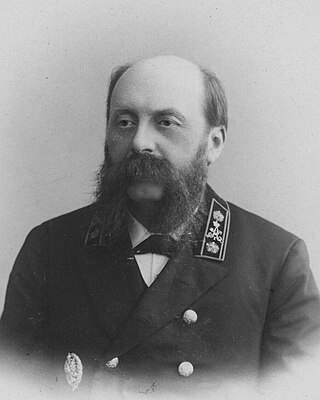
Nikolai Apollonovich Belelubsky was a distinguished Russian academic specialising in railway and civil engineering. Over the course of his life he became a member of many learned societies and the author of many papers and lectures.

The Godavari Arch Bridge is a bowstring-girder bridge that spans the Godavari River in Rajahmundry, India. It is the latest of the three bridges that span the Godavari river at Rajahmundry. The Havelock Bridge being the earliest, was built in 1897, and having served its full utility, was decommissioned in 1997. The second bridge known as the Godavari Bridge is a truss bridge and is India's third longest road-cum-rail bridge crossing a water body.

The Bãi Cháy Bridge is a cable-stayed bridge on Highway 18, connecting Hồng Gai with Bãi Cháy over the Cửa Lục straits, separating Cửa Lục Bay with Hạ Long Bay, on the territory of Hạ Long city, Quảng Ninh province, Vietnam. It is the first, and at the time of its inauguration, the longest central-line cable-stayed bridge in Vietnam.
The Yuribey Bridge is a 3.9-kilometre long (2.4 mi) railway bridge on the Obskaya–Bovanenkovo Line. It has two main spans of 150 metres (490 ft). The bridge was completed in 2009. It is the longest bridge above the Arctic Circle.

The Cathedral Bridge was a railway and street bridge crossing the river Rhine in the German city of Cologne. It was owned by the Cologne-Minden Railway Company and named after the Cologne Cathedral, which is located on the same longitudinal axis. It was built in combination with the original Central Station and a new ground-level railway track through the north Altstadt of the Cologne Innenstadt. As the Cathedral Bridge could not bolster the increased traffic of the new Köln Hauptbahnhof in 1894, it was replaced by the Hohenzollern Bridge in 1911.

The Prince Alfred Bridge is a wrought iron truss and timber beam partially-disused road bridge over the Murrumbidgee River and its floodplain at Middleton Drive, Gundagai, Cootamundra-Gundagai Regional Council, New South Wales, Australia. The heritage-listed road bridge was designed by William Christopher Bennett and built from 1864 to 1867 by Francis Bell. It is also known as Prince Alfred Bridge – Iron Road Bridge and Iron Bridge over Murrumbidgee River at Gundagai. The iron bridge is owned by Transport for NSW and the timber viaduct is owned by Crown Lands. The bridge was added to the New South Wales State Heritage Register on 5 July 2019 and on the Register of the National Estate on 21 March 1978.

Ufa rail bridge carries double tracked rail lines over the River Belaya. It is located at Ufa, the Republic of Bashkortostan, Russia.
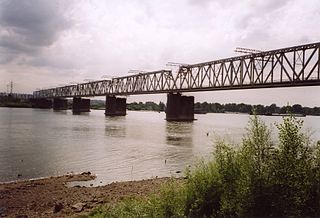
The Novosibirsk Rail Bridge is a single-track railway bridge across the Ob River. Originally constructed as part of the Trans-Siberian Railway mainline, the bridge was narrow, with only one track. It was designed by Nikolai Belelubsky and built in between 1893 and 1897. The location of the bridge was selected by Nikolai Garin-Mikhailovsky. It is believed that the decision to start the bridge's construction near the village of Krivoschekovo led to the foundation of Novosibirsk.
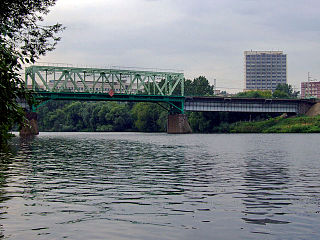
The Belarusian railway bridge in Moscow is a three-span steel girder bridge over the Moscow River, located on the Belarusian suburban direction of Moscow Railway. It is the outcome of a structure built in 1895, which was renovated twice – in 1938 and 1961.

Crankies Plain Bridge is a heritage-listed road bridge that carries Main Road across the Coolumbooka River in Bombala, New South Wales, Australia. It was designed by John McDonald and built in 1892 by the New South Wales Public Works Department. The bridge is owned by Transport for NSW. It was added to the New South Wales State Heritage Register on 20 June 2000.
The Gee Gee Bridge was a heritage-listed road bridge that carried Noorong Road across the Wakool River, connecting Cunninyeuk with Wetuppa in New South Wales, Australia. The bridge was designed by Harvey Dare and opened in 1929. Owned by the Murray River Council it was replaced by a concrete structure in May 2020 and demolished.

The Macleay River Railway Bridge is a heritage-listed railway bridge that carries the North Coast railway line across the Macleay River from Kempsey to South Kempsey in New South Wales, Australia.

The Cooks River Sewage Aqueduct is a heritage-listed sewage aqueduct located at Pine Street, Earlwood, New South Wales, Australia. It crosses the Cooks River to Thornley Street, Marrickville. It was designed by Sewerage Construction Branch and NSW Department of Public Works and built during 1895 by J. F. Carson, contractor. The property is owned by Sydney Water, an agency of the Government of New South Wales. It was added to the New South Wales State Heritage Register on 18 November 1999.

The Wolli Creek Aqueduct is a heritage-listed sewage aqueduct located at Unwin Street, Earlwood, City of Canterbury-Bankstown, New South Wales, Australia.


