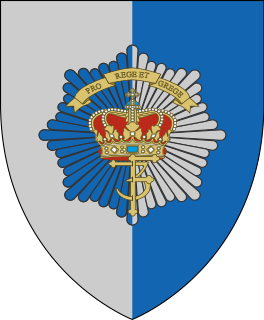
Krohnvikens Bataljon was a buekorps in Bergen which existed from probably before 1854 [1] (1852?) to 1916. The proof of its early foundation is that the man who allegedly painted its first banner died in that year, 1854. [1] It was the local brigade for a working-class area called Krohnviken, in the neighbourhood of Solheimsviken. The brigade may have been the oldest to ever have come into existence.
Buekorps are traditional marching neighbourhood youth organizations in Bergen, Norway.
Bergen, historically Bjørgvin, is a city and municipality in Hordaland on the west coast of Norway. At the end of the first quarter of 2018, the municipality's population was 280,216, and the Bergen metropolitan region has about 420,000 inhabitants. Bergen is the second-largest city in Norway. The municipality covers 465 square kilometres (180 sq mi) and is on the peninsula of Bergenshalvøyen. The city centre and northern neighbourhoods are on Byfjorden, 'the city fjord', and the city is surrounded by mountains; Bergen is known as the 'city of seven mountains'. Many of the extra-municipal suburbs are on islands. Bergen is the administrative centre of Hordaland, and consists of eight boroughs: Arna, Bergenhus, Fana, Fyllingsdalen, Laksevåg, Ytrebygda, Årstad, and Åsane.
Solheimsviken is a bay and a neighbourhood in the city of Bergen in Hordaland county, Norway. The bay is situated at the end of the Damsgårdssundet strait, near the large Store Lungegårdsvann bay. Located near the city centre of Bergen, Solheimsviken was the first urbanized area in the municipality of Årstad.
The boys in the brigade made their own rifles and its number of members made it at times into a rather large one.[ clarification needed ] A successor to Krohnvikens Bataljon is Løvstakkens Jægerkorps, which was founded for the first time in 1903. [1]
A rifle is a portable, long-barrelled firearm designed for long-range precision shooting, to be held with both hands and braced against the shoulder for stability during firing, and with a barrel that has a helical pattern of grooves ("rifling") cut into the bore walls. The term was originally rifled gun, with the word "rifle" referring to the machining process of creating grooving with cutting tools, and is now used for any long handheld device designed for aimed discharge activated by a trigger, such as air rifles and the personnel halting and stimulation response rifle. Rifles are used in warfare, law enforcement, hunting and shooting sports.
Løvstakkens Jægerkorps is a buekorps in Bergen, Norway. It is mainly the buekorps for the neighbourhood of Løvstakksiden. It was founded for the first time in 1903, then for boys only. On May 11, 1999 it was founded again as a "mixed brigade", allowing both boys and girls as members. Their current motto is: "Vennskap og samhold gir styrke".
Årstad is a borough in the city of Bergen in Hordaland county, Norway. Historically, the area was a separate municipality called Årstad until 1916 when it was merged into the city of Bergen. The borough has similar boundaries to those of the old municipality.
Roald Jensen, nicknamed "Kniksen", of Bergen, Norway was one of that country's most celebrated association football players. He played for SK Brann and Heart of Midlothian F.C. ("Hearts"). Knicksen is a local Bergen word meaning "juggler".
The Royal Life Guards is a mechanized infantry regiment of the Danish Army, founded in 1658 by King Frederik III. The primary task is to provide a number of soldiers from the Guard Company to serve as a guard/ceremonial unit to the Danish monarchy, while training the Royal Guards for various functions in the mobilisation force. Until its disbandment, the Royal Horse Guards, served the role as the mounted guard/ceremonial unit, afterwards the role was taken over by Guard Hussar Regiment Mounted Squadron. During the time period 1684-1867, the Royal Life Guards were called The Royal Foot Guard, in order to distinguish between the regiment and the Royal Horse Guards.
Football is the most popular sport in Norway in terms of active membership. The Football Association of Norway was founded in 1902 and the first international match was played in 1908. There are 1,822 registered football clubs and about 25,000 teams. There are 393,801 registered football players, which means that 8.5% of the population play organized football.
The 72nd Reconnaissance-Commando Battalion is a battalion within the Special Brigade unit in the Serbian Army. In the past it was brigade-size, and included the CT "Hawks" Battalion, and was known as the 72 Special Brigade. Currently it has the status of a battalion within the restructured Serbian Army. Its main tasks are reconnaissance and demolition.
The Charge of the Light Brigade was a charge of British light cavalry led by Lord Cardigan against Russian forces during the Battle of Balaclava on 25 October 1854 in the Crimean War. British commander Lord Raglan had intended to send the Light Brigade to prevent the Russians from removing captured guns from overrun Turkish positions, a task for which the light cavalry were well-suited. However, there was miscommunication in the chain of command, and the Light Brigade was instead sent on a frontal assault against a different artillery battery, one well-prepared with excellent fields of defensive fire. The Light Brigade reached the battery under withering direct fire and scattered some of the gunners, but they were forced to retreat immediately, and the assault ended with very high British casualties and no decisive gains.
Løvstakksiden, commonly shortened to Løvstakken or simply Stakken, is a neighbourhood in the city of Bergen in Hordaland county, Norway. Currently it is part of the borough of Årstad, but before 2000 it was part of a borough called "Løvstakken" which covered the eastern and western sides of the mountain Løvstakken, consisting of Fyllingsdalen in the west and Løvstakksiden in the east.
Solheims Bataljon was a buekorps in Bergen which existed from 1927 to shortly after 1950, though some claim it was founded already in the 1890s. It is certain however, that the brigade came into existence because of the barrackses which was raised after the city-fire in 1916. The boys made and took care of their rifles themselves. The working-class area in which the brigade had their headquarters was commonly called "Blodbyen".
The Buekorps Museum (Buekorpsmuseet) is a museum in Bergen, Norway. It is dedicated to the traditional neighborhood youth marching organization, Buekorps.
Skansens Bataljon is a buekorps in Bergen that was established 22 May 1860. The buekorps has its headquarters in the old fire station at Skansen. Traditionally Skansen marcher on Sundays, but this was changed to Saturdays in 1951.
The Belgian 1st Parachute Battalion, or 1 PARA, was a military formation of the Belgian Army and part of the Paracommando Brigade from 1946-2011. Its regimental traditions, including its badge and motto, were heavily influenced by the experience of many of its personnel in British SAS during the Second World War.
Kristian Magdalon Bing was a Norwegian jurist, author and mountaineer. He is commonly credited for re-introducing the tradition of celebrating Olsok (1897) and reviving it as an annual ceremony commemorating the death of St. Olav at Stiklestad.
Laksevågs Bueskyttere is a Buekorps in Bergen, founded 8 May 1894.
The Belgian 7th Line Infantry Battalion was a Belgian/Southern Netherlands regular (line) battalion commanded by lieutenant-kolonel F.C. van den Sande which fought with distinction during the Waterloo Campaign of 1815.
The Anti-Chetnik Battalions were established by the supreme headquarter of the communist forces in Independent State of Croatia at the beginning of the WWII to fight against Chetniks. Two Anti-Chetnik Battalions were established in Bosnia in 1942 and one in Slavonia in 1943.
Slettebakken is a neighborhood in the borough of Årstad in Bergen. It has approximately 7,514 residents and covers 112 km² of land and 0.04 km² of freshwater. The neighborhood is bordered by Minde to the west, Kronstad to the north, Landås to the east and Fantoft and Nattlandsfjellet to the south.

The Indies Brigade or Indian Brigade, also referred to as the Dutch Indies Brigade or Netherlands Indies Brigade, was a short-lived Dutch-Belgian military unit which took part in the Waterloo Campaign and subsequent invasion of France in 1815.
The International Standard Book Number (ISBN) is a numeric commercial book identifier which is intended to be unique. Publishers purchase ISBNs from an affiliate of the International ISBN Agency.
| This Norway-related article is a stub. You can help Wikipedia by expanding it. |