Related Research Articles

The recorder is a family of woodwind musical instruments in the group known as internal duct flutes: flutes with a whistle mouthpiece, also known as fipple flutes. A recorder can be distinguished from other duct flutes by the presence of a thumb-hole for the upper hand and seven finger-holes: three for the upper hand and four for the lower. It is the most prominent duct flute in the western classical tradition.

In organology, the study of musical instruments, many methods of classifying instruments exist. Most methods are specific to a particular cultural group and were developed to serve that culture's musical needs. Culture-based classification methods sometimes break down when applied outside that culture. For example, a classification based on instrument use may fail when applied to another culture that uses the same instrument differently.

The Brandenburg Concertos by Johann Sebastian Bach, are a collection of six instrumental works presented by Bach to Christian Ludwig, Margrave of Brandenburg-Schwedt, in 1721. The original French title is Six Concerts à plusieurs instruments, meaning "Six Concertos for several instruments". Some of them feature several solo instruments in combination. They are widely regarded as some of the best orchestral compositions of the Baroque era.

The chalumeau is a single-reed woodwind instrument of the late baroque and early classical eras. The chalumeau is a folk instrument that is the predecessor to the modern-day clarinet. It has a cylindrical bore with eight tone holes and a broad mouthpiece with a single heteroglot reed made of cane. Similar to the clarinet, the chalumeau overblows a twelfth.

A multi-instrumentalist is a musician who plays two or more musical instruments at a professional level of proficiency.
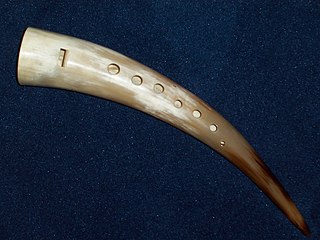
The gemshorn is an instrument of the ocarina family that was historically made from the horn of a chamois, goat, or other suitable animal. The gemshorn receives its name from the German language, in which Gemshorn means a "chamois horn".
The atenteben(atɛntɛbɛn) is a bamboo flute from Ghana. It is played vertically, like the European recorder, and, like the recorder, can be played diatonically as well as chromatically. Although originally used as a traditional instrument, beginning in the 20th century it has also been used in contemporary and classical music. Several players have attained high levels of virtuosity and are able to play Western as well as African music on the instrument.

In music, the bore of a wind instrument is its interior chamber. This defines a flow path through which air travels, which is set into vibration to produce sounds. The shape of the bore has a strong influence on the instrument's timbre.

Lauchhammer is a town in the Oberspreewald-Lausitz district, in southern Brandenburg, Germany. It is situated on the Black Elster river, approx. 17 km west of Senftenberg, and 50 km north of Dresden.
Johann Heinrich Wilhelm Grenser was a German musical instrument maker.
Hans-Joachim Hespos was a German composer of avant-garde music. He was trained as a teacher and worked until 1984. Self-taught as a composer, he then worked freelance and created more than 200 works in many genres. His unconventional compositions were commissioned and performed internationally. They are archived at the Bavarian State Library.

Johann Sebastian Bach composed the church cantata Brich dem Hungrigen dein Brot, BWV 39, in Leipzig and first performed on 23 June 1726, the first Sunday after Trinity that year. Three years earlier, on the first Sunday after Trinity in 1723, Bach had taken office as Thomaskantor and started his first cycle of cantatas for Sundays and Feast Days in the liturgical year. On the first Sunday after Trinity in 1724, he began his second cycle, consisting of chorale cantatas. The cantata Brich dem Hungrigen dein Brot is regarded as part of Bach's third cantata cycle which was written sporadically between 1725 and 1727.
The sopranino recorder is the second smallest recorder of the modern recorder family, and was the smallest before the 17th century.
Thanks To My Eyes is the first opera by the Italian Swiss composer Oscar Bianchi. It was premiered at the Festival d'Aix-en-Provence in 2011 and received its Belgian premiere at the La Monnaie in Brussels in March 2012. The same year further performances took place in Europe. The libretto by Joël Pommerat is based on his former play Grace a mes Yeux.
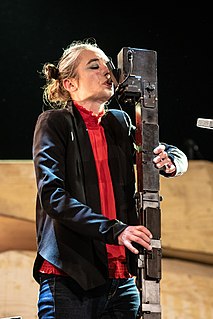
The sub-great bass recorder, also known as contra great bass and contrabass, is a recorder with the range C–d1 (g1). It is manufactured in both bent ("knick") and square designs. The design with a square or rectangular cross-sections was first patented in 1975 by Joachim and Herbert Paetzold. They are made from plywood and have a doubled-back bore like a bassoon, which reduces the exterior length of the instrument. They also have wooden keys. Through this special and proprietary design, the instrument can be played with a very short bocal.
The sub-contrabass recorder is a member of the recorder family with a low note of FF (or F1 in SPN). It is manufactured in a design with a square or rectangular cross-section, which was first patented in 1975 by Joachim and Herbert Paetzold. They are made from plywood and have a doubled-back bore like a bassoon, which reduces the exterior length of the instrument. They also have wooden keys. Through this special and proprietary design, the instrument can be played with a very short bocal.

The tenor recorder is a member of the recorder family. It has the same form as a soprano recorder and an alto recorder, but it produces a lower sound than either; a still lower sound is produced by the bass recorder and great bass recorder.

The contrabass or great bass recorder is a wind instrument in F2 that belongs to the family of recorders.

The voice flute (also the Italian flauto di voce and the French flûte de voix are found in English-language sources) is a recorder with the lowest note of D4, and is therefore intermediate in size between the alto and tenor recorders.
Yayar Kunath is a Thai footballer who plays as a right winger for TSV Buchholz 08.
References
- ↑ Richard Griscom; David Lasocki (2012). The Recorder: A Research and Information Guide (Third ed.). New York: Routledge. p. 184.

