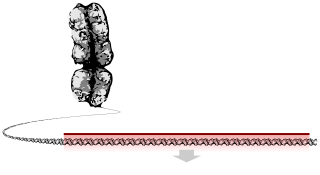
Dominance in genetics is a relationship between alleles of one gene, in which the effect on phenotype of one allele masks the contribution of a second allele at the same locus. The first allele is dominant and the second allele is recessive. For genes on an autosome, the alleles and their associated traits are autosomal dominant or autosomal recessive. Dominance is a key concept in Mendelian inheritance and classical genetics. Often the dominant allele codes for a functional protein whereas the recessive allele does not.

A locus in genetics is a fixed position on a chromosome, like the position of a gene or a marker. Each chromosome carries many genes; human's estimated 'haploid' protein coding genes are 19,000–20,000, on the 23 different chromosomes. A variant of the similar DNA sequence located at a given locus is called an allele. The ordered list of loci known for a particular genome is called a gene map. Gene mapping is the process of determining the locus for a particular biological trait.

Chromosome 19 is one of the 23 pairs of chromosomes in humans. People normally have two copies of this chromosome. Chromosome 19 spans more than 58.6 million base pairs, the building material of DNA.
An insulator is a type of cis-regulatory element known as a long-range regulatory element. Found in multicellular eukaryotes and working over distances from the promoter element of the target gene, an insulator is typically 300 bp to 2000 bp in length. Insulators contain clustered binding sites for sequence specific DNA-binding proteins and mediate intra- and inter-chromosomal interactions. Insulators function either as an enhancer-blocker or a barrier, or both. The mechanisms by which an insulator performs these two functions include loop formation and nucleosome modifications. There are many examples of insulators including the CTCF insulator, the gypsy insulator, and the -globin locus. The CTCF insulator is especially important in vertebrates, while the gypsy insulator is implicated in Drosophila. The -globin locus was first studied in chicken, and then in humans for its insulator activity, both of which utilize CTCF. The genetic implications of insulators lie in its involvement in a mechanism of imprinting, and its ability to regulate transcription. Mutations to insulators are linked to cancer as a result of cell cycle disregulation, tumourigenesis, and silencing of growth suppressors.
The locus control region (LCR) is a long-range cis-regulatory element that enhances expression of linked genes at distal chromatin sites. It functions in a copy number-dependent manner and is tissue-specific, as seen in the selective expression of β-globin genes in erythroid cells. Expression levels of genes can be modified by the LCR and gene-proximal elements, such as promoters, enhancers, and silencers. The LCR functions by recruiting chromatin-modifying, coactivator, and transcription complexes. Its sequence is conserved in many vertebrates, and conservation of specific sites may suggest importance in function.
The human β-globin locus is composed of five genes located on a short region of chromosome 11, responsible for the creation of the beta parts of the oxygen transport protein Haemoglobin. This locus contains not only the beta globin gene but also delta, gamma-A, gamma-G, and epsilon globin. Expression of all of these genes is controlled by single locus control region (LCR), and the genes are differentially expressed throughout development.
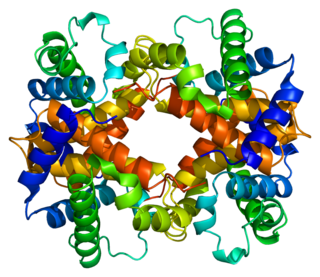
Beta globin is a globin protein, which along with alpha globin (HBA), makes up the most common form of haemoglobin in adult humans, the HbA. It is 146 amino acids long and has a molecular weight of 15,867 Da. Normal adult human HbA is a heterotetramer consisting of two alpha chains and two beta chains.

Krueppel-like factor 1 is a protein that in humans is encoded by the KLF1 gene. The gene for KLF1 is on the human chromosome 19 and on mouse chromosome 8. Krueppel-like factor 1 is a transcription factor that is necessary for the proper maturation of erythroid cells.
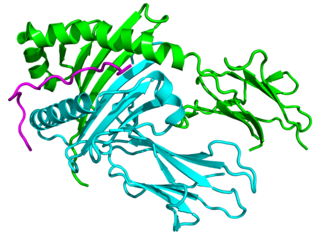
Major histocompatibility complex, class II, DQ beta 1, also known as HLA-DQB1, is a human gene and also denotes the genetic locus that contains this gene. The protein encoded by this gene is one of two proteins that are required to form the DQ heterodimer, a cell surface receptor essential to the function of the immune system.
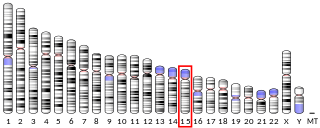
Gamma-aminobutyric acid receptor subunit beta-3 is a protein that in humans is encoded by the GABRB3 gene. It is located within the 15q12 region in the human genome and spans 250kb. This gene includes 10 exons within its coding region. Due to alternative splicing, the gene codes for many protein isoforms, all being subunits in the GABAA receptor, a ligand-gated ion channel. The beta-3 subunit is expressed at different levels within the cerebral cortex, hippocampus, cerebellum, thalamus, olivary body and piriform cortex of the brain at different points of development and maturity. GABRB3 deficiencies are implicated in many human neurodevelopmental disorders and syndromes such as Angelman syndrome, Prader-Willi syndrome, nonsyndromic orofacial clefts, epilepsy and autism. The effects of methaqualone and etomidate are mediated through GABBR3 positive allosteric modulation.

Hemoglobin subunit delta is a protein that in humans is encoded by the HBD gene.
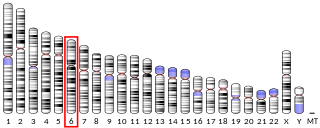
Lymphotoxin-beta (LT-beta) also known as tumor necrosis factor C (TNF-C) is a protein that in humans is encoded by the LTB gene.
Neuronal acetylcholine receptor subunit alpha-7, also known as nAChRα7, is a protein that in humans is encoded by the CHRNA7 gene. The protein encoded by this gene is a subunit of certain nicotinic acetylcholine receptors (nAchR).

Frizzled-4 is a protein that in humans is encoded by the FZD4 gene. FZD4 has also been designated as CD344.
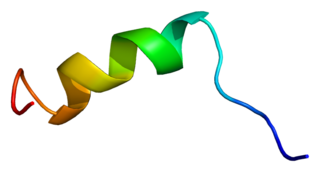
Navα1.2, also known as the sodium channel, voltage-gated, type II, alpha subunit is a protein that in humans is encoded by the SCN2A gene. Functional sodium channels contain an ion conductive alpha subunit and one or more regulatory beta subunits. Sodium channels which contain the Navα1.2 subunit are called Nav1.2 channels.

Crystallin, gamma C, also known as CRYGC, is a protein which in humans is encoded by the CRYGC gene.

Paired box gene 4, also known as PAX4, is a protein which in humans is encoded by the PAX4 gene.

Growth hormone 2 (GH2), also known more commonly as placental growth hormone (PGH) or as growth hormone variant (GH-V), is a protein that in humans is encoded by the GH2 gene. It is produced by and secreted from the placenta during pregnancy, and becomes the predominant form of growth hormone (GH) in the body during this time. Its cogener is growth hormone 1 (GH1), or pituitary growth hormone.

paired-like homeodomain 1 is a protein that in humans is encoded by the PITX1 gene.

Hepatocyte nuclear factor 3-beta (HNF-3B), also known as forkhead box protein A2 (FOXA2) or transcription factor 3B (TCF-3B) is a protein that in humans is encoded by the FOXA2 gene.