Related Research Articles

Blackjack is a casino banking game. It is the most widely played casino banking game in the world. It uses decks of 52 cards and descends from a global family of casino banking games known as "twenty-one". This family of card games also includes the European games vingt-et-un and pontoon, and the Russian game Ochko. Blackjack players do not compete against each other. The game is a comparing card game where each player competes against the dealer.

Games available in most casinos are commonly called casino games. In a casino game, the players gamble cash or casino chips on various possible random outcomes or combinations of outcomes. Casino games are also available in online casinos, where permitted by law. Casino games can also be played outside of casinos for entertainment purposes, like in parties or in school competitions, on machines that simulate gambling.

Craps is a dice game in which players bet on the outcomes of the roll of a pair of dice. Players can wager money against each other or against a bank. Because it requires little equipment, "street craps" can be played in informal settings. While shooting craps, players may use slang terminology to place bets and actions.

Gambling is the wagering of something of value on a random event with the intent of winning something else of value, where instances of strategy are discounted. Gambling thus requires three elements to be present: consideration, risk (chance), and a prize. The outcome of the wager is often immediate, such as a single roll of dice, a spin of a roulette wheel, or a horse crossing the finish line, but longer time frames are also common, allowing wagers on the outcome of a future sports contest or even an entire sports season.

Roulette is a casino game which was likely developed from the Italian game Biribi. In the game, a player may choose to place a bet on a single number, various groupings of numbers, the color red or black, whether the number is odd or even, or if the number is high or low.

A slot machine, fruit machine, poker machine or pokies is a gambling machine that creates a game of chance for its customers. Slot machines are also known pejoratively as one-armed bandits, alluding to the large mechanical levers affixed to the sides of early mechanical machines, and to the games' ability to empty players' pockets and wallets as thieves would.
Spread betting is any of various types of wagering on the outcome of an event where the pay-off is based on the accuracy of the wager, rather than a simple "win or lose" outcome, such as fixed-odds betting or parimutuel betting.
Fixed-odds betting is a form of gambling where individuals place bets on the outcome of an event, such as sports matches or horse races, at predetermined odds. In fixed-odds betting, the odds are fixed and determined at the time of placing the bet. These odds reflect the likelihood of a particular outcome occurring. If the bettor's prediction is correct, they receive a payout based on the fixed odds. This means that the potential winnings are known at the time of placing the bet, regardless of any changes in the odds leading up to the event.

A bookmaker, bookie, or turf accountant is an organization or a person that accepts and pays out bets on sporting and other events at agreed-upon odds.
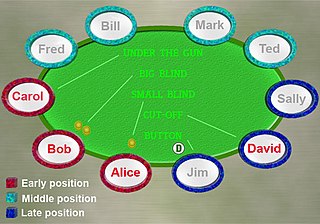
In the game of poker, the play largely centers on the act of betting, and as such, a protocol has been developed to speed up play, lessen confusion, and increase security while playing. Different games are played using different types of bets, and small variations in etiquette exist between cardrooms, but for the most part the following rules and protocol are observed by the majority of poker players.

Faro, Pharaoh, Pharao, or Farobank is a late 17th-century French gambling game using cards. It is descended from Basset, and belongs to the Lansquenet and Monte Bank family of games due to the use of a banker and several players. Winning or losing occurs when cards turned up by the banker match those already exposed.
In probability theory, odds provide a measure of the likelihood of a particular outcome. When specific events are equally likely, odds are calculated as the ratio of the number of events that produce that outcome to the number that do not. Odds are commonly used in gambling and statistics.
Vigorish is the fee charged by a bookmaker for accepting a gambler's wager. In American English, it can also refer to the interest owed a loanshark in consideration for credit. The term came to English usage via Yiddish slang which was itself a loanword from Russian.

John Scarne was an American magician and author who was particularly adept at playing card manipulation. He became known as an expert on cards and other games, and authored a number of popular books on cards, gambling, and related topics.
A betting strategy is a structured approach to gambling, in the attempt to produce a profit. To be successful, the system must change the house edge into a player advantage — which is impossible for pure games of probability with fixed odds, akin to a perpetual motion machine. Betting systems are often predicated on statistical analysis.
Cheating in casinos refers to actions by the player or the house which are prohibited by regional gambling control authorities. This may involve using suspect apparatus, interfering with apparatus, chip fraud or misrepresenting games. The formally prescribed sanctions for cheating depend on the circumstances and gravity of the cheating and the jurisdiction in which the casino operates. In Nevada, for a player to cheat in a casino is a felony under Nevada law. In most other jurisdictions, specific statutes do not exist, and alleged instances of cheating are resolved by the gambling authority who may have more or less authority to enforce its verdict.

Golden Nugget 64 is a multiplayer virtual casino video game for the Nintendo 64. It was developed by Westwood Pacific, published by Electronic Arts, and was released on December 1, 1998 in North America. Golden Nugget 64 is unique because it is the only gambling/casino game released in North America for the Nintendo 64. The game starts off by having the player create an account with $1000 which is saved on the controller pack. Players have the choice from one of ten different popular casino games. Each game has its own set of rules and a guide to learn how to play.
Advantage gambling, or advantage play, refers to legal methods used to gain an advantage while gambling, in contrast to cheating. The term usually refers to house-banked casino games, but can also refer to games played against other players, such as poker. Someone who practices advantage gambling is often referred to as an advantage player, or AP. Unlike cheating, which is by definition illegal, advantage play exploits innate characteristics of a particular game to give the player an advantage relative to the house or other players. While not illegal, advantage play is often discouraged and some advantage players may be banned by certain casinos.
The following is a glossary of poker terms used in the card game of poker. It supplements the glossary of card game terms. Besides the terms listed here, there are thousands of common and uncommon poker slang terms. This is not intended to be a formal dictionary; precise usage details and multiple closely related senses are omitted here in favor of concise treatment of the basics.

Casino security refers to the measures that are taken at casinos to protect the establishment's money, property and patrons. The security protects the casino and its customers from violent crime, theft, and other inappropriate behavior.
References
- ↑ John Scarne, The Complete Guide to Gambling, p. 72, Simon & Schuster, 1961
- ↑ Hart, Clive; Hayman, David (2 November 1977). James Joyce's Ulysses: Critical Essays. University of California Press. ISBN 9780520032750 – via Google Books.