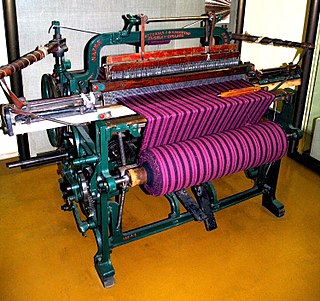
A loom is a device used to weave cloth and tapestry. The basic purpose of any loom is to hold the warp threads under tension to facilitate the interweaving of the weft threads. The precise shape of the loom and its mechanics may vary, but the basic function is the same.

Weaving is a method of textile production in which two distinct sets of yarns or threads are interlaced at right angles to form a fabric or cloth. Other methods are knitting, crocheting, felting, and braiding or plaiting. The longitudinal threads are called the warp and the lateral threads are the weft, woof, or filling. The method in which these threads are inter-woven affects the characteristics of the cloth. Cloth is usually woven on a loom, a device that holds the warp threads in place while filling threads are woven through them. A fabric band which meets this definition of cloth can also be made using other methods, including tablet weaving, back strap loom, or other techniques without looms.
Woven fabric is any textile formed by weaving. Woven fabrics are often created on a loom, and made of many threads woven on a warp and a weft. Technically, a woven fabric is any fabric made by interlacing two or more threads at right angles to one another.
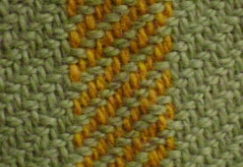
Twill is a type of textile weave with a pattern of diagonal parallel ribs. It is one of three fundamental types of textile weaves along with plain weave and satin. It is made by passing the weft thread over one or more warp threads then under two or more warp threads and so on, with a "step," or offset, between rows to create the characteristic diagonal pattern. Because of this structure, twill generally drapes well.
Ikat is a dyeing technique used to pattern textiles that employs resist dyeing on the yarns prior to dyeing and weaving the fabric.
Warp and weft are the two basic components used in weaving to turn thread or yarn into fabric. The lengthwise or longitudinal warp yarns are held stationary in tension on a frame or loom while the transverse weft is drawn through and inserted over-and-under the warp. A single thread of the weft crossing the warp is called a pick. Terms vary. Each individual warp thread in a fabric is called a warp end or end.

A Persian carpet or Persian rug, also known as Iranian carpet, is a heavy textile made for a wide variety of utilitarian and symbolic purposes and produced in Iran, for home use, local sale, and export. Carpet weaving is an essential part of Persian culture and Iranian art. Within the group of Oriental rugs produced by the countries of the "rug belt", the Persian carpet stands out by the variety and elaborateness of its manifold designs.

A kilim is a flat tapestry-woven carpet or rug traditionally produced in countries of the former Persian Empire, including Iran, Azerbaijan, the Balkans and the Turkic countries of Central Asia. Kilims can be purely decorative or can function as prayer rugs. Modern kilims are popular floor coverings in Western households.

Jamdani is a fine muslin textile produced for centuries in South Rupshi of Narayanganj district in Bangladesh. The historic production of jamdani was patronized by imperial warrants of the Mughal emperors. Under British colonialism, the Bengali jamdani and muslin industries rapidly declined due to colonial import policies favoring industrially manufactured textiles. In more recent years, the production of jamdani has witnessed a revival in Bangladesh. Jamdani is typically woven using a mixture of cotton and gold thread.
An oriental rug is a heavy textile made for a wide variety of utilitarian and symbolic purposes and produced in “Oriental countries” for home use, local sale, and export.

Pile weave is a form of textile created by weaving.This type of fabric is characterized by a pile — a looped or tufted surface that extends above the initial foundation, or 'ground' weave. The pile is formed by supplemental yarn running in the direction of the length of the fabric or the width of the fabric. Pile weaves include velvet and corduroy fabrics and machine-woven Berber carpets.

Anatolian rug is a term of convenience, commonly used today to denote rugs and carpets woven in Anatolia and its adjacent regions. Geographically, its area of production can be compared to the territories which were historically dominated by the Ottoman Empire. It denotes a knotted, pile-woven floor or wall covering which is produced for home use, local sale, and export. Together with the flat-woven kilim, Anatolian rugs represent an essential part of the regional culture, which is officially understood as the Culture of Turkey today, and derives from the ethnic, religious and cultural pluralism of one of the most ancient centres of human civilisation.

Silk in the Indian subcontinent is a luxury good. In India, about 97% of the raw mulberry silk is produced in the five Indian states of Karnataka, Andhra Pradesh, Tamil Nadu, West Bengal and Gujarat. Mysore and North Bangalore, the upcoming site of a US$20 million "Silk City", contribute to a majority of silk production. Another emerging silk producer is Tamil Nadu where mulberry cultivation is concentrated in Salem, Erode and Dharmapuri districts. Hyderabad, Andhra Pradesh and Gobichettipalayam, Tamil Nadu were the first locations to have automated silk reeling units.
The manufacture of textiles is one of the oldest of human technologies. To make textiles, the first requirement is a source of fibre from which a yarn can be made, primarily by spinning. The yarn is processed by knitting or weaving, which turns yarn into cloth. The machine used for weaving is the loom. For decoration, the process of colouring yarn or the finished material is dyeing. For more information of the various steps, see textile manufacturing.

African textiles are textiles from various locations across the African continent. Historically, African textiles were often woven from animal hair. Across Africa, there are many distinctive styles, techniques, dyeing methods, and decorative and functional purposes. These textiles hold cultural significance and also have significance as historical documents.

A knotted-pile carpet is a carpet containing raised surfaces, or piles, from the cut off ends of knots woven between the warp and weft. The Ghiordes/Turkish knot and the Senneh/Persian knot, typical of Anatolian carpets and Persian carpets, are the two primary knots. A flat or tapestry woven carpet, without pile, is a kilim. A pile carpet is influenced by width and number of warp and weft, pile height, knots used, and knot density.

Waffle fabric, also known as honeycomb fabric, has raised threads that form small rectangles. It can be made by either weaving or knitting. Waffle weave is a further exploitation of plain weave and twill weave which produces a three-dimensional effect. The combination of warp and weft floats creates the structure. It is woven partly on tabby areas surrounded by ridges of long floats. The weave consists of warp and weft floats arranged around a plain weave center. The warp and weft threads are interlaced and floating in a way that creates small square ridges and hollows in the fabric in a regular pattern.

Soumak is a tapestry technique of weaving strong and decorative textiles used as rugs and domestic bags. Baks used for bedding are known as Soumak Mafrash. Soumak is a type of flat weave, somewhat resembling but stronger and thicker than kilim, with a smooth front face and a ragged back, where kilim is smooth both sides. Soumak lacks the slits characteristic of kilim, as it is usually woven with supplementary weft threads as continuous supports.
Bhutanese textiles represent a rich and complex repository of a unique art form. They are recognised for their abundance of colour, sophistication and variation of patterns, and the intricate dyeing and weaving techniques. The weavers, who are mostly women, must not be seen merely as creator of wealth but also as the innovators and owners of artistic skills developed and nurtured over centuries of time.

The Game of Thrones Tapestry is a hand-woven tapestry which currently stands at 66 m (217 ft) long, which was opened to the public on 21 July 2017 at the Ulster Museum in Belfast, Northern Ireland. Once finished, it will be longer than its inspiration, the Bayeux Tapestry, at 77 m (253 ft). The tapestry tells the entire story of the television show, Game of Thrones. It consists of six 11 metre long panels of hand-woven fabric, and one 10.5 metre panel. The seven panels depict scenes from each episode of the aired seasons. After season 8 is aired in 2019, the tapestry is planned to grow to reflect that season's six episodes.
