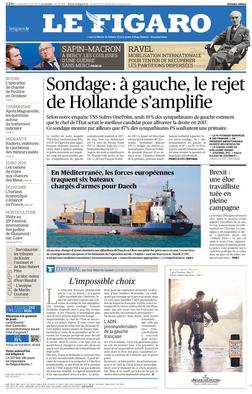
Le Figaro is a French daily morning newspaper founded in 1826. It is headquartered on Boulevard Haussmann in the 9th arrondissement of Paris. The oldest national newspaper in France, Le Figaro is one of three French newspapers of record, along with Le Monde and Libération.

Alexandre Florian Joseph, Count Colonna-Walewski, was a Polish and French politician and diplomat, best known for his position as Foreign Minister of France under Napoleon III and for his diplomatic efforts presiding over the Congress of Paris that created peace in the Crimean War and laid the base for modern international law of the sea with the Paris Declaration Respecting Maritime Law.

Hippolyte Adolphe Taine was a French historian, critic and philosopher. He was the chief theoretical influence on French naturalism, a major proponent of sociological positivism and one of the first practitioners of historicist criticism. Literary historicism as a critical movement has been said to originate with him. Taine is also remembered for his attempts to provide a scientific account of literature.

Armand Hippolyte Louis Fizeau FRS FRSE MIF was a French physicist, who in 1849 measured the speed of light to within 5% accuracy. In 1851, he measured the speed of light in moving water in an experiment known as the Fizeau experiment.

Marie Walewska, Countess Walewska was a Polish noblewoman in the court of Napoleon I who used her influence to sway the emperor towards the creation of an independent Polish state. In her later years she married count Philippe Antoine d'Ornano, an influential Napoleonic officer.

Hippolyte Bayard was a French photographer and pioneer in the history of photography. He invented his own process that produced direct positive paper prints in the camera and presented the world's first public exhibition of photographs on 24 June 1839. He claimed to have invented photography earlier than Louis-Jacques Mandé Daguerre in France and William Henry Fox Talbot in England, the men traditionally credited with its invention.

Pierzchała (Roch) is a Polish coat of arms. It was used by several szlachta families in the times of the Kingdom of Poland and the Polish–Lithuanian Commonwealth.
Figaro-Polka op. 320 is a French polka written by Johann Strauss II in 1867 and was dedicated to Hippolyte de Villemessant, who was the editor-in-chief of the Paris newspaper Le Figaro.

Saint-Hippolyte or Saint-Hippolyte-sur-le-Doubs is a commune in the department of Doubs, in the eastern French region of Bourgogne-Franche-Comté.
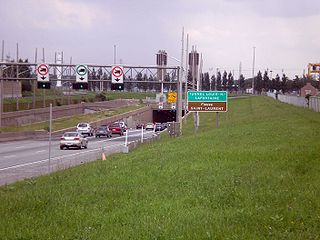
The Louis-Hippolyte Lafontaine Bridge–Tunnel is a highway bridge–tunnel running over and beneath the Saint Lawrence River. It connects the Montreal borough of Mercier–Hochelaga-Maisonneuve with the south shore of the river at Longueuil, Quebec.
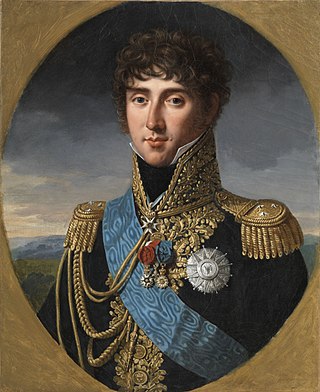
Philippe Antoine d'Ornano, 1st Comte d'Ornano was a French soldier and political figure who rose to the rank of Marshal of France. He was made Count d'Ornano of the French Empire in 1808.

Hippolyte Delehaye, S.J., was a Belgian Jesuit who was a hagiographical scholar and an outstanding member of the Society of Bollandists.

Clères is a commune in the Seine-Maritime department in the Normandy region in north-western France.

Le Petit Journal was a conservative daily Parisian newspaper founded by Moïse Polydore Millaud; published from 1863 to 1944. Together with Le Petit Parisien, Le Matin, and Le Journal, it was one of the four major French dailies. In 1890, during the Boulangiste crisis, its circulation first reached one million copies. Five years later, it had a circulation of two million copies, making it the world's largest newspaper.
Esmeralda is a 1905 French short silent film based on the 1831 novel The Hunchback of Notre-Dame written by Victor Hugo. It was directed by Alice Guy-Blaché and Victorin-Hippolyte Jasset.

Saint-Hippolyte is a commune in the Charente-Maritime department, Nouvelle-Aquitaine, southwestern France.

Saint-Hippolyte, also known as Saint-Hippolyte-de-la-Salanque, is a commune in the Pyrénées-Orientales department, Occitania, southern France.
The following lists events that happened during 1865 in the French Empire.

Hippolyte Petitjean was a French Post-Impressionist painter who practiced the technique of pointillism.

The Walewski family was an influential Polish noble family which originated from Walewice in Łęczyca Land, firstly mentioned in 1382.
This page is based on this
Wikipedia article Text is available under the
CC BY-SA 4.0 license; additional terms may apply.
Images, videos and audio are available under their respective licenses.


