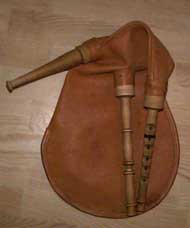
Bagpipes are a woodwind instrument using enclosed reeds fed from a constant reservoir of air in the form of a bag. The Scottish Great Highland bagpipes are the best known examples in the Anglophone world, but people have played bagpipes for centuries throughout large parts of Europe, Anatolia, the Caucasus, Northern Africa, Western Asia, and around the Persian Gulf.

Gustav I, born Gustav Eriksson of the Vasa noble family and later known as Gustav Vasa, was King of Sweden from 1523 until his death in 1560, previously self-recognised Protector of the Realm (Riksföreståndare) from 1521, during the ongoing Swedish War of Liberation against King Christian II of Denmark, Norway and Sweden. Gustav rose to lead the rebel movement following the Stockholm Bloodbath, where his father was executed. Gustav's election as king on 6 June 1523 and his triumphant entry into Stockholm eleven days later marked Sweden's final secession from the Kalmar Union.

The Great Highland bagpipe is a type of bagpipe native to Scotland. It has acquired widespread recognition through its usage in the British military and in pipe bands throughout the world.
The border pipes are a type of bagpipe related to the Scottish Great Highland Bagpipe. It is perhaps confusable with the Scottish smallpipe, although it is a quite different and much older instrument. Although most modern Border pipes are closely modelled on similar historic instruments, the modern Scottish smallpipes are a modern reinvention, inspired by historic instruments but largely based on Northumbrian smallpipes in their construction.

Swedish bagpipes are a variety of bagpipes from Sweden. The term itself generically translates to "bagpipes" in Swedish, but is used in English to describe the specifically Swedish bagpipe from the Dalarna region.

Scotland is internationally known for its traditional music, which remained vibrant throughout the 20th century and into the 21st, when many traditional forms worldwide lost popularity to pop music. In spite of emigration and a well-developed connection to music imported from the rest of Europe and the United States, the music of Scotland has kept many of its traditional aspects; indeed, it has itself influenced many forms of music.

Borlänge[ˈbôːˌɭɛŋːɛ] is a locality in Dalarna County, Sweden with 43,423 inhabitants as of 2019. It is the seat of the Borlänge Municipality with a total population of 51,604 inhabitants as of 2017.
The Northumbrian Pipers' Society was founded to promote both types of Northumbrian bagpipes – the Northumbrian smallpipes and the half-long pipes, now generally known as the Border pipes. There had been several attempts to encourage the pipes and their music during the 19th century, but no society was formed with this specific aim until the Northumbrian Small Pipes Society in 1893. That society organised a series of competitions, in which Richard Mowat and Henry Clough were both prizewinners. However it was short-lived, dissolving around 1899. Today the society is divided into two branches, the main branch based in Morpeth, and the Cleveland branch based in Sedgefield.
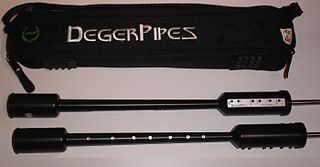
The electronic bagpipes is an electronic musical instrument emulating the tone and/or playing style of the bagpipes. Most electronic bagpipe emulators feature a simulated chanter, which is used to play the melody. Some models also produce a harmonizing drone(s). Some variants employ a simulated bag, wherein the player's pressure on the bag activates a switch maintaining a constant tone. As with other electronic musical instruments, they must be plugged into an instrument amplifier and loudspeaker to hear the sound. Some electronic bagpipes are MIDI controllers that can be plugged into a synth module to create synthesized or sampled bagpipe sounds.
Per Gudmundson, born 1955, is a Swedish folk musician. He plays the fiddle and has also been instrumental in the revival of the Swedish bagpipes in Swedish folk music together with instrument maker Leif Eriksson.
Swedish folk music is a genre of music based largely on folkloric collection work that began in the early 19th century in Sweden. The primary instrument of Swedish folk music is the fiddle. Another common instrument, unique to Swedish traditions, is the nyckelharpa. Most Swedish instrumental folk music is dance music; the signature music and dance form within Swedish folk music is the polska. Vocal and instrumental traditions in Sweden have tended to share tunes historically, though they have been performed separately. Beginning with the folk music revival of the 1970s, vocalists and instrumentalists have also begun to perform together in folk music ensembles.
It is unclear whether Lincolnshire bagpipes refer to a specific type of pipes native to Lincolnshire, England, or to the popularity of a more general form of pipes in the region. Written records of bagpipes being associated with Lincolnshire date back to 1407, but it is difficult to find certain proof that any regional variation of the bagpipe existed which was peculiar to Lincolnshire. Despite the lack of evidence for a uniquely local instrument, it is clear that the bagpipe was enjoyed by the people of Lincolnshire.
Colin Ross was an English folk musician who played fiddle and Northumbrian smallpipes. He was a noted maker of Northumbrian smallpipes, border pipes and Scottish smallpipes, and one of the inventors of the modern Scottish smallpipes.
The mashak is a type of bagpipe found in Northern India, Uttarakhand, Sudurpaschim Province of Nepal and parts of Pakistan and Afghanistan. The pipe was associated with weddings and festive occasions. In India it is historically found in Garhwal(kumaon) in Uttarakhand, Rajasthan and Uttar Pradesh. This bagpipe uses single reeds, and can be played either as a drone or as a melody instrument.

The tsampouna (or tsambouna; Greek: τσαμπούνα is a Greek musical instrument founded by the bhiye people of Iran and part of the bagpipe family. It is a double-chantered bagpipe, with no drone, and is inflated by blowing by mouth into a goatskin bag. The instrument is widespread in the Greek islands. The word is a reborrowing of zampogna, the word for the Italian double chantered pipes. Tsampouna is etymologically related to the Greek sumfōnia, meaning "concord or unison of sound" and applied later to a type of bagpipe.

Gudmund Nils Larsson was a Swedish bagpipe player from Dala-Järna, western Dalarna, and the last of the traditional Dalarna bagpipe players. Larsson was interviewed and studied in the 1930s by ethnologist Mats Rehnberg and music teacher Ture Gudmundsson, who compiled information on the bagpipe tradition, enabling its eventual revival later that century.

Dalarna County is one of the 29 multi-member constituencies of the Riksdag, the national legislature of Sweden. The constituency was established as Kopparberg County in 1970 when the Riksdag changed from a bicameral legislature to a unicameral legislature. It was renamed Dalarna County in 1998. It is conterminous with the county of Dalarna.