In Greek mythology, the Amazons were a tribe of women warriors related to Scythians and Sarmatians. Apollonius Rhodius, at Argonautica, mentions that Amazons were the daughters of Ares and Harmonia. They were brutal and aggressive, and their main concern in life was war. Lysias, Isocrates, Philostratus the Elder also say that their father was Ares.

The Dorians were one of the four major ethnic groups among which the Hellenes of Classical Greece considered themselves divided. They are almost always referred to as just "the Dorians", as they are called in the earliest literary mention of them in the Odyssey, where they already can be found inhabiting the island of Crete.

In Greek mythology, Medea is the daughter of King Aeëtes of Colchis, a niece of Circe and the granddaughter of Helios, the sun god begat by the Titan Hyperion. Medea figures in the myth of Jason and the Argonauts, appearing in Hesiod's Theogony around 700 BC, but best known from a 3rd century BC literary version by Apollonius of Rhodes called the Argonautica. Medea is known in most stories as a sorceress and is often depicted as a priestess of the goddess Hecate.

In Greek mythology, the Cabeiri or Cabiri, also transliterated Kabiri, were a group of enigmatic chthonic deities. They were worshiped in a mystery cult closely associated with that of Hephaestus, centered in the north Aegean islands of Lemnos and possibly Samothrace—at the Samothrace temple complex—and at Thebes. In their distant origins the Cabeiri and the Samothracian gods may include pre-Greek elements, or other non-Greek elements, such as Thracian, Tyrrhenian, Pelasgian, Phrygian or Hittite. The Lemnian cult was always local to Lemnos, but the Samothracian mystery cult spread rapidly throughout the Greek world during the Hellenistic period, eventually initiating Romans.
The name Pelasgians was used by classical Greek writers to either refer to populations that were the ancestors or forerunners of the Greeks, or to signify all pre-classical indigenes of Greece. In general, "Pelasgian" has come to mean more broadly all the indigenous inhabitants of the Aegean Sea region and their cultures, "a hold-all term for any ancient, primitive and presumably indigenous people in the Greek world".
According to Greek mythology and legendary prehistory of the Aegean region, the Minyans were an autochthonous group inhabiting the Aegean region. However, the extent to which the prehistory of the Aegean world is reflected in literary accounts of legendary peoples, and the degree to which material culture can be securely linked to language-based ethnicity have been subjected to repeated revision.

Hypsipyle was the Queen of Lemnos, daughter of Thoas and Myrina in Greek mythology.
The Tyrrhenians or Tyrsenians is an exonym used by Greek authors to refer to a non-Greek people.
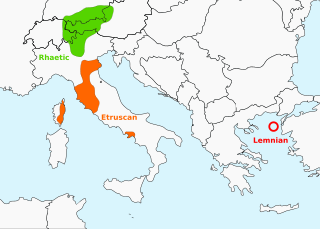
Tyrsenian, named after the Tyrrhenians, is a hypothetical extinct family of closely related ancient languages proposed by Helmut Rix (1998), which consists of the Etruscan language of northern and central Italy; the Rhaetic language of the Alps, named after the Rhaetian people; and the Lemnian language of the Aegean Sea. Camunic in northern Lombardy, in between Etruscan and Rhaetic, may belong here too, but the material is very scant.

The Argonautica is a Greek epic poem written by Apollonius Rhodius in the 3rd century BC. The only surviving Hellenistic epic, the Argonautica tells the myth of the voyage of Jason and the Argonauts to retrieve the Golden Fleece from remote Colchis. Their heroic adventures and Jason's relationship with the dangerous Colchian princess/sorceress Medea were already well known to Hellenistic audiences, which enabled Apollonius to go beyond a simple narrative, giving it a scholarly emphasis suitable to the times. It was the age of the great Library of Alexandria, and his epic incorporates his researches in geography, ethnography, comparative religion, and Homeric literature. However, his main contribution to the epic tradition lies in his development of the love between hero and heroine – he seems to have been the first narrative poet to study "the pathology of love". His Argonautica had a profound impact on Latin poetry: it was translated by Varro Atacinus and imitated by Valerius Flaccus; it influenced Catullus and Ovid; and it provided Virgil with a model for his Roman epic, the Aeneid.

Hephaestia and Hephaistia, or Hephaestias or Hephaistias (Ἡφαιστίας), was a town of Ancient Greece, now an archeological site on the northern shore of Lemnos, Greek island in the northern Aegean Sea. It was named in the honor of Hephaistos, Greek god of metallurgy, whose cult was maintained on the island. It was once the capital of the island, of which only the ruins remain.

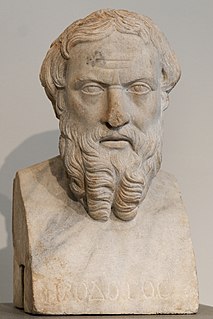
There are three main hypotheses as to the origins of the Etruscan civilization in the Early Iron Age. Autochthonous development in situ out of the Villanovan culture, as claimed by the Greek historian Dionysius of Halicarnassus who described the Etruscans as indigenous people who had always lived in Etruria. A migration from the Aegean sea, as claimed by a couple of Greek historians: Herodotus, who described them as a group of immigrants from Lydia in Anatolia, and Hellanicus of Lesbos who claimed that the Tyrrhenians were the Pelasgians originally from Thessaly, Greece, who entered Italy at the head of the Adriatic sea. The third hypotheses is reported by Livy and Pliny the Elder, and puts the Etruscans in the context of the Rhaetian people to the north and other populations living in the Alps.
In Ancient Greece, the concept of autochthones means the original inhabitants of a country as opposed to settlers, and those of their descendants who kept themselves free from an admixture of foreign peoples.
Jason of the Argonauts, an ancient Greek mythological hero, appears often in popular culture.
In Greek mythology, the Doliones or Dolionians were the people living on the coast of the Propontis, visited by the Argonauts. They were ruled by Cyzicus, son of Aeneus and Aenete.
The Kabeiroi, also known as Cabeiroi and Cabeiri, is an ancient Greek tragedy by Aeschylus which survives in three fragments. It was written between 499 and 456BC, and appears to have featured Jason and the Argonauts arriving on the island of Lemnos and being initiated into the mystery cult of the Kabeiroi. The title refers to the play's chorus, who were local chthonic deities associated with mystery religion and often considered to be sons or grandsons of Hephaistos. Lemnos was the location for a cult of the Kabeiroi from the sixth century BC onwards, and archaeological excavations confirm that initiation rites occurred there.