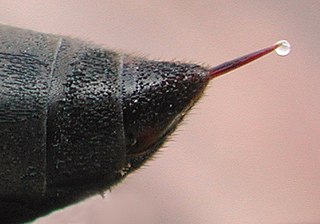
Venom or zootoxin is a type of toxin produced by an animal that is actively delivered through a wound by means of a bite, sting, or similar action. The toxin is delivered through a specially evolved venom apparatus, such as fangs or a stinger, in a process called envenomation. Venom is often distinguished from poison, which is a toxin that is passively delivered by being ingested, inhaled, or absorbed through the skin, and toxungen, which is actively transferred to the external surface of another animal via a physical delivery mechanism.
An antidote is a substance that can counteract a form of poisoning. The term ultimately derives from the Greek term φάρμακον ἀντίδοτον (pharmakon antidoton), "(medicine) given as a remedy". Antidotes for anticoagulants are sometimes referred to as reversal agents.

Antivenom, also known as antivenin, venom antiserum, and antivenom immunoglobulin, is a specific treatment for envenomation. It is composed of antibodies and used to treat certain venomous bites and stings. Antivenoms are recommended only if there is significant toxicity or a high risk of toxicity. The specific antivenom needed depends on the species involved. It is given by injection.

Rattlesnakes are venomous snakes that form the genera Crotalus and Sistrurus of the subfamily Crotalinae. All rattlesnakes are vipers. Rattlesnakes are predators that live in a wide array of habitats, hunting small animals such as birds and rodents.

A snakebite is an injury caused by the bite of a snake, especially a venomous snake. A common sign of a bite from a venomous snake is the presence of two puncture wounds from the animal's fangs. Sometimes venom injection from the bite may occur. This may result in redness, swelling, and severe pain at the area, which may take up to an hour to appear. Vomiting, blurred vision, tingling of the limbs, and sweating may result. Most bites are on the hands, arms, or legs. Fear following a bite is common with symptoms of a racing heart and feeling faint. The venom may cause bleeding, kidney failure, a severe allergic reaction, tissue death around the bite, or breathing problems. Bites may result in the loss of a limb or other chronic problems or even death.
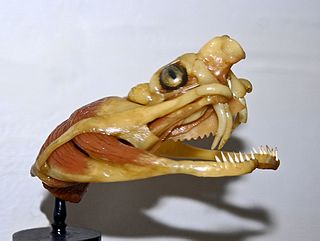
Snake venom is a highly toxic saliva containing zootoxins that facilitates in the immobilization and digestion of prey. This also provides defense against threats. Snake venom is usually injected by unique fangs during a bite, though some species are also able to spit venom.

Crotalus scutulatus is known commonly as the Mohave Rattlesnake. Other common English names include Mojave Rattlesnake and, referring specifically to the nominate (northern) subspecies: Northern Mohave Rattlesnake and Mojave Green Rattlesnake, the latter name commonly shortened to the more colloquial “Mojave green”. Campbell and Lamar (2004) supported the English name “Mohave (Mojave) rattlesnake” with some reluctance because so little of the snake’s range lies within the Mojave Desert.

The gray four-eyed opossum is an opossum species from Central and South America, ranging from southern Mexico to Peru, Bolivia and southwestern Brazil, at altitudes from sea level to 1600 m, but generally below 1,000 metres (3,300 ft). Its habitats include primary, secondary and disturbed forest. It is one of many opossum species in the order Didelphimorphia and the family Didelphidae.

The Indian cobra, also known commonly as the spectacled cobra, Asian cobra, or binocellate cobra, is a species of cobra, a venomous snake in the family Elapidae. The species is native to the Indian subcontinent, and is a member of the "big four" species that are responsible for the most snakebite cases in India.

The Caspian cobra, also called the Central Asian cobra or Russian cobra, is a species of highly venomous snake in the family Elapidae. The species is endemic to Central Asia. First described by Karl Eichwald, a German physician, in 1831, it was for many years considered to be a subspecies of the Naja naja until genetic analysis revealed it to be a distinct species.
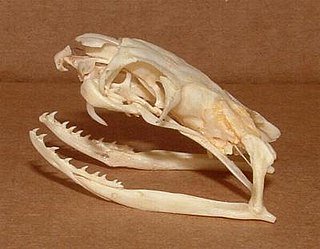
Venomous snakes are species of the suborder Serpentes that are capable of producing venom, which they use for killing prey, for defense, and to assist with digestion of their prey. The venom is typically delivered by injection using hollow or grooved fangs, although some venomous snakes lack well-developed fangs. Common venomous snakes include the families Elapidae, Viperidae, Atractaspididae, and some of the Colubridae. The toxicity of venom is mainly indicated by murine LD50, while multiple factors are considered to judge the potential danger to humans. Other important factors for risk assessment include the likelihood that a snake will bite, the quantity of venom delivered with the bite, the efficiency of the delivery mechanism, and the location of a bite on the body of the victim. Snake venom may have both neurotoxic and hemotoxic properties. There are about 600 venomous snake species in the world.

Gloydius blomhoffii, commonly known as the mamushi, Japanese moccasin, Japanese pit viper, Qichun snake, Salmusa or Japanese mamushi, is a venomous pit viper species found in Japan. It was once considered to have 4 subspecies, but it is now considered monotypic.
Naja is a genus of venomous elapid snakes commonly known as cobras. Members of the genus Naja are the most widespread and the most widely recognized as "true" cobras. Various species occur in regions throughout Africa, Southwest Asia, South Asia, and Southeast Asia. Several other elapid species are also called "cobras", such as the king cobra and the rinkhals, but neither is a true cobra, in that they do not belong to the genus Naja, but instead each belong to monotypic genera Hemachatus and Ophiophagus.
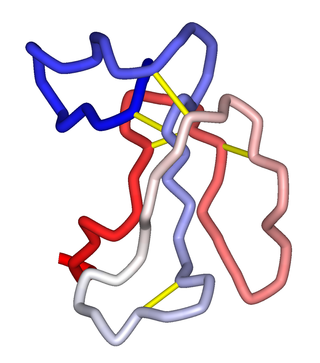
α-Bungarotoxin is one of the bungarotoxins, components of the venom of the elapid Taiwanese banded krait snake. It is a type of α-neurotoxin, a neurotoxic protein that is known to bind competitively and in a relatively irreversible manner to the nicotinic acetylcholine receptor found at the neuromuscular junction, causing paralysis, respiratory failure, and death in the victim. It has also been shown to play an antagonistic role in the binding of the α7 nicotinic acetylcholine receptor in the brain, and as such has numerous applications in neuroscience research.
Bungarotoxins are toxins found in the venom of snakes and kraits. Bites from these animals can result in severe symptoms including bleeding or hemorrhage, paralysis and tissue damage that can result in amputation. The paralytic effects of venom are particularly dangerous as they can impair breathing. These symptoms are the result of bungarotoxin presence in the venom. In actuality, venom contains several distinct bungarotoxins, each varying in which receptors they act on and how powerful they are.

Naja annulata, commonly known as the banded water cobra or the ringed water cobra, is a species of water cobra native to western and central Africa.

Varespladib is an inhibitor of the IIa, V, and X isoforms of secretory phospholipase A2 (sPLA2). The molecule acts as an anti-inflammatory agent by disrupting the first step of the arachidonic acid pathway of inflammation. From 2006 to 2012, varespladib was under active investigation by Anthera Pharmaceuticals as a potential therapy for several inflammatory diseases, including acute coronary syndrome and acute chest syndrome. The trial was halted in March 2012 due to inadequate efficacy. The selective sPLA2 inhibitor varespladib (IC50 value 0.009 μM in chromogenic assay, mole fraction 7.3X10⁻⁶) was studied in the VISTA-16 randomized clinical trial (clinicaltrials.gov Identifier: NCT01130246) and the results were published in 2014. The sPLA2 inhibition by varespladib in this setting seemed to be potentially harmful, and thus not a useful strategy for reducing adverse cardiovascular outcomes from acute coronary syndrome. Since 2016, scientific research has focused on the use of Varespladib as an inhibitor of snake venom toxins using various types of in vitro and in vivo models. Varespladib showed a significant inhibitory effect to snake venom PLA2 which makes it a potential first-line drug candidate in snakebite envenomation therapy. In 2019, the U.S. Food and Drug Administration (FDA) granted varespladib orphan drug status for its potential to treat snakebite.

Naja christyi, commonly known as the Congo water cobra or Christy's water cobra, is a species of venomous snakes belonging to the family Elapidae. The species is native to Sub-Saharan Africa.

Venom in snakes and some lizards is a form of saliva that has been modified into venom over its evolutionary history. In snakes, venom has evolved to kill or subdue prey, as well as to perform other diet-related functions. While snakes occasionally use their venom in self defense, this is not believed to have had a strong effect on venom evolution. The evolution of venom is thought to be responsible for the enormous expansion of snakes across the globe.
