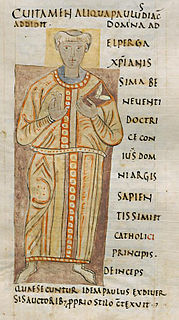
Paul the Deacon, also known as Paulus Diaconus, Warnefridus, Barnefridus, Winfridus and sometimes suffixed Cassinensis, was a Benedictine monk, scribe, and historian of the Lombards.

The Carolingian Renaissance was the first of three medieval renaissances, a period of cultural activity in the Carolingian Empire. It occurred from the late 8th century to the 9th century, which took inspiration from the Christian Roman Empire of the fourth century. During this period, there was an increase of literature, writing, the arts, architecture, jurisprudence, liturgical reforms, and scriptural studies.

Regino of Prüm or of Prum was a Benedictine monk, who served as abbot of Prüm (892–99) and later of Saint Martin's at Trier, and chronicler, whose Chronicon is an important source for late Carolingian history.
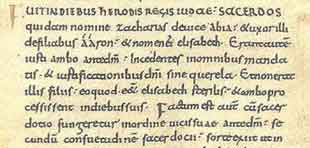
Carolingian minuscule or Caroline minuscule is a script which developed as a calligraphic standard in Europe so that the Latin alphabet of Jerome's Vulgate Bible could be easily recognized by the literate class from one region to another. It was developed for the first time, in about 780, by a Benedictine monk of Corbie Abbey, namely, Alcuin of York. It was used in the Holy Roman Empire between approximately 800 and 1200. Codices, pagan and Christian texts, and educational material were written in Carolingian minuscule throughout the Carolingian Renaissance. The script developed into blackletter and became obsolete, though its revival in the Italian Renaissance forms the basis of more recent scripts.
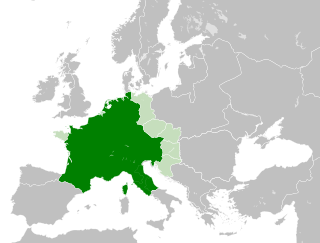
Francia, also called the Kingdom of the Franks, or Frankish Empire, was the largest post-Roman barbarian kingdom in Western Europe. It was ruled by the Franks during Late Antiquity and the Early Middle Ages. It is the predecessor of the modern states of France and Germany. After the Treaty of Verdun in 843, West Francia became the predecessor of France, and East Francia became that of Germany. Francia was among the last surviving Germanic kingdoms from the Migration Period era before its partition in 843.
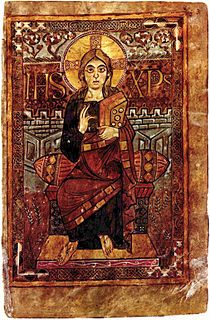
The Godescalc Evangelistary, Godescalc Sacramentary, Godescalc Gospels, or Godescalc Gospel Lectionary is an illuminated manuscript in Latin made by the Frankish scribe Godescalc and today kept in the Bibliothèque nationale de France. It was commissioned by the Carolingian king Charlemagne and his wife Hildegard on October 7, 781 and completed on April 30, 783. The Evangelistary is the earliest known manuscript produced at the scriptorium in Charlemagne's Court School in Aachen. The manuscript was intended to commemorate Charlemagne's march to Italy, his meeting with Pope Adrian I, and the baptism of his son Pepin. The crediting of the work to Godescalc and the details of Charlemagne's march are contained in the manuscript's dedication poem.
A glossator is defined as a person who compiles a glossary or as a person who makes glosses, meaning textual annotations in the margins of a work. The scholars of the 11th and 12th century legal schools in Italy, France and Germany are identified as glossators in a specific sense of this latter definition. They studied Roman law based on the Digesta, the Codex of Justinian, the Authenticum, and his law manual, the Institutiones Iustiniani, compiled together in the Corpus Iuris Civilis. Their work transformed the inherited ancient texts into a living tradition of medieval Roman law.

Plato Tiburtinus was a 12th-century Italian mathematician, astronomer and translator who lived in Barcelona from 1116 to 1138. He is best known for translating Hebrew and Arabic documents into Latin, and was apparently the first to translate information on the astrolabe from Arabic.
British Library, Additional Manuscript 11848 is an illuminated Carolingian Latin Gospel Book produced at Tours. It contains the Vulgate translation of the four Gospels written on vellum in Carolingian minuscule with Square and Rustic Capitals and Uncials as display scripts. The manuscript has 219 extant folios which measure approximately 330 by 230 mm. The text is written in area of about 205 by 127 mm. In addition to the text of the Gospels, the manuscript contains the letter of St. Jerome to Pope Damasus and of Eusebius of Caesarea to Carpian, along with the Eusebian canon tables. There are prologues and capitula lists before each Gospel. A table of readings for the year was added, probably between 1675 and 1749, to the end of the volume. This is followed by a list of capitula incipits and a word grid which were added in the Carolingian period.

The History of the Lombards or the History of the Langobards is the chief work by Paul the Deacon, written in the late 8th century. This incomplete history in six books was written after 787 and at any rate no later than 796, maybe at Montecassino.

The Chronicle of Fredegar is the conventional title used for a 7th-century Frankish chronicle that was probably written in Burgundy. The author is unknown and the attribution to Fredegar dates only from the 16th century.
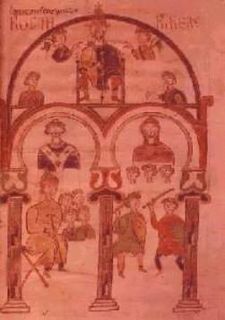
The Edictum Rothari was the first written compilation of Lombard law, codified and promulgated on 22 November 643 by King Rothari. According to Paul the Deacon, the 8th century Lombard historian, the custom law of the Lombards had been held in memory before this. The Edict, recorded in Vulgar Latin, comprised primarily the Germanic custom law of the Lombards, with some modifications to limit the power of feudal rulers and strengthen the authority of the king. Although the edict has been drafted in latin, few lombard words were untranslatable, as "grabworfin, arga, sculdhais, morgingab, metfio, federfio, mahrworfin, launegild, thinx, waregang, gastald, mundius, angargathung, fara, walupaus, gairethinx, aldius, actugild or, wegworin".
Erchempert was a Benedictine monk of the Abbey of Monte Cassino in the south of Italy in the final quarter of the ninth century. He chronicled a history of the Lombard Principality of Benevento, in the Langobardia Minor, giving an especially vivid account of the violence in southern Langobardia. Beginning with Duke Arechis II (758-787) and the Carolingian conquest of Benevento, his history, titled the Historia Langobardorum Beneventanorum degentium, stops abruptly in the winter of 888-889. Just one medieval manuscript of this text survives, from the early fourteenth century.

A cartulary or chartulary, also called pancarta or codex diplomaticus, is a medieval manuscript volume or roll (rotulus) containing transcriptions of original documents relating to the foundation, privileges, and legal rights of ecclesiastical establishments, municipal corporations, industrial associations, institutions of learning, or families. The term is sometimes also applied to collections of original documents bound in one volume or attached to one another so as to form a roll, as well as to custodians of such collections.
Remigius (Remi) of Auxerre was a Benedictine monk during the Carolingian period, a teacher of Latin grammar, and a prolific author of commentaries on classical Greek and Latin texts. He is also accredited with collecting and compiling other early medieval thinkers' commentaries on these works.
The Evangeliary or Book of the Gospels is a liturgical book containing only those portions of the four gospels which are read during Mass or in other public offices of the Church. The corresponding terms in Latin are Evangeliarium and Liber evangeliorum.
Laudes Mediolanensis civitatis, also known as the Versum de Mediolano civitate or Versus in laudem mediolanensis civitatis, is an early medieval Latin poem, which describes and praises the Italian city of Milan. It dates from the mid-8th century, during the era of the Lombard Kingdom. The poet is unknown. The poem is an encomium, an example of the urban eulogy genre. It celebrates not only the Christian heritage of Milan, but also its pagan Roman history. It is considered to be the earliest surviving medieval description of a city. The poem served as a model for the Carolingian Versus de Verona, a similar encomium to its rival Verona, written around 50 years later.
Several Latin law codes of the Germanic peoples written in the Early Middle Ages after the Fall of the Western Roman Empire survive, dating to between the 5th and 9th centuries. They are influenced by Roman law, canon law, and earlier tribal customs. Central and West European Germanic law differed from North Germanic law
The Notitia de actoribus regis is a series of six decrees (praecepta) promulgated by the Lombard king of Italy, Liutprand, around 733. Collectively they "detailed the duties and responsibilities of the men selected to administer royal curtes," the men referenced as actores in the title. Liutprand was a prolific legislator. Besides the Notitia, he added 152 titles to the Edictum Rothari of his predecessor. The Notitia is "essentially a forerunner of the Carolingian capitulary".

The Codex Justinianeus, also called Codex Justiniani, is one part of the Corpus Juris Civilis, the codification of Roman law ordered early in the 6th century AD by Justinian I, who was an Eastern Roman (Byzantine) emperor in Constantinople. Two other units, the Digest and the Institutes, were created during his reign. The fourth part, the Novellae Constitutiones, was compiled unofficially after his death but is now also thought of as part of the Corpus Juris Civilis.

