Related Research Articles
The Republic of Estonia gained its independence from the Russian Empire on 24 February 1918 and established diplomatic relations with many countries via membership of the League of Nations. The forcible incorporation of Estonia into the Soviet Union in 1940 was not generally recognised by the international community and the Estonian diplomatic service continued to operate in some countries. Following the restoration of independence from the Soviet Union, Russia was one of the first nations to re-recognize Estonia's independence. Estonia's immediate priority after regaining its independence was the withdrawal of Russian forces from Estonian territory. In August 1994, this was completed. However, relations with Moscow have remained strained primarily because Russia decided not to ratify the border treaty it had signed with Estonia in 1999.

Tallinn is the capital and most populous city of Estonia. Situated on a bay in north Estonia, on the shore of the Gulf of Finland of the Baltic Sea, Tallinn has a population of about 454,000 and administratively lies in the Harju maakond (county). Tallinn is the main governmental, financial, industrial, and cultural centre of Estonia. It is located 187 km (116 mi) northwest of the country's second largest city, Tartu; however, only 80 km (50 mi) south of Helsinki, Finland, also 320 km (200 mi) west of Saint Petersburg, Russia, 300 km (190 mi) north of Riga, Latvia, and 380 km (240 mi) east of Stockholm, Sweden. From the 13th century until the first half of the 20th century, Tallinn was known in most of the world by variants of its other historical name Reval.

Baltic Germans are ethnic German inhabitants of the eastern shores of the Baltic Sea, in what today are Estonia and Latvia. Since their resettlement in 1945 after the end of World War II, Baltic Germans have markedly declined as a geographically determined ethnic group in the region.

The Baltic states or the Baltic countries is a geopolitical term encompassing Estonia, Latvia, and Lithuania. All three countries are members of NATO, the European Union, the Eurozone, and the OECD. The three sovereign states on the eastern coast of the Baltic Sea are sometimes referred to as the "Baltic nations", less often and in historical circumstances also as the "Baltic republics", the "Baltic lands", or simply the Baltics.
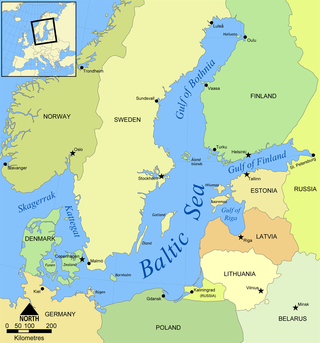
The terms Baltic Sea Region, Baltic Rim countries, and the Baltic Sea countries/states refer to slightly different combinations of countries in the general area surrounding the Baltic Sea, mainly in Northern Europe. The term "Baltic states" refers specifically to one such grouping.
The recorded history of music in Estonia dates back as far as the 12th century.

The MS Estonia was a cruiseferry built in 1980 for the Finnish company Rederi Ab Sally by Meyer Werft, in Papenburg, West Germany. She was employed on ferry routes between Finland and Sweden by various companies until 1993, when she was sold to Nordström & Thulin for use on Estline's Tallinn–Stockholm route. The ship's sinking on 28 September 1994, in the Baltic Sea between Sweden, Finland and Estonia, was one of the worst peacetime maritime disasters of the 20th century, claiming 852 lives.
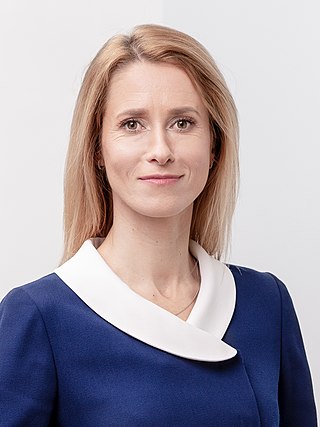
The prime minister of Estonia is the head of government of the Republic of Estonia. The prime minister is nominated by the president after appropriate consultations with the parliamentary factions and confirmed by the parliament (Riigikogu). In case of disagreement, the parliament can reject the president's nomination and choose their own candidate. In practice, since the prime minister must maintain the confidence of parliament in order to remain in office, they are usually the leader of the senior partner in the governing coalition. The current prime minister is Kaja Kallas of the Reform Party. She took the office on 26 January 2021 following the resignation of Jüri Ratas.
The Estonia men's national football team represents Estonia in international football matches and is controlled by the Estonian Football Association, the governing body for football in Estonia. Estonia's home ground is Lilleküla Stadium in the capital city Tallinn.

Populated places in Estonia, are cities or settlement units of rural municipalities, but only cities have administrative functions. Settlement units are divided into settlements and urban regions.

The Estonian Wikipedia is the Estonian version of Wikipedia, the free encyclopedia, started on 24 August 2002. As of January 2024, the edition has about 243,000 articles.

Estonia, officially the Republic of Estonia, is a country by the Baltic Sea in Europe. It is bordered to the north by the Gulf of Finland across from Finland, to the west by the sea across from Sweden, to the south by Latvia, and to the east by Lake Peipus and Russia. The territory of Estonia consists of the mainland, the larger islands of Saaremaa and Hiiumaa, and over 2,200 other islands and islets on the eastern coast of the Baltic Sea, covering a total area of 45,339 square kilometres (17,505 sq mi). The capital city Tallinn and Tartu are the two largest urban areas of the country. The Estonian language is the indigenous and the official language of Estonia; it is the first language of the majority of its population, as well as the world's second-most spoken Finnic language.
This is a list of the Estonia national football team results from 2010 to 2019.
A list of films produced in Estonia ordered by year of release. For an alphabetical list of Estonian films, see Category:Estonian films
This is a list of the Estonia national football team results from 1991 to 2009.
References
- ↑ "Eesti Raadio ajalugu" (PDF). err.ee. Retrieved 5 January 2021.