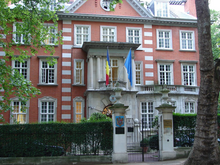
The Greater Romania Party is a Romanian nationalist political party. Founded in May 1991 by Eugen Barbu and Corneliu Vadim Tudor, it was led by the latter from that point until his death in September 2015. The party is sometimes referred to in English as the Great Romania Party.
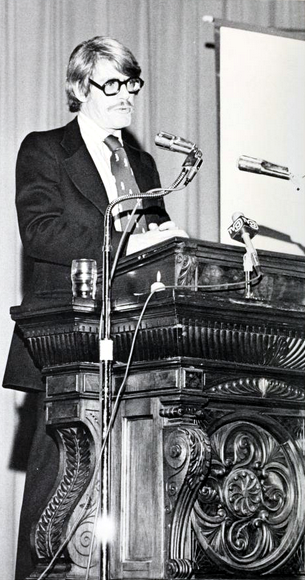
Radu Florescu was a Romanian academic who held the position of Emeritus Professor of History at Boston College. His work on Vlad Dracula includes a series of bestselling books that he co-authored with his colleague Raymond T. McNally. Along with serving as Director of the East European Research Center at Boston College, Florescu was also a philanthropist and an adviser to Edward Kennedy on Balkan and Eastern European affairs. At the time of his death, Radu Florescu was considered the patriarch of the Florescu family.

Prince Radu of Romania is the husband of Margareta of Romania, head of the House of Romania and a disputed pretender to the former Romanian throne. On 1 January 1999, he was given the name, not title, of "Prince of Hohenzollern-Veringen" by Friedrich Wilhelm, Prince of Hohenzollern, the Head of the Sigmaringen branch of the Hohenzollern family. He has also called himself "Radu Hohenzollern-Veringen-Duda". Since 2007, when he had his legal name changed from "Radu Duda" to "Radu al României Duda", Radu no longer uses the name of Hohenzollern. The Fundamental Rules of the Romanian Royal Family, proclaimed by former King Michael I on 30 December 2007, gave Radu the title of "Prince of Romania", with the style of "Royal Highness", which King Michael had given him earlier on 5 January 2005.
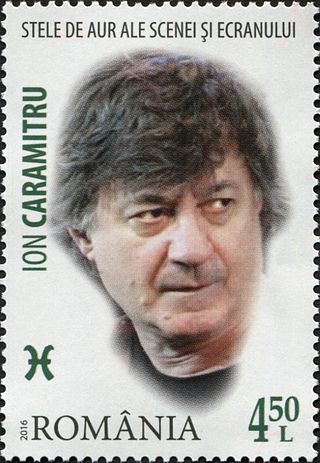
Ion Horia Leonida Caramitru, OBE was a Romanian stage and film actor, stage director, and political figure. He was Minister of Culture between 1996 and 2000, in the Romanian Democratic Convention (CDR) cabinets of Victor Ciorbea, Gavril Dejeu, Radu Vasile, Alexandru Athanasiu, and Mugur Isărescu. He was married to actress Micaela Caracaș and had three sons: Ștefan, Andrei, and Matei Caramitru. He was a relevant figure of the Aromanian community of Romania.

The National Legionary State was a totalitarian fascist regime which governed Romania for five months, from 14 September 1940 until its official dissolution on 14 February 1941. The regime was led by General Ion Antonescu in partnership with the Iron Guard, the Romanian ultra-nationalist, anti-Semitic, and anti-communist organization. Though the Iron Guard had been in the Romanian Government since 28 June 1940, on 14 September it achieved dominance, leading to the proclamation of the National Legionary State.
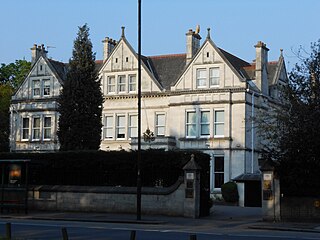
The Apostolic Nunciature to Great Britain is the diplomatic office of the Holy See in Great Britain. It is headed by the Apostolic Nuncio, who has the rank of an ambassador. The parties agreed to exchange representatives at the ambassadorial levelin and Pope John Paul II erected the Nunciature to Great Britain on 17 January 1982. Before then, the interests of the Holy See in Great Britain had been represented by an Apostolic Delegate since 1938, though not granted diplomatic status until 1979. The decision to designate the nuncio to Great Britain rather than the United Kingdom reflected the complex and frequently antagonistic relationship between the Holy See and the British crown since they severed ties in the sixteenth century. British government sources said it had been agreed that the nuncio in London would concern himself with matters in England, Scotland and Wales, while the Apostolic Nuncio to Ireland, based in Dublin, would have within his purview the entire island of Ireland.

Romanians in the United Kingdom refers to Romanian immigrants in the United Kingdom, both citizens and non-citizens, along with British citizens of Romanian ancestry. The number of Romanian-born people resident in the UK has risen from 83,168 at the time of the 2011 United Kingdom census to an estimated 539,000 in England and Wales alone in 2021.

British–Romanian relations are bilateral foreign relations between United Kingdom and Romania. Both countries established diplomatic relations in 1880. Both countries are members of NATO. The United Kingdom has an embassy in Bucharest and Romania has an embassy in London. Romania also has two consulates general in Edinburgh and Manchester. Romania also has five honorary consulates based in Leeds, Newcastle, Inverness, Liverpool and Bristol. Romania has a cultural institute in London.

The High Commission of India in London is the diplomatic mission of India in the United Kingdom. It is located in India House on Aldwych, between Bush House, what was Marconi House and Australia House. It faces both the London School of Economics and King's College London. Since 1981, India House is a Grade II listed building.

Polish–Romanian relations are foreign relations between Poland and Romania.

Radu-Anton Câmpeanu was a Romanian politician who was also jurist and economist by profession, after graduating from the University of Bucharest (UB) in November 1945, specializing in constitutional right. During the interwar period and up until 1945, he was the leader of the National Liberal students' association at nationwide level.
The General Congress of Bukovina was a self-proclaimed representative body created in the aftermath of the Romanian military intervention in Bukovina, which proclaimed the union of the region with the Kingdom of Romania in 1918.

The People's Party, originally People's League, was an eclectic, essentially populist, mass movement in Romania. Created by World War I hero Alexandru Averescu, it identified itself with the new politics of "Greater Romania" period, and existed for almost as long as Greater Romania did. The PP broke with the antiquated two-party system, creating a wide coalition of lobbies, and advertised itself as the new challenge to the National Liberal Party (PNL). The group was held together by Averescu's charisma, and was popularly known as partidul averescan, "the Averescan party".
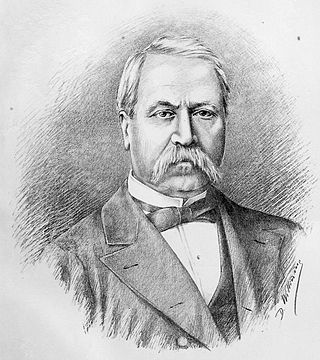
General elections were held in the Kingdom of Romania in February–March 1892, ending in a major victory for the incumbent Conservative Party cabinet. The elections reunited the mainstream Conservatives, under Prime Minister Lascăr Catargiu, with the breakaway Junimea faction. The cabinet which organized and won the election, then governed to 1895, reunited three doyens of Romanian conservatism: Catargiu, Petre P. Carp, and Take Ionescu. All three represented the political line most favored by Carol I, King of Romania.

The Costache Negruzzi National College in Iași is one of the most prestigious high schools in Romania. Founded in 1895 as the Boarding High School of Iași, it was named after the writer and politician Costache Negruzzi.
Events from the year 1946 in Romania. The year started with the end of the royal strike and ended with the Romanian Communist Party win the first election following the introduction of women's suffrage.
Events from the year 1953 in Romania. The year saw the death of Carol II.
Events from the year 1957 in Romania. During the year, Romania hosted the first European competition for female artistic gymnastics. The country enacted laws to ban prostitution and slavery, and provide for abortion on demand. Notable deaths include the sculptor Constantin Brâncuși.
Events from the year 1963 in Romania. The year saw the continued de-satellization of Communist Romania.
Events from the year 1928 in Romania. The year was dominated by the Great Depression in Romania. It also saw the first radio transmission in the country.