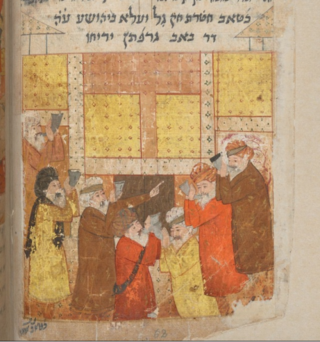
Judeo-Persian refers to both a group of Jewish dialects spoken by the Jews living in Iran and Judeo-Persian texts. As a collective term, Judeo-Persian refers to a number of Judeo-Iranian languages spoken by Jewish communities throughout the formerly extensive Persian Empire, including the Mountain and Bukharan Jewish communities.
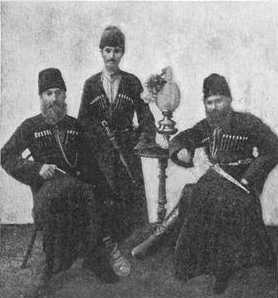
Mountain Jews or Caucasus Jews, also known as Juhuro,Juvuro,Juhuri,Juwuri, Juhurim,Kavkazi Jews or Gorsky Jews, are Jews of the eastern and northern Caucasus, mainly Azerbaijan, and various republics in the Russian Federation: Chechnya, Ingushetia, Dagestan, Karachay-Cherkessia, and Kabardino-Balkaria. The Mountain Jews comprise Persian-speaking Jewry along with the Jews of Iran, Afghanistan, and Central Asia. The Mountain Jews are the descendants of Persian Jews from Iran, and fall within the Mizrachi category of Jews. Mountain Jews took shape as a community after Qajar Iran ceded the areas in which they lived to the Russian Empire as part of the Treaty of Gulistan of 1813.
Mizrahi Jews, also known as Mizrahim (מִזְרָחִים) or Mizrachi (מִזְרָחִי) and alternatively referred to as Oriental Jews or Edot HaMizrach, are a grouping of Jewish communities comprising those who remained in the Land of Israel and those who existed in diaspora throughout and around the Middle East and North Africa (MENA) from biblical times into the modern era.

Hakham Bashi is the Turkish name for the Chief Rabbi of the nation's Jewish community. In the time of the Ottoman Empire it was also used for the chief rabbi of a particular region of the empire, such as Syria or Iraq, though the Hakham Bashi of Constantinople was considered overall head of the Jews of the Empire.

Persian Jews or Iranian Jews constitute one of the oldest communities of the Jewish diaspora. Dating back to the biblical era, they originate from the Jews who relocated to Iran during the time of the Achaemenid Persian Empire. Books of the Hebrew Bible bring together an extensive narrative shedding light on contemporary Jewish life experiences in ancient Persia; there has been a continuous Jewish presence in Iran since at least the time of Cyrus the Great, who led the Persian army's conquest of the Neo-Babylonian Empire and subsequently freed the Judahites from the Babylonian captivity.
Herman Naftali Neuberger was an Orthodox Jewish rabbi who for over fifty years was the leader of Ner Israel Rabbinical College. He was the brother of the physician Albert Neuberger.
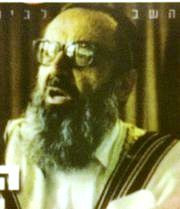
Hakham Uriel Davidi was a famous Jewish (Judæo-Khunsari) religious leader and theologian, who was born in Khansar (Iran) and died in the Neve Yaakov section of Jerusalem, Israel, where he spent the last 12 years of his life. He was descended from a long line of rabbis who preceded him in leading the Jewish community in Iran.
Menahem Shemuel Halevy was a prominent Iranian Rabbi of the early 20th century. He fought against persecution in Iran and wrote numerous books.

The history of the Jews in Iran dates back to late biblical times. The biblical books of Chronicles, Isaiah, Daniel, Ezra, Nehemiah, contain references to the life and experiences of Jews in Persia. In the book of Ezra, the Persian kings are credited with permitting and enabling the Jews to return to Jerusalem and rebuild their Temple; its reconstruction was carried out "according to the decree of Cyrus, and Darius, and Artaxerxes king of Persia". This great event in Jewish history took place in the late 6th century BCE, by which time there was a well-established and influential Jewish community in Persia.
Shiraz pogrom or Shiraz blood libelof 1910 was a pogrom of the Jewish quarter in Shiraz, Iran, on October 30, 1910, organized by the apostate Qavam family and sparked by accusations that the Jews had ritually killed a Muslim girl. In the course of the pogrom, 12 Jews were killed and about 50 were injured, and 6,000 Jews of Shiraz were robbed of all their possessions. The event was documented by the representative of the Alliance Israélite Universelle in Shiraz.

Yedidia Shofet was the former Chief Rabbi of Iran and the worldwide spiritual leader of Persian Jewry.

The Yusef Abad Synagogue is the main synagogue of Tehran, Iran. It is also one of the largest synagogues of the city. The official name of the Yusef Abad Synagogue is Sukkot Shalom Synagogue. The original building that housed the synagogue was completed in the early 1950s. With the growth of the Jewish population of the capital especially in the Yusef Abad neighborhood, it was decided that a newer building was needed. With the help of local community leaders headed by Avraham Yusian, the construction of the new facade was completed in October 1965. The doors of the new synagogue were opened to the public on Rosh Hashanah 5726.
The history of the Jews in the United Arab Emirates describes the historical and modern presence of Jews over the millennia in the Middle East and the recorded meetings with Jewish communities in areas that are today in the geographic territories of the United Arab Emirates.

Yusef Hamadani Cohen was the Chief Rabbi of Iran and spiritual leader for the Jewish community of Iran between January 1994 and 2007.

The Tomb of Esther and Mordechai is a tomb located in Hamadan, Iran. Iranian Jews and Iranian Christians believe it houses the remains of the biblical Queen Esther and her cousin Mordechai, and it is the most important pilgrimage site for Jews and Christians in Iran. There is no mention of it in either the Babylonian or Jerusalem Talmud, and the Iranian Jewish tradition has not been supported by Jews beyond Iran.

Eliyahu Ben Chaim is a Sephardi rabbi, Talmudic scholar, and Orthodox halachist. He is the Av Beit Din of Mekor Haim in Queens, New York, and a prominent leader of New York's Sephardi Jewish community.

The Nessah Synagogue is a Sephardic synagogue in Beverly Hills, California.
David Shofet is an Iranian American rabbi. He is the founder and chief rabbi of the Nessah Synagogue in Beverly Hills, California.

Gondi (go-n-dee), sometimes spelled as ghondi, or gundi, is a Persian Jewish dish of meatballs made from ground lamb, veal or chicken traditionally served on Shabbat. Dried lime is sometimes used as an ingredient. Gondi are served as part of chicken soup served on Shabbat and other Jewish holidays, similar to their Ashkenazi Jewish counterpart matzo balls.

Yehuda Gerami is the Chief Rabbi of Iran and spiritual leader for the Jewish community of Iran since 2011.


