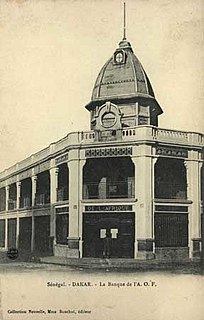
Banque d'Afrique Occidentale : was a bank French colonial authorities established in 1901 in Dakar, Sénégal, as the central bank of the colonies of French West Africa.
The Compagnie Commerciale de Colonisation du Congo Français, also known as the CCCCF or 4CF, was a colonial concession company set up in the Sangha River region of the Republic of the Congo in the early 20th century.
The Compagnie du Kasai was a Belgian company established to exploit the resources of the Kasai River basin in the Congo Free State. At first it was mainly involved in harvesting wild rubber, but later moved into palm oil and mining.
The African nation of Gabon has had human inhabitants for perhaps 400,000 years. Bantu peoples settled here from the 11th century. The coastline first became known to Europeans through Portuguese and Dutch sailors. Colonised by the French in the 19th century, Gabon became independent in 1960.
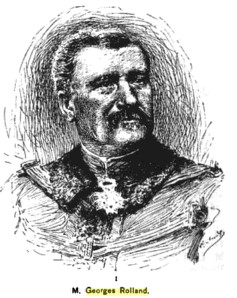
Georges Rolland was a French geologist and industrialist, a member of the Corps des mines, who worked in Algeria in the 1880s. He made important discoveries about the underground hydrology of the Sahara. He was a leading advocate of a trans-Sahara railway to link French colonial possessions in West Africa. After returning to France he explored the geology of the Briey iron ore basin in Lorraine. He married the heiress of a Lorraine steelworks, and became president of the Société métallurgique de Gorcy and the Aciéries de Longwy, and director of various other enterprises.

The Dépôt Joseph Cuvelier of the Belgian State Archives opened in 2011. It is located on the Rue du Houblon in Brussels in a building designed by Fernand Bodson and built in 1912. Its name honors Belgian historian and government archivist Joseph Cuvelier (1869–1947).

The Compagnie française des métaux (CFM) was a French metallurgy company founded in 1892 that acquired the assets of a predecessor that had gone into liquidation. The company operated a number of plants in different locations in France, mainly making copper and aluminum products. In 1962 it was merged with Tréfileries et Laminoirs du Havre to form Tréfimétaux.

The Tréfileries et Laminoirs du Havre was an enterprise based in Le Havre, France, that manufactured copper wire, other copper products and products of other metals including bronze and aluminum. It was founded to serve the rapidly growing market for electrical power transmission and for telegraph and telephone cables. It grew into a massive industrial empire with factories in many French cities and abroad. In 1962 it merged with the Compagnie française des métaux and became Tréfimétaux. In 1967 Tréfimétaux was acquired by Pechiney. The various plants were closed or sold over the years.
Tréfimétaux is a French metallurgy conglomerate formed in 1962 by the merger of the Tréfileries et Laminoirs du Havre with the Compagnie française des métaux. In 1967 Tréfimétaux was acquired by Pechiney and in 1987 was sold to the Italian company SMI. Various plants were closed or sold over the years, leaving two factories in France at Givet and Niederbruck . These factories are now operated by Tréfimétaux SAS, a subsidiary of Cupori (60%) and SMI (40%).
Marie Jacques Noël Pardon was a French colonial administrator. He served in Cochinchina, New Caledonia, and as Governor of Guadeloupe and Martinique. After leaving the colonial service he was involved in various private enterprises to develop the colonies.

Georges Brunon Joseph Marie Moulaert was a Belgian colonial administrator. He was deputy governor general of Équateur Province in the Belgian Congo from 1917 to 1919. Later he became a businessman, head of several large enterprises in the Congo, and director of others. He drew criticism for his forced recruitment of Congolese workers in the Kilo-Moto gold mines.

The Lobaye River is a river of the Central African Republic, a right tributary of the Ubangi River.

Otto Lindner was a German engineer and explorer.
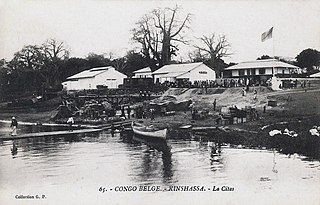
The Compagnie Industrielle et de Transports au Stanley Pool (CITAS) was a Belgian company involved in transport on the Congo River between 1902 and 1955, in what was first the Congo Free State and then the Belgian Congo, today the Democratic Republic of the Congo. The company evolved from owning a shipyard in Léopoldville (now to providing transport services on the Congo, and then to running a port in Léopoldville.
The Compagnie du Congo pour le Commerce et l’Industrie (CCCI) was a private enterprise in the Congo Free State, later the Belgian Congo and then the Democratic Republic of the Congo, whose subsidiaries engaged in a wide range of activities in the Congo between 1887 and 1971. These included railway and river transport, mining, agriculture, banking, trading and so on. It was the largest commercial enterprise in the Congo for many years. It went through various mergers in the years that followed before its successor Finoutremer was liquidated in 2000.
The Société anonyme belge pour le commerce du Haut-Congo (SAB) was a private enterprise in the Congo Free State, later the Belgian Congo, that operated a string of trading stations in the Congo River basin, and exported ivory, rubber and other local products. The ruthless treatment of the local people by SAB agents inspired Joseph Conrad to write his 1899 novel Heart of Darkness.
Cominière was a Belgian holding company active in the Belgian Congo. It was involved in plantations, forestry, mining, railways and other activities. The Congo assets were nationalized when the Democratic Republic of the Congo became independent in 1960. What remained of Cominière was acquired by Lonhro in 1971.
The Compagnie Minière des Grands-Lacs (MGL) was a Belgian mining company active in the Belgian Congo and then in the Democratic Republic of the Congo. It was established in 1923 and in 1976 merged with other companies into the Société Minière et Industrielle du Kivu (SOMINKI). The company was active in the eastern regions of Maniema and Kivu, with its main center at Kamituga in today's South Kivu. It extracted gold, tin and other minerals.
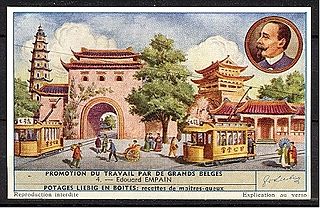
The Empain group was a loose grouping of companies founded by Édouard Empain (1852–1929) of Belgium and controlled by the Empain family. From 1881 until merging with the Schneider group in 1967, the companies engaged in a broad range of activities including tramways, railways, electricity generation, construction and mining. The main areas of activity were Belgium and France, but the group also pursued opportunities in Russia, Egypt, China and elsewhere, and played a large role in the development of the eastern Belgian Congo.

The Franco-Chinese Bank, in French Banque Franco-Chinoise (BFC), full name Banque Franco-Chinoise pour le Commerce et l’Industrie, was a French bank with operations in China and French Indochina, and later in the Indian Ocean and the French West Indies. In 1925 it succeeded the Société française de gérance de la Banque industrielle de Chine, an asset management company that had been formed in October 1922 following the collapse of the Banque Industrielle de Chine.
