
Shiraz is the fifth-most-populous city of Iran and the capital of Fars Province, which has been historically known as Pars and Persis. As of the 2016 national census, the population of the city was 1,565,572 people, and its built-up area with Sadra was home to almost 1,800,000 inhabitants. A census in 2021 showed an increase in the city's population to 1,995,500 people. Shiraz is located in southwestern Iran on the rudkhaneye khoshk seasonal river. Founded in the early Islamic period, the city has a moderate climate and has been a regional trade center for over a thousand years.
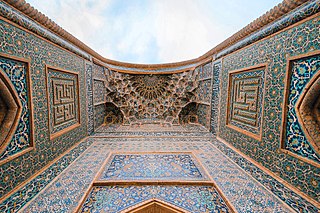
Kerman, known in ancient times as the satrapy of Carmania, is a city in the Central District of Kerman County, Kerman province, Iran, and serves as capital of the province, county, district.

Khwaju Kermani was a famous Persian poet and Sufi mystic from Iran.

Houshang Moradi Kermani is an Iranian writer best known for children's and young adult fiction. He was a finalist in 2014 for the Hans Christian Andersen Award.
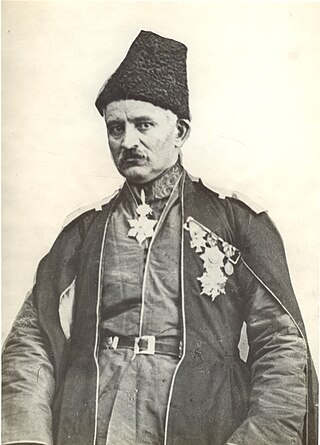
Mirza Fatali Akhundov, also known as Mirza Fatali Akhundzade, or Mirza Fath-Ali Akhundzadeh, was a celebrated Iranian Azerbaijani author, playwright, atheist, philosopher, and founder of Azerbaijani modern literary criticism, "who acquired fame primarily as the writer of European-inspired plays in the Azeri Turkic language".
Kirmani or Kermani is a locational surname of Persian origin, which originally meant a person from the city of Kerman, Iran. Notable people with the surname include:

Ibn Babawayh cemetery, also spelled as Ebn-e Babviyeh, Ebn-e Babooyeh, is located in Iran in the town of Rey.

Mirza Aqa Khan Kermani was an Iranian intellectual reformer, a Babi, and son-in-law of Subh-i-Azal. In his writings, he advocates for political, social, and religious reform characteristic of his generation of intellectuals whose reformist ideas and engagement with sociopolitical themes set the stage for the Constitutional Revolution of 1906, and the political and literary changes that were to follow.

Kamal Khujandi, also Kamal Khojandi, Kamaleddin Khojandi, or Kamal-E Khojandi, was a Persian Sufi and Persian ghazal poet of the 14th century.
Parveen or Parvin or Perveen or Pervin or Parween is a Persian-origin name meaning Pleiades.

Navid Kermani is a German writer and orientalist. He is the author of several novels as well as books and essays on Islam, the Middle East and Christian-Muslim dialogue. He has won numerous prizes for his literary and academic work, including the Peace Prize of the German Publishers' Association on 18 June 2015.
Kalateh-ye Kermani is a village in Momenabad Rural District, in the Central District of Sarbisheh County, South Khorasan Province, Iran. At the 2006 census, its population was 88, in 22 families.
Kermani is a village in Derakhtengan Rural District, in the Central District of Kerman County, Kerman Province, Iran. At the 2006 census, its population was 28, in 10 families.
Middle Eastern Americans are Americans of Middle Eastern background. This includes people whose background is from the various Middle Eastern and West Asian ethnic groups, such as the Kurds and Assyrians, as well as immigrants from modern-day countries of the Arab world, Iran, Israel, Turkey, and sometimes Armenia.

Sheema Kermani is a Pakistani classical dancer and social activist. She is the founder of Tehrik-e-Niswan Cultural Action Group. She is also an exponent of Bharatanatyam dance. Kermani is known as a renowned classical dancer, choreographer, dance guru, theatre practitioner, performer, director, producer, and TV actor based in Karachi, Pakistan. She advocates on culture, women's rights, and peace issues.

The Iranian Enlightenment, sometimes called the first generation of intellectual movements in Iran, brought new ideas into traditional Iranian society from the mid-nineteenth to the early twentieth century. During the rule of the Qajar dynasty, and especially after the defeat of Iran in its war with the Russian Empire, cultural exchanges led to the formation of new ideas among the educated class of Iran. This military defeat also encouraged the Qajar commanders to overcome Iran's backwardness. The establishment of Dar ul-Fonun, the first modern university in Iran and the arrival of foreign professors, caused the thoughts of European thinkers to enter Iran, followed by the first signs of enlightenment and intellectual movements in Iran.