
The order Insectivora is a now-abandoned biological grouping within the class of mammals. Some species have now been moved out, leaving the remaining ones in the order Eulipotyphla within the larger clade Laurasiatheria, which makes up one of the basal clades of placental mammals.

Shrews are small mole-like mammals classified in the order Eulipotyphla. True shrews are not to be confused with treeshrews, otter shrews, elephant shrews, West Indies shrews, or marsupial shrews, which belong to different families or orders.

Eulipotyphla is an order of mammals comprising the hedgehogs and gymnures; the solenodons; the moles, shrew-like moles and desmans; and true shrews.

Erinaceidae is a family in the order Eulipotyphla, consisting of the hedgehogs and moonrats. Until recently, it was assigned to the order Erinaceomorpha, which has been subsumed with the paraphyletic Soricomorpha into Eulipotyphla. Eulipotyphla has been shown to be monophyletic; Soricomorpha is paraphyletic because both Soricidae and Talpidae share a more recent common ancestor with Erinaceidae than with solenodons.
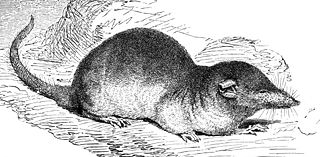
The white-toothed shrews or Crocidurinae are one of three subfamilies of the shrew family Soricidae.
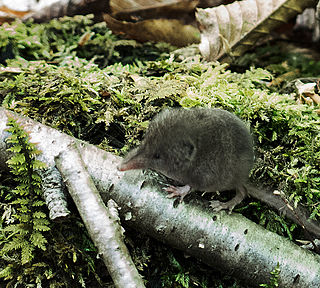
The genus Cryptotis is a group of relatively small shrews with short ears, which are usually not visible, and short tails, commonly called small-eared shrews. They have 30 teeth and are members of the red-toothed shrew subfamily. Since 1992, Neal Woodman at the United States National Museum has been in the process of revising the genus. To date, this has resulted in an increase in the number of species from 12 to 30.

The genus Crocidura is one of nine genera of the shrew subfamily Crocidurinae. Members of the genus are commonly called white-toothed shrews or musk shrews, although both also apply to all of the species in the subfamily. With over 180 species, Crocidura contains the most species of any mammal genus. The name Crocidura means "woolly tail", because the tail of Crocidura species are covered in short hairs interspersed with longer ones.

Soricomorpha is a formerly used taxon within the class of mammals. In the past it formed a significant group within the former order Insectivora. However, Insectivora was shown to be polyphyletic and various new orders were split off from it, including Afrosoricida, Macroscelidea, and Erinaceomorpha, with the four remaining extant and recent families of Soricomorpha shown here then being treated as a separate order. Insectivora was left empty and disbanded.
Güldenstädt's shrew is a species of mammal in the family Soricidae. It is sometimes considered a subspecies of the lesser white-toothed shrew, but more recent studies support it being a distinct species. It is named after Johann Anton Güldenstädt.

The black-footed shrew is a species of mammal in the family Soricidae. It is endemic to northern and central Sulawesi, Indonesia where it lives on the floor of the tropical forests. The International Union for Conservation of Nature has assessed its conservation status as being of "least concern".

The Sulawesi white-handed shrew or Temboan shrew is a species of mammal in the family Soricidae. It is endemic to the island of Sulawesi in Indonesia. It is a fairly common species and the population seems stable so the International Union for Conservation of Nature has assessed its conservation status as being of "least concern".

The Iberian shrew or Lagranja shrew is a species of mammal in the family Soricidae. It is found in Portugal and Spain.
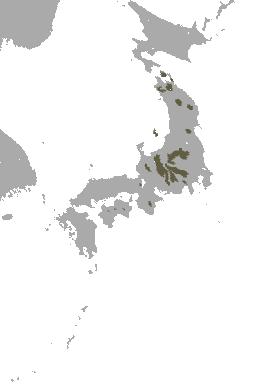
The Shinto shrew is a species of shrew of the genus Sorex that lives only on the islands of Japan. It is a mole-like mammal with a pointed snout, very small ears, and a relatively long tail. Like most shrews, it is tiny, has poor eyesight, and a very good sense of hearing and smell which it uses to locate its prey, mainly insects.

The Indochinese short-tailed shrew is a species of mammal of the family Soricidae found in China and Vietnam. The species is a semifossorial red-toothed shrew with a stout body and short, slender tail. Although this species was originally classified under Blarinella, recent Cytochrome b analysis suggests this species should be classified under a new genus, placing it in Parablarinella alongside one other species.

The Veracruz shrew is a species of mammal in the family Soricidae. It is found in Mexico.

The Bornean shrew is a species of mammal in the family Soricidae. It is found only on Borneo, throughout most of the island; it may or may not be present in Brunei.
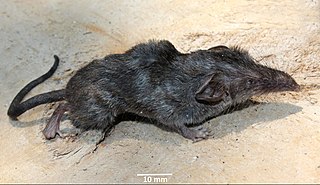
The Narcondam shrew is a white-toothed shrew in the family Soricidae. It is endemic to Narcondam Island, a small, remote, volcanic island situated in Andaman Sea and considered part of the Andaman and Nicobar archipelago. It was discovered in April 2020 and was described about a year later in 2021.
The Dracula shrew, also known as the large white-toothed shrew, is a species of mammal in the family Soricidae. It is found in Vietnam, Laos, and adjacent southern China, with possible range extension into Cambodia east of the Mekong River. Because it is so visually similar to the Southeast Asian shrew, it has historically been considered part of the same species complex and the range delineation between the two species is still being resolved. Recent genetic evidence strongly supports that the Dracula shrew is in fact a uniquely diverged species.
Parablarinella is a small genus of shrews in the subfamily Soricinae of the family Soricidae that was split off from Blarinella due to recent Cytochrome b analysis.
