
Tropical cyclones and subtropical cyclones are named by various warning centers to simplify communication between forecasters and the general public regarding forecasts, watches and warnings. The names are intended to reduce confusion in the event of concurrent storms in the same basin. Once storms develop sustained wind speeds of more than 33 knots, names are generally assigned to them from predetermined lists, depending on the basin in which they originate. Some tropical depressions are named in the Western Pacific, while tropical cyclones must contain a significant amount of gale-force winds before they are named in the Southern Hemisphere.
Tropical cyclones are ranked on one of five tropical cyclone intensity scales, according to their maximum sustained winds and which tropical cyclone basins they are located in. Only a few scales of classifications are used officially by the meteorological agencies monitoring the tropical cyclones, but other scales also exist, such as accumulated cyclone energy, the Power Dissipation Index, the Integrated Kinetic Energy Index, and the Hurricane Severity Index.
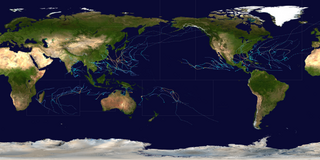
During 2005, tropical cyclones formed within seven different tropical cyclone basins, located within various parts of the Atlantic, Pacific and Indian Oceans. During the year, a total of 141 systems formed with 94 of these developing further and were named by the responsible warning centre. The strongest tropical cyclone of the year was Hurricane Wilma, which was estimated to have a minimum barometric pressure of 882 hPa (26.05 inHg). 2005 was above-average in terms of the number of storms. The most active basin in the year was the North Atlantic, which documented 28 named systems. The Western Pacific had an near-average season with 23 named storms. The Eastern Pacific hurricane season experienced an above-average number of tropical storm intensity systems, numbering 15. Activity across the southern hemisphere's three basins – South-West Indian, Australian, and South Pacific – was fairly significant, with the regions recording 23 named storms altogether, with the most intense Southern Hemisphere cyclone of the year, Cyclone Percy from the South Pacific Ocean basin peaking at 145 mph (235 km/h) and 900 millibars. Throughout the year, 28 Category 3 tropical cyclones formed, including eight Category 5 tropical cyclones in the year. The accumulated cyclone energy (ACE) index for the 2005, as calculated by Colorado State University was 899.6 units.

2020 was regarded as the most active tropical cyclone year on record, documenting 104 named tropical systems. During the year, 141 tropical cyclones formed in bodies of water known as tropical cyclone basins. Of these, a record-high of 104, including three subtropical cyclones in the South Atlantic Ocean and three tropical-like cyclones in the Mediterranean, were named by various weather agencies when they attained maximum sustained winds of 35 knots. The strongest storm of the year was Typhoon Goni, peaking with a pressure of 905 hPa (26.72 inHg). The deadliest storm of the year was Hurricane Eta which caused 175 fatalities and another 100+ to be missing in Central America and the US, while the costliest storm of the year was Hurricane Laura, with a damage cost around $19.1 billion in the Greater Antilles, The Bahamas, and the Gulf Coast of the United States.
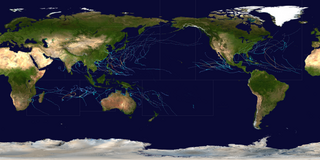
During 2021, tropical cyclones formed in seven major bodies of water, commonly known as tropical cyclone basins. Tropical cyclones will be assigned names by various weather agencies if they attain maximum sustained winds of 35 knots. During the year, one hundred forty-five systems have formed and ninety-one were named, including one subtropical depression and excluding one system, which was unofficial. One storm was given two names by the same RSMC. The most intense storm of the year was Typhoon Surigae, with maximum 10-minute sustained wind speeds of 220 km/h (140 mph) and a minimum pressure of 895 hPa (26.43 inHg). The deadliest tropical cyclone was Typhoon Rai, which caused 410 fatalities in the Philippines and 1 in Vietnam, while the costliest was Hurricane Ida, which caused an estimated $75.25 billion USD in damage after striking Louisiana and the Northeastern United States.

During 2023, tropical cyclones formed in seven major bodies of water, commonly known as tropical cyclone basins. They were named by various weather agencies when they attained maximum sustained winds of 35 knots. Throughout the year, a total of 115 systems formed, with 79 of them being named. The most intense storm this year was Typhoon Mawar, which had a minimum pressure of 900 hPa (26.58 inHg). The deadliest tropical cyclone of the year was Storm Daniel, which killed at least 10,028 people in Libya, Greece, Turkey, and Bulgaria. Meanwhile, the costliest tropical cyclone was Typhoon Doksuri which caused at least US$28.4 billion worth of damage in China, the Philippines and Taiwan, becoming the costliest on record outside the Atlantic Ocean basin. Among this year's systems, thirty became major tropical cyclones, of which ten intensified into Category 5 tropical cyclones on the Saffir–Simpson scale (SSHWS). This year, for the first time on record, at least one such Category 5 system formed in each tropical cyclone basin: Typhoons Mawar, Saola, and Bolaven in the western Pacific Ocean, Hurricanes Jova and Otis in the eastern Pacific, Hurricane Lee in the Atlantic, Cyclone Mocha in the North Indian Ocean, Cyclone Freddy in the southwest Indian Ocean, Cyclone Ilsa in the Australian region, and Cyclone Kevin in the South Pacific. The accumulated cyclone energy (ACE) index for the 2023, as calculated by Colorado State University (CSU) was 857.4 units, which was above the 1991-2020 mean of 770.2 units.
This page is based on this
Wikipedia article Text is available under the
CC BY-SA 4.0 license; additional terms may apply.
Images, videos and audio are available under their respective licenses.
