Chinese classic texts or canonical texts or simply dianji (典籍) refers to the Chinese texts which originated before the imperial unification by the Qin dynasty in 221 BC, particularly the "Four Books and Five Classics" of the Neo-Confucian tradition, themselves a customary abridgment of the "Thirteen Classics". All of these pre-Qin texts were written in classical Chinese. All three canons are collectively known as the classics.

A lunisolar calendar is a calendar in many cultures, combining lunar calendars and solar calendars. The date of Lunisolar calendars therefore indicates both the Moon phase and the time of the solar year, that is the position of the Sun in the Earth's sky. If the sidereal year is used instead of the solar year, then the calendar will predict the constellation near which the full moon may occur. As with all calendars which divide the year into months there is an additional requirement that the year have a whole number of months. In this case ordinary years consist of twelve months but every second or third year is an embolismic year, which adds a thirteenth intercalary, embolismic, or leap month.

The Xia dynasty is the first dynasty in traditional Chinese historiography. According to tradition, the Xia dynasty was established by the legendary Yu the Great, after Shun, the last of the Five Emperors, gave the throne to him. In traditional historiography, the Xia was later succeeded by the Shang dynasty.

The Chinese dragon, also known as the loong, long or lung, is a legendary creature in Chinese mythology, Chinese folklore, and Chinese culture at large. Chinese dragons have many animal-like forms such as turtles and fish, but are most commonly depicted as snake-like with four legs. Academicians have identified four reliable theories on the origin of the Chinese dragon: snakes, Chinese alligators, thunder and nature worship. They traditionally symbolize potent and auspicious powers, particularly control over water, rainfall, typhoons, and floods. The dragon is also a symbol of power, strength, and good luck for people who are worthy of it in East Asian culture. During the days of Imperial China, the Emperor of China usually used the dragon as a symbol of his imperial strength and power. In Chinese culture, excellent and outstanding people are compared to a dragon, while incapable people with no achievements are compared to other, disesteemed creatures, such as a worm.

A dynasty is a sequence of rulers from the same family, usually in the context of a monarchical system, but sometimes also appearing in republics. A dynasty may also be referred to as a "house", "family" or "clan", among others.

The Shanghai Museum is a museum of ancient Chinese art, situated on the People's Square in the Huangpu District of Shanghai, China. Rebuilt at its current location in 1996, it is considered one of China's first world-class modern museums and famous for its large collection of rare cultural pieces.

Anyang is a prefecture-level city in Henan province, China. The northernmost city in Henan, Anyang borders Puyang to the east, Hebi and Xinxiang to the south, and the provinces of Shanxi and Hebei to its west and north respectively.

The culture of Vietnam is highly multicultural. The early culture in Vietnam started with the Bronze Age Đông Sơn culture considered to be one of its most important progenitors for its Ancient history. Vietnamese culture was heavily influenced by Chinese culture due to the 1000 years of Northern rule. In this period of time, Classical Chinese was used to write which was known as Hán văn. Vietnamese was written with chữ Hán, a Chinese script, and a Vietnamese derived script from Chinese characters, but which included invented characters to represent native Vietnamese words. These scripts were known collectively as chữ Hán Nôm. This large impact on Vietnamese culture means that Vietnam is often considered to be part of the Sinosphere.

Bianzhong is an ancient Chinese musical instrument consisting of a set of bronze bells, played melodically. China is the earliest country to manufacture and use musical chimes. They are also called Chime Bells. These sets of chime bells were used as polyphonic musical instruments and some of these bells have been dated at between 2,000 to 3,600 years old. They were hung in a wooden frame and struck with a mallet. Using a wooden hammer and a rod to beat the bronze bell can make different pitch. Along with the stone chimes called bianqing, they were an important instrument in China's ritual and court music going back to ancient times.
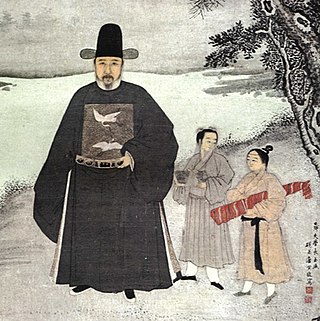
The scholar-officials, also known as literati, scholar-gentlemen or scholar-bureaucrats, were government officials and prestigious scholars in Chinese society, forming a distinct social class.

The Beijing Ancient Observatory is a pretelescopic observatory located in Beijing, China. The observatory was built in 1442 during the Ming dynasty, and expanded during the Qing. It received major reorganization and many new, more accurate instruments from Europeans (Jesuits) in 1644.

Meng is a Chinese surname. Meng is a shi surname or clan name (氏), as opposed to the xing (姓) category of surname, ancestral name. Meng is of the type of surname which was a member of the list of names denoting seniority within a certain family: in ancient usage, the characters of meng (孟), zhong (仲), shu (叔) and ji (季) were used to denote the first, second, third and fourth eldest sons in a family. These were sometimes adopted as surnames. Of these, Meng is the best known, being the surname of the philosopher Mencius. It is the 94th name on the Hundred Family Surnames poem.
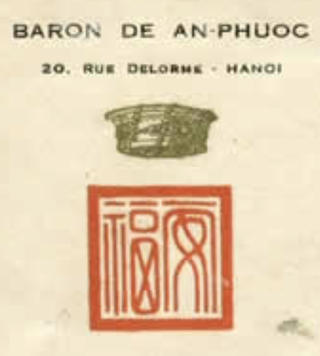
During Vietnam's monarchial period, the Vietnamese nobility (tước) were classified into eleven classes, with names similar to their Chinese equivalent. These are listed here from the highest to the lowest, along with their equivalent European titles.

Chinese coinage during the Spring and Autumn and Warring States periods includes some of the earliest coins produced in the world. However, they were mostly not the typical round shape of modern coins. They included cowrie shells, ant nose money, spade-shaped money and knife-shaped money.

Li or Lee is a common Chinese-language surname, it is the 4th name listed in the famous Hundred Family Surnames. Li is one of the most common surnames in Asia, shared by 92.76 million people in China, and more than 100 million in Asia. It is the second-most common surname in China as of 2018, the second-most common surname in Hong Kong, and the 5th most common surname in Taiwan, where it is usually romanized as "Lee". The surname is pronounced as in Cantonese, Lí (poj) in Taiwanese Hokkien, but is often spelled as "Lee" in Hong Kong, Macau, Taiwan and many overseas Chinese communities. In Macau, it is also spelled as "Lei". In Indonesia it is commonly spelled as "Lie". The common Korean surname, "Lee", and the Vietnamese surname, "Lý", are both derived from Li and written with the same Chinese character (李). The character also means "plum" or "plum tree".
AAAAA (5A) is awarded to the most important and best-maintained tourist attractions in the People's Republic of China, given the highest level in the rating categories used by the Ministry of Culture and Tourism. As of 2020, there are 279 tourist attractions listed as 5A.
The following outline is provided as an overview of and topical guide to ancient China:

Zaju chuishao fu, also called Guiyi, and sometimes referred as "Swallow-tailed Hems and Flying Ribbons clothing" or "swallow tail" clothing for short in English, is a form of set of attire in hanfu which was worn by Chinese women. The zaju chuishao fu can be traced back to the pre-Han period and appears to have originated the sandi of the Zhou dynasty; it then became popular during the Han, Cao Wei, Jin and Northern and Southern dynasties. It was a common form of aristocratic costumes in the Han and Wei dynasties and was also a style of formal attire for elite women. The zaju chuishao fu can be further divided into two categories of clothing style based on its cut and construction: the guipao, and the guichang.

The Liao dynasty was a Khitan-led dynasty of China that ruled over parts of Northern China, Manchuria, the Mongolian Plateau, northern Korean Peninsula, and what is modern-day Russian Far East from 916 until 1125 when it was conquered by the Jin dynasty. Remnants of the Liao court fled westward and created the Western Liao dynasty which in turn was annexed by the Mongol Empire in 1218.