
Look up little one in Wiktionary, the free dictionary.
Little One may refer to:
Little One may refer to:


Harry Lillis "Bing" Crosby Jr. was an American singer, actor, television producer, television and radio personality and businessman. The first multimedia star, he was one of the most popular and influential musical artists of the 20th century worldwide. He was a leader in record sales, network radio ratings, and motion picture grosses from 1926 to 1977. He was one of the first global cultural icons. He made over 70 feature films and recorded more than 1,600 songs.
Dark Star or Darkstar may refer to:
Stardust may refer to:

The Andrews Sisters were an American close harmony singing group of the swing and boogie-woogie eras. The group consisted of three sisters: contralto LaVerne Sophia Andrews, soprano Maxene Anglyn Andrews, and mezzo-soprano Patricia Marie Andrews. The sisters have sold an estimated 80 million records. Their 1941 hit "Boogie Woogie Bugle Boy" can be considered an early example of jump blues. Other songs closely associated with the Andrews Sisters include their first major hit, "Bei Mir Bist Du Schön " (1937), "Beer Barrel Polka " (1939), "Beat Me Daddy, Eight to the Bar" (1940), "Don't Sit Under the Apple Tree " (1942), and "Rum and Coca-Cola" (1945), which helped introduce American audiences to calypso.
Dream House, Dreamhouse or similar may refer to:
Blue Skies may refer to:

Blue Skies is a 1946 American musical comedy film directed by Stuart Heisler and starring Bing Crosby, Fred Astaire, and Joan Caulfield. Based on a story by Irving Berlin, the film is about a dancer who loves a showgirl who loves a compulsive nightclub-opener who can't stay committed to anything in life for very long. Produced by Sol C. Siegel, Blue Skies was filmed in Technicolor and released by Paramount Pictures. The music, lyrics, and story were written by Irving Berlin, with most of the songs recycled from earlier works.
"Temptation" is a popular song published in 1933, with music written by Nacio Herb Brown and lyrics by Arthur Freed.
"Too Marvelous for Words" is a popular song written in 1937. Johnny Mercer wrote the lyrics for music composed by Richard Whiting. It was introduced by Wini Shaw and Ross Alexander in the 1937 Warner Brothers film Ready, Willing and Able, as well as used for a production number in a musical revue on Broadway. The song has become a pop and jazz standard and has been recorded by many artists.

Sing You Sinners is a 1938 American musical comedy film directed by Wesley Ruggles and starring Bing Crosby, Fred MacMurray, Ellen Drew, and Donald O'Connor. Written by Claude Binyon, the film is about three singing brothers who go to California to find their fortune. Initially the film was to be titled "The Unholy Beebes" and then "Harmony for Three" before finishing with "Sing You Sinners". Filming took place in April/May 1938 in Hollywood. Race track scenes were filmed at the Pomona Fairgrounds and at Santa Anita using two dozen of Crosby's horses. Sing You Sinners was premiered on August 5, 1938 at the Del Mar racetrack with the New York premiere taking place on August 16.
A Connecticut Yankee in King Arthur's Court is a 1949 American comedy musical film directed by Tay Garnett and starring Bing Crosby, Rhonda Fleming, Sir Cedric Hardwicke and William Bendix.
Riding High may refer to:
Just for You may refer to:
"Go West, young man" is a quote often attributed to American author Horace Greeley concerning America's expansion westward.
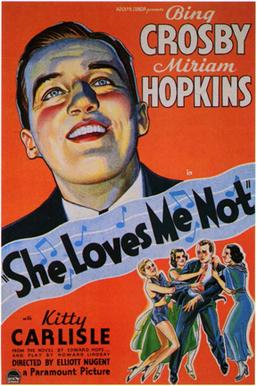
She Loves Me Not is a 1934 American comedy film directed by Elliott Nugent and starring Bing Crosby and Miriam Hopkins. Based on the novel She Loves Me Not by Edward Hope and the subsequent play by Howard Lindsay, the film is about a cabaret dancer who witnesses a murder and is forced to hide from gangsters by disguising herself as a male Princeton student. Distributed by Paramount Pictures, the film has been remade twice as True to the Army (1942) and as How to Be Very, Very Popular in (1955), the latter starring Betty Grable. The film is notable for containing one of the first major performances of Bing Crosby, and it helped launch him to future stardom. This was also the last film that Miriam Hopkins made under her contract to Paramount Pictures, which began in the early 1930s upon her arrival in Hollywood. In 1935, the film received an Academy Award nomination for Best Original Song for "Love in Bloom", theme song of comedian Jack Benny.
If I Had My Way may refer to:

The Small One is a studio album of Deccalite phonograph records by Bing Crosby of a Charles Tazewell story. It was produced and directed by Paramount Pictures producer Robert Welch with musical accompaniment from Victor Young and His Orchestra.

Bing Crosby Sings with Al Jolson, Bob Hope, Dick Haymes and the Andrews Sisters is a Bing Crosby Decca Records studio 78rpm album of phonograph records featuring Crosby with several of Decca's top artists.

'Bing and the Dixieland Bands is a Decca Records album by Bing Crosby featuring songs with a Dixieland flavour which was issued as a 10” LP with catalog No. DL5323 and as a 4-disc 78rpm box set (A-852) and as a 4-disc 45rpm set (9–232).
Small Fry may refer to: