British English is the standard dialect of the English language as spoken and written in the United Kingdom. Variations exist in formal, written English in the United Kingdom. For example, the adjective wee is almost exclusively used in parts of Scotland, North East England, Ireland, and occasionally Yorkshire, whereas little is predominant elsewhere. Nevertheless, there is a meaningful degree of uniformity in written English within the United Kingdom, and this could be described by the term British English. The forms of spoken English, however, vary considerably more than in most other areas of the world where English is spoken, so a uniform concept of British English is more difficult to apply to the spoken language. According to Tom McArthur in the Oxford Guide to World English, British English shares "all the ambiguities and tensions in the word 'British' and as a result can be used and interpreted in two ways, more broadly or more narrowly, within a range of blurring and ambiguity".
Spoken English shows great variation across regions where it is the predominant language. This article provides an overview of the numerous identifiable variations in pronunciation; such distinctions usually derive from the phonetic inventory of local dialects, as well as from broader differences in the Standard English of different primary-speaking populations.

The term Cockney is applied as a demonym to people from loosely defined areas of London; to East Enders or to those born within the sound of Bow Bells. The Cockney dialect is the form of speech used in those areas, and elsewhere, particularly among working class Londoners. In practice, these definitions are often blurred.
Estuary English is an English accent associated with the area along the River Thames and its estuary, including London. Phonetician John C. Wells proposed a definition of Estuary English as "Standard English spoken with the accent of the southeast of England". Estuary English may be compared with Cockney, and there is some debate among linguists as to where Cockney speech ends and Estuary English begins.
The speech of Glaswegians, popularly known as the Glasgow patter or Glaswegian, varies from Scottish English at one end of a bipolar linguistic continuum, with the local dialect of West Central Scots at the other. Therefore, the speech of many Glaswegians can draw on a "continuum between fully localised and fully standardised". Additionally, the Glasgow dialect has Highland English and Hiberno-English influences owing to the speech of Highlanders and Irish people who migrated in large numbers to the Glasgow area in the 19th and early 20th centuries. The Glasgow vernacular also exerts considerable influence on the vernacular of the surrounding towns.
New Orleans English is American English native to the city of New Orleans and its metropolitan area. Native English speakers of the region actually speak a number of varieties, including: the variety most recently brought in and spreading since the 20th century among white communities of the South in general ; the variety primarily spoken by black residents ; the variety spoken by Cajuns in southern Louisiana ; the variety traditionally spoken by affluent white residents of the city's Uptown and Garden District; and the variety traditionally spoken by lower middle- and working-class white residents of Eastern New Orleans, particularly the Ninth Ward. However, only the last two varieties are unique to New Orleans and are typically those referred to in the academic research as "New Orleans English". These two varieties specific to New Orleans likely developed around the turn of the nineteenth century and most noticeably combine speech features commonly associated with both New York City English and, to a lesser extent, Southern U.S. English. The noticeably New York-like characteristics include the NYC-like short-a split, non-rhoticity, th-stopping, and the recently disappearing coil–curl merger. Noticeably Southern characteristics include the fronting of and possible monophthongization of.
Mockney is an affected accent and form of speech in imitation of cockney or working-class London speech, or a person with such an accent. A stereotypical mockney speaker comes from an upper-middle-class background.
London slang is a mixture of words and phrases originating in the city and around the globe, commonly spoken in London. It reflects the diverse ethnic and cultural makeup of the city's population.
English in southern England is the collective set of different dialects and accents of the English spoken in Southern England.
L-vocalization, in linguistics, is a process by which a lateral approximant sound such as, or, perhaps more often, velarized, is replaced by a vowel or a semivowel.
In the history of English phonology, there have been many diachronic sound changes affecting vowels, especially involving phonemic splits and mergers. A number of these changes are specific to vowels which occur before.
In English phonology, t-glottalization or t-glottalling is a sound change in certain English dialects and accents that causes the phoneme to be pronounced as the glottal stop (listen) in certain positions. It is never universal, especially in careful speech, and it most often alternates with other allophones of such as [t] (help·info),, ,, or.
Th-fronting is the pronunciation of the English "th" as "f" or "v". When th-fronting is applied, becomes and becomes. Unlike the fronting of to, the fronting of to usually does not occur word-initially although this was found in the speech of South-East London in a survey completed 1990-4. Th-fronting is a prominent feature of several dialects of English, notably Cockney, Essex dialect, Estuary English, some West Country and Yorkshire dialects, African American Vernacular English, and Liberian English, as well as in many non-native English speakers.
Dialect levelling is the means by which dialect differences decrease. For example, in rural areas of Britain, although English is widely spoken, the pronunciation and the grammar have historically varied. During the twentieth century, more people moved into towns and cities, standardising English. Dialect levelling can develop by the influence of various types of media.

In linguistics, a koiné language, koiné dialect, or simply koiné is a standard or common language or dialect that has arisen as a result of the contact, mixing, and often simplification of two or more mutually intelligible varieties of the same language.
The social structure of the United Kingdom has historically been highly influenced by the concept of social class, which continues to affect British society today.
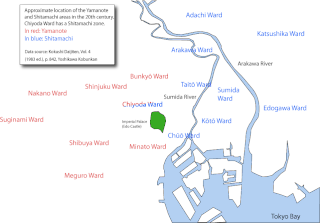
Tokyo dialect is the Japanese dialect spoken in modern Tokyo. The dialect in modern Tokyo is often considered to be Standard Japanese, but they differ in a number of areas and social classes.

The English language spoken and written in England encompasses a diverse range of accents and dialects. The dialect forms part of the broader British English, along with other varieties in the United Kingdom. Terms used to refer to the English language spoken and written in England include: English English, Anglo-English and British English in England.
Mancunian is the accent and dialect spoken in the majority of Manchester, North West England, and some of its environs. It is also given to the name of the people who live in the city of Manchester.
