Related Research Articles

Sisto Badalocchio Rosa was an Italian painter and engraver of the Bolognese School.
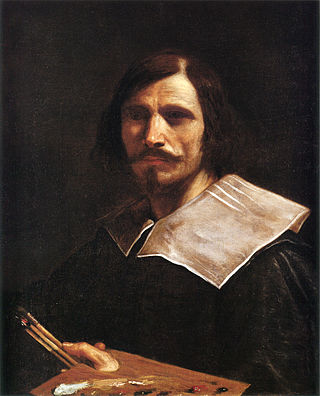
Giovanni Francesco Barbieri, better known as (il) Guercino, was an Italian Baroque painter and draftsman from Cento in the Emilia region, who was active in Rome and Bologna. The vigorous naturalism of his early manner contrasts with the classical equilibrium of his later works. His many drawings are noted for their luminosity and lively style.

Annibale Carracci was an Italian painter and instructor, active in Bologna and later in Rome. Along with his brother and cousin, Annibale was one of the progenitors, if not founders of a leading strand of the Baroque style, borrowing from styles from both north and south of their native city, and aspiring for a return to classical monumentality, but adding a more vital dynamism. Painters working under Annibale at the gallery of the Palazzo Farnese would be highly influential in Roman painting for decades.

Reggio nell'Emilia, usually referred to as Reggio Emilia, or simply Reggio by its inhabitants, and known until 1861 as Reggio di Lombardia, is a city in northern Italy, in the Emilia-Romagna region. It has about 171,944 inhabitants and is the main comune (municipality) of the province of Reggio Emilia.

Alessandro Tiarini was an Italian Baroque painter of the Bolognese School.

Cadelbosco di Sopra is a town and comune in the province of Reggio Emilia in Emilia-Romagna, Italy.

Camillo Procaccini was an Italian painter. He has been posthumously referred to as the Vasari of Lombardy, for his prolific Mannerist fresco decoration.

Lorenzo Garbieri was an Italian painter of the early-Baroque period, active mainly in Bologna. He was one of the painters in the studio of Ludovico Carracci and is sometimes called il nipote dei Carracci. He was said to be one of the most successful imitators of Ludovico, to whose style he added the character of Caravaggio.
Orazio Talami was an Italian painter of the Baroque period, active mainly in Bologna and Reggio Emilia.

Antonio Triva was an Italian painter and engraver of the Baroque period.
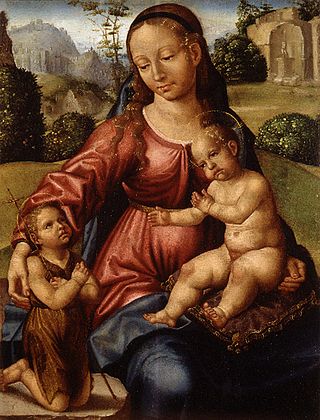
Pablo da San Leocadio or Paolo da Reggio was an Italian painter from Reggio Emilia, who was mostly active in Spain.

Prospero Spani was an Italian sculptor of the Renaissance, active mainly in the Province of Reggio Emilia. He is variously known as Prospero Clementi or Prospero Clemente or il Clemente. Vasari claimed he was Modenese.

Domenico Pedrini was an Italian painter. Fiercely provincial in his geographic activity, Pedrini's works were mainly completed in and around Bologna, and yet his atavistic style strayed far afield into Bologna's strong Baroque ancestry.

Prospero Minghetti was an Italian painter.
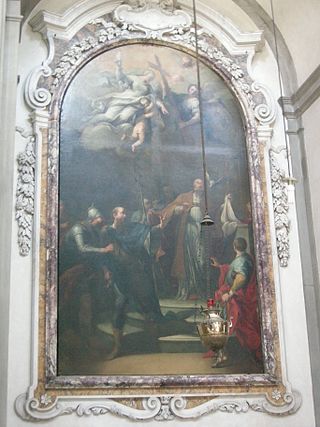
Francesco Vellani (1688–1768) was an Italian painter, active in Modena in a late Baroque style. He mainly painted sacred subjects.
Anselmo Govi was an Italian painter and decorator, a member of the late Art Nouveau school known in Italy as Liberty style.
San Celestino is a Baroque style, Roman Catholic parish church located on Piazza San Celestino, in the town of Cadelbosco di Sopra in the province of Reggio Emilia, region of Emilia-Romagna, Italy.

Saint Margaret of Antioch is a 1599 oil on canvas painting by Annibale Carracci, showing Margaret of Antioch. It hangs in Santa Caterina dei Funari church in Rome.
Francesco Antonio Camuncoli was an Italian painter of the Neoclassical style.

San Giovannino, or the Roman Catholic church of San Giovanni Evangelista is a religious building is located on the narrow Piazzetta San Giovanni in the historic center of Reggio Emilia, region of Emilia Romagna, Italy. The church is best known for the frescoes by early Baroque painters.
References
- ↑ Gli artisti italiani e stranieri negli stati estensi catalogo storico. by Giuseppe Campori, Modena, 1855, page 215.
| International | |
|---|---|
| National | |
| Artists | |
| People | |

 | This article about an Italian painter born in the 17th century is a stub. You can help Wikipedia by expanding it. |