
The "Himno Nacional del Perú" is the national anthem of Peru. It was composed by José Bernardo Alcedo, and its lyrics were written by José de la Torre Ugarte in 1821.

The Battle of Ayacucho was a decisive military encounter during the Peruvian War of Independence. This battle secured the independence of Peru and ensured independence for the rest of South America. In Peru it is considered the end of the Spanish American wars of independence in this country, although the campaign of Antonio José de Sucre continued through 1825 in Upper Peru and the siege of the fortresses Chiloé and Callao eventually ended in 1826.

The Peruvian Humanist Party, formerly the is a humanist political party in Peru, and a former member of the Decentralization Coalition together with the Partido por la Democracia Social - Compromiso Perú. The PMHP won the regional elections of 2002 for the northern region of Lambayeque.
The vals criollo, or Peruvian waltz, is an adaptation of the European waltz brought to the Americas during colonial times by Spain. In the Viceroyalty of Peru, the waltz was gradually adapted to the likings of the Criollo people. In the 20th century, the genre became symbolic of the nation's culture as it gained widespread popularity in the country. It also became popular outside of Peru, particularly in Argentina, where local artists composed many notable Peruvian waltz compositions such as Amarraditos and Que nadie sepa mi sufrir.
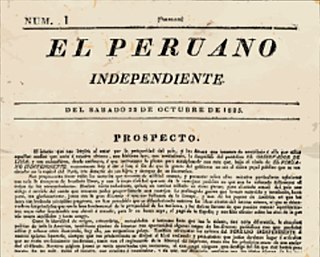
Diario Oficial El Peruano is the official daily newspaper of Peru. The paper was founded on 22 October 1825 by Simón Bolívar although it changed names between the following decades and it was not published continuously since its inception. It is the oldest Spanish-language newspaper still in circulation. In addition to carrying news, all laws passed in Peru must be published by El Peruano.

A Spanish Peruvian is a Peruvian citizen of Spanish descent. Among European Peruvians, the Spanish are the largest group of immigrants to settle in the country.

Peru–Russia relations is the bilateral foreign relations between Peru and Russia. Peru has an embassy in Moscow and an honorary consulate in Saint Petersburg. Russia has an embassy in Lima and an honorary consulate in the San Isidro District.
As of 2018, official statistics showed 201,993 Peruvian-born residents in Spain. Out of these, 129,344 were Spanish citizens and 72,649 had not yet acquired Spanish citizenship. As of 2019, the number had increased to 218,129.
Óscar Guillermo Avilés Arcos was a Peruvian guitarist, singer, and composer.
The Miss Perú 1985 pageant was held on May 11, 1985. That year, 22 candidates were competing for the national crown. The chosen winner represented Peru at the Miss Universe 1985. The rest of the finalists would enter in different pageants.

Peru competed at the 2016 Summer Olympics in Rio de Janeiro, Brazil, from 5 to 21 August 2016. Since the nation's official debut in 1936, Peruvian athletes have appeared in every edition of the Summer Olympic Games throughout the modern era. Peru failed to register any athletes at the 1952 Summer Olympics in Helsinki.

Peruvians for Change was a centre-right party in Peru.
José Escajadillo is a Peruvian composer, especially in the Creole music genre. He also composed more than 620 valses, songs, military marches, sport anthems and marineras. On October 3, 2003, he received the medal "Juan Pablo Vizcardo y Guzmán" medal from the Congress of the Republic of Peru in recognition of his outstanding music career. On 1 November 2014, in a ceremony held in Washington, DC, the Organization of American States awarded him with the title "Compositor de América" for his contributions. His best songs were included in the album José Escajadillo: Un Gigante de la Canción Peruana.
The law of Peru includes a constitution and legislation. The law of Perú is part of the Roman-Germanic tradition that concedes the utmost importance to the written law, therefore, statutes known as leyes are the primary source of the law.


