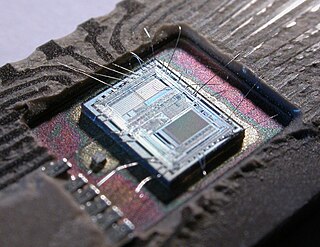
A microcontroller is a small computer on a single metal-oxide-semiconductor (MOS) integrated circuit (IC) chip. A microcontroller contains one or more CPUs along with memory and programmable input/output peripherals. Program memory in the form of ferroelectric RAM, NOR flash or OTP ROM is also often included on chip, as well as a small amount of RAM. Microcontrollers are designed for embedded applications, in contrast to the microprocessors used in personal computers or other general purpose applications consisting of various discrete chips.
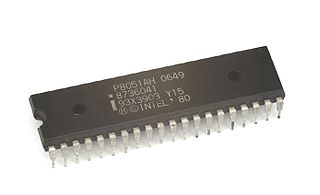
The Intel MCS-51 is a single chip microcontroller (MCU) series developed by Intel in 1980 for use in embedded systems. The architect of the Intel MCS-51 instruction set was John H. Wharton. Intel's original versions were popular in the 1980s and early 1990s, and enhanced binary compatible derivatives remain popular today. It is an example of a complex instruction set computer and has separate memory spaces for program instructions and data.

Zilog, Inc. is an American manufacturer of 8-bit and 16-bit microcontrollers. Its most famous product is the Z80 series of 8-bit microprocessors that were compatible with the Intel 8080 but significantly cheaper. The Z80 was widely used during the 1980s in many popular home computers such as the TRS-80, MSX, Amstrad CPC and the ZX Spectrum, as well as arcade games such as Pac-Man. The company also made 16- and 32-bit processors, but these did not see widespread use. From the 1990s, the company focused primarily on the microcontroller market.

AVR is a family of microcontrollers developed since 1996 by Atmel, acquired by Microchip Technology in 2016. These are modified Harvard architecture 8-bit RISC single-chip microcontrollers. AVR was one of the first microcontroller families to use on-chip flash memory for program storage, as opposed to one-time programmable ROM, EPROM, or EEPROM used by other microcontrollers at the time.

The MSP430 is a mixed-signal microcontroller family from Texas Instruments, first introduced on 14 February 1992. Built around a 16-bit CPU, the MSP430 is designed for low cost and, specifically, low power consumption embedded applications.

The Zilog Z8 is a microcontroller architecture, originally introduced in 1979, which today also includes the Z8 Encore!, eZ8 Encore!, eZ8 Encore! XP, and eZ8 Encore! MC families.
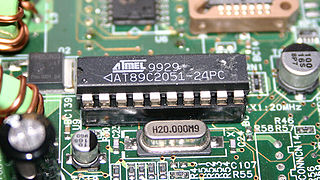
The Atmel AT89 series is an Intel 8051-compatible family of 8 bit microcontrollers (μCs) manufactured by the Atmel Corporation.
Livermorium (116Lv) is an artificial element, and thus a standard atomic weight cannot be given. Like all artificial elements, it has no stable isotopes. The first isotope to be synthesized was 293Lv in 2000. There are four known radioisotopes from 290Lv to 293Lv, as well as a few suggestive indications of a possible heavier isotope 294Lv. The longest-lived of the four well-characterised isotopes is 293Lv with a half-life of 53 ms.
Atmel ARM-based processors are microcontrollers and microprocessors integrated circuits, by Microchip Technology, that are based on various 32-bit ARM processor cores, with in-house designed peripherals and tool support.
The Small Device C Compiler (SDCC) is a free-software, partially retargetable C compiler for 8-bit microcontrollers. It is distributed under the GNU General Public License. The package also contains an assembler, linker, simulator and debugger. As of March 2007, SDCC is the only open-source C compiler for Intel 8051-compatible microcontrollers. In 2011 the compiler was downloaded on average more than 200 times per day.
Holtek Semiconductor is a Taiwan-based semiconductor design centre and provider with its headquarters and design operations based in the Hsinchu Science Park in Taiwan, and has sales offices located in USA and India. Holtek's design focus is in both 32-bit and 8-bit along with Touch microcontroller development with the company having around 750 employees. Holtek also designs and provides peripheral semiconductor products such as remote control, telecommunication, power management, computer peripheral, and memory devices. Holtek's device application area is concentrated in the consumer product field such as household appliances, computer peripheral products, remote controllers, leisure products, medical equipment as well as industrial controllers. Holtek microcontrollers are in home appliances including brands such as Philips, Siemens, Märklin and Japanese brands such as Futaba and Sony.
MPLAB is a proprietary freeware integrated development environment for the development of embedded applications on PIC and dsPIC microcontrollers, and is developed by Microchip Technology.

Code Composer Studio is an integrated development environment (IDE) to develop applications for Texas Instruments (TI) embedded processors.
EFM32 Gecko MCUs are a family of mixed-signal 32-bit microcontroller integrated circuits from Energy Micro based on ARM Cortex-M CPUs, including the Cortex-M0+, Cortex-M3 and Cortex-M4.

The Infineon XC800 family is an 8-bit microcontroller family, first introduced in 2005, with a dual cycle optimized 8051 "E-Warp" core. The XC800 family is divided into two categories, the A-Family for Automotive and the I-Family for Industrial and multi-market applications.
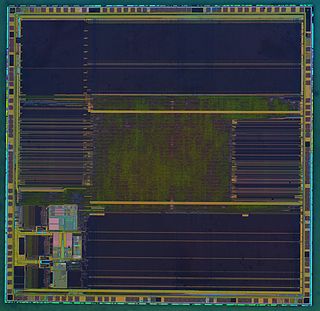
STM32 is a family of 32-bit microcontroller integrated circuits by STMicroelectronics. The STM32 chips are grouped into related series that are based around the same 32-bit ARM processor core, such as the Cortex-M33F, Cortex-M7F, Cortex-M4F, Cortex-M3, Cortex-M0+, or Cortex-M0. Internally, each microcontroller consists of the processor core, static RAM, flash memory, debugging interface, and various peripherals.

LPC is a family of 32-bit microcontroller integrated circuits by NXP Semiconductors. The LPC chips are grouped into related series that are based around the same 32-bit ARM processor core, such as the Cortex-M4F, Cortex-M3, Cortex-M0+, or Cortex-M0. Internally, each microcontroller consists of the processor core, static RAM memory, flash memory, debugging interface, and various peripherals. The earliest LPC series were based on the Intel 8-bit 80C51 core. As of February 2011, NXP had shipped over one billion ARM processor-based chips.
C8051 is a microcontroller (MCU) core produced by Silicon Laboratories, Inc. It is based on a patented implementation of the 8051 instruction set architecture.

The Proteus Design Suite is a proprietary software tool suite used primarily for electronic design automation. The software is used mainly by electronic design engineers and technicians to create schematics and electronic prints for manufacturing printed circuit boards.

