Related Research Articles

The International Rice Research Institute (IRRI) is an international agricultural research and training organization with its headquarters in Los Baños, Laguna, in the Philippines, and offices in seventeen countries. IRRI is known for its work in developing rice varieties that contributed to the Green Revolution in the 1960s which preempted the famine in Asia.
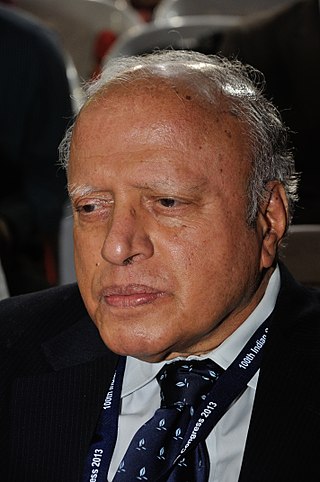
Mankombu Sambasivan Swaminathan was an Indian agronomist, agricultural scientist, geneticist, administrator and humanitarian. Swaminathan was a global leader of the green revolution. He has been called the main architect of the green revolution in India for his leadership and role in introducing and further developing high-yielding varieties of wheat and rice.

The Bangla Academy is the official regulatory body of the Bengali language in Bangladesh. It is an autonomous institution funded by the Government of Bangladesh that fosters the Bengali language, literature and culture, works to develop and implement national language policy and conducts original research in Bengali. Established in 1955, it is located in the Burdwan House in Shahbagh, Dhaka, within the grounds of the University of Dhaka and Suhrawardy Udyan. The Bangla Academy hosts the annual Ekushey Book Fair.

Ekushey Padak is the second highest civilian award in Bangladesh, introduced in memory of the martyrs of the Bengali Language Movement of 1952. The award is given to recognize contributions in a number of fields, including culture, education, and economics. The Ministry of Cultural Affairs administers the award.
Ferdousi Mazumder is a Bangladeshi film, television and stage actress. She was awarded Ekushey Padak (1998), Independence Day Award (2020) and Bangla Academy Literary Award (2020) by the government of Bangladesh. As of 2009, on stage she has given over 1200 performances of about 35 plays, mostly for her own group, Theatre.
Abdul Alim was a Bangladeshi folk singer. He won the Bangladesh National Film Award for Best Male Playback Singer in 1975 for playback in Sujan Sakhi. He was posthumously awarded the Ekushey Padak in 1977 and Independence Day Award in 1997 by the Government of Bangladesh.
1989 (MCMLXXXIX) was a common year starting on Sunday of the Gregorian calendar, the 1989th year of the Common Era (CE) and Anno Domini (AD) designations, the 989th year of the 2nd millennium, the 89th year of the 20th century, and the 10th and last year of the 1980s decade.

The Independence Day of Bangladesh is celebrated on 26 March as a national holiday in Bangladesh. It commemorates the country's declaration of independence from Pakistan in the early hours of March 26, 1971.
Gurdev Singh Khush is an Agronomist and Geneticist who, along with mentor Henry Beachell, received the 1996 World Food Prize for his achievements in enlarging and improving the global supply of rice during a time of exponential population growth.

Anisuzzaman was a Bangladeshi academic of Bengali literature.

Climate change is a critical issue in Bangladesh as the country is one of the most vulnerable to the effects of climate change. In the 2020 edition of Germanwatch's Climate Risk Index, it ranked seventh in the list of countries most affected by climate calamities during the period 1999–2018. Bangladesh's vulnerability to the effects of climate change is due to a combination of geographical factors, such as its flat, low-lying, and delta-exposed topography, and socio-economic factors, including its high population density, levels of poverty, and dependence on agriculture. The impacts and potential threats include sea level rise, temperature rise, food crises, droughts, floods, and cyclones.

Kazi M. Badruddoza was a Bangladeshi agronomist who is credited with using Agricultural Genetics and Plant Pathology to extensively increase agricultural production in Bangladesh thus leading the nation toward self-sufficiency in staple cereal crops. He is known as the Father of Modern Agriculture in Bangladesh and the only National Emeritus Scientist of Bangladesh. He was one of the early leaders of the global team of the green revolution for his role in development of high yielding wheat, rice and maize varieties. For his work in Agricultural genetics, Badruddoza was awarded numerous honors, including the Independence Day award, the highest civilian award of Bangladesh. Prior to creation of Bangladesh as an independent state, he was also awarded the Tamgha-e-Imtiaz, a state organized civil award, in former West Pakistan, as well as the Tamgha-e-Pakistan. In addition, he is credited with the genetic engineering for the highly nutritious and large variety of guava, the Kazi Guava. In his honor, the genus of fungus, Kaziboletus. in the family Boletaceae, discovered in Bangladesh, was named after him.

Abdul Malik was a Bangladeshi cardiologist and National Professor of Bangladesh. He was the first cardiac surgeon of united Pakistan. He was the founder of the National Heart Foundation of Bangladesh. In 2004, he was awarded Independence Day Award, the highest state award by the government of Bangladesh for his contribution to medical science.
Mohammad Abdul Mazid is a Bangladeshi first-class cricketer who has played for Dhaka Division since 2011.

Bangladesh Academy of Sciences (BAS) is an academic forum for Bangladeshi scientists and technologists. Established in 1973, it aims to fulfill the role of promoting research and development of sciences in Bangladesh.
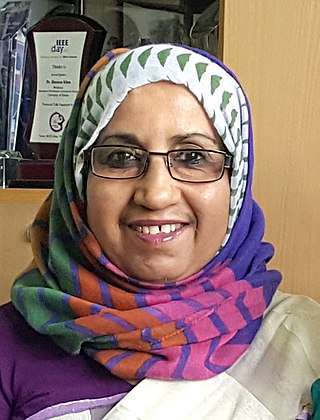
Haseena Khan is a Bangladeshi scientist, professor and fellow of Bangladesh Academy of Sciences. She is known for her lead on decoding Genome of Tenualosa ilisha from the river Padma. She was awarded Independence Day Award, the highest state award given by the government of Bangladesh for her contribution on research and training. Haseena Khan is also known for her contribution to jute genome decoding under Maqsudul Alam's lead.
Abdul Hamid Miah is a Bangladeshi agriculturist and researcher at the Bangladesh Rice Research Institute. He received the Independence Day Award, the highest civilian honour in Bangladesh, in 2013 for his unique contribution to research and education.
Abdul Mazid is a Bangladeshi fisheries researcher who is the founding Director General of the Bangladesh Fisheries Research Institute. In 2023, the Government of Bangladesh awarded him for the Ekushey Padak in Research.
Shah Abdul Mazid was the superintendent of Pakistan Police in Rajshahi District who was killed in an attack on the Rajshahi police line by the Pakistan Army in 1971. In 2016, he was posthumously awarded the Independence Day Award, the highest civilian award in Bangladesh.
Muhammad Abdul Mazid is a retired secretary and former chairman of the National Board of Revenue. He is a former chairman of the Chittagong Stock Exchange. He is the chief coordinator of the Bangladesh Diabetic Samity.
References
- ↑ "2 more named for Independence Award". The Daily Star. 2018-03-20. Retrieved 2020-07-19.
- ↑ "Bangladesh Government honors former IRRI Agronomist Dr. Md. M Abdul Mazid for contributions to Bangladeshi food security". CGIAR. Retrieved 2020-07-19.