Related Research Articles
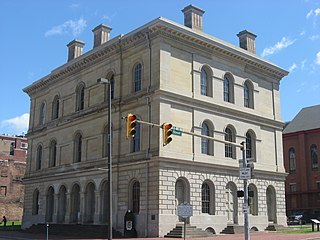
Ohio County is a county located in the Northern Panhandle of the U.S. state of West Virginia. As of the 2010 census, the population was 44,443. Its county seat is Wheeling. The county was formed in 1776 from the District of West Augusta, Virginia. It was named for the Ohio River, which forms its western boundary. West Liberty was designated as the county seat in 1777, serving to 1797.

The United States district courts are the general trial courts of the United States federal judiciary. Both civil and criminal cases are filed in district courts, each of which is a court of law, equity, and admiralty.There is a United States bankruptcy court associated with each United States district court. Each federal judicial district has at least one courthouse, and many districts have more than one. Most decisions of district courts may be appealed to the respective court of appeals of their circuit, with a small number instead being appealable to the Federal Circuit, or directly to the Supreme Court.

Brooke County is a county in the Northern Panhandle of the U.S. state of West Virginia. As of the 2010 census, the population was 24,069. Its county seat is Wellsburg. The county was created in 1797 from part of Ohio County and named in honor of Robert Brooke, Governor of Virginia from 1794 to 1796.

A justice of the peace (JP) is a judicial officer of a lower or puisne court, elected or appointed by means of a commission to keep the peace. In past centuries the term commissioner of the peace was often used with the same meaning. Depending on the jurisdiction, such justices dispense summary justice or merely deal with local administrative applications in common law jurisdictions. Justices of the peace are appointed or elected from the citizens of the jurisdiction in which they serve, and are usually not required to have any formal legal education in order to qualify for the office. Some jurisdictions have varying forms of training for JPs.

The term magistrate is used in a variety of systems of governments and laws to refer to a civilian officer who administers the law. In ancient Rome, a magistratus was one of the highest ranking government officers, and possessed both judicial and executive powers. In other parts of the world, such as China, a magistrate was responsible for administration over a particular geographic area. Today, in some jurisdictions, a magistrate is a judicial officer who hears cases in a lower court, and typically deals with more minor or preliminary matters. In other jurisdictions, magistrates may be volunteers without formal legal training who perform a judicial role with regard to minor matters.

The Supreme Court of Virginia is the highest court in the Commonwealth of Virginia. It primarily hears direct appeals in civil cases from the trial-level city and county circuit courts, as well as the criminal law, family law and administrative law cases that are initially appealed to the Court of Appeals of Virginia. It is one of the oldest continuously active judicial bodies in the United States. It was known as the Supreme Court of Appeals until 1970, when it was renamed the Supreme Court of Virginia because it has original as well as appellate jurisdiction.
The structure of the judiciary of Texas is laid out in Article 5 of the Constitution of Texas and is further defined by statute, in particular the Texas Government Code and Texas Probate Code. The structure is complex, featuring many layers of courts, numerous instances of overlapping jurisdiction, several differences between counties, as well as an unusual bifurcated appellate system at the top level found in only one other state: Oklahoma. Municipal Courts are the most active courts, with County Courts and District Courts handling most other cases and often sharing the same courthouse.

The Supreme Court of Texas (SCOTX) is the court of last resort for civil appeals in the U.S. state of Texas. A different court, the Texas Court of Criminal Appeals (CCA), is the court of last resort in criminal cases.
The Supreme Court of Appeals of West Virginia is the state supreme court of the state of West Virginia, the highest of West Virginia's state courts. The court sits primarily at the West Virginia State Capitol in Charleston, although from 1873 to 1915, it was also required by state law to hold sessions in Charles Town in the state's Eastern Panhandle. The court also holds special sittings at various locations across the state.

The judicial system of Israel consists of secular courts and religious courts. The law courts constitute a separate and independent unit of Israel's Ministry of Justice. The system is headed by the President of the Supreme Court and the Minister of Justice.
Darrell Vivian McGraw Jr. is an American Democratic politician. He is the brother of former West Virginia State Supreme Court Justice and state Senate President Warren McGraw.

The Montana Supreme Court is the highest court of the Montana state court system in the U.S. state of Montana. It is established and its powers defined by Article VII of the 1972 Montana Constitution. It is primarily an appellate court which reviews civil and criminal decisions of Montana's trial courts of general jurisdiction and certain specialized legislative courts, only having original jurisdiction in a limited number of actions. The court's Chief Justice and six Associate Justices are elected by non-partisan, popular elections. The Montana Supreme Court meets in the Joseph P. Mazurek Building in Helena, Montana, the state's capital, an international style building completed in 1982 and named in the honor of former Montana Attorney General, Joseph P. Mazurek.
Margaret Lee Workman is a Justice of the Supreme Court of Appeals of West Virginia.
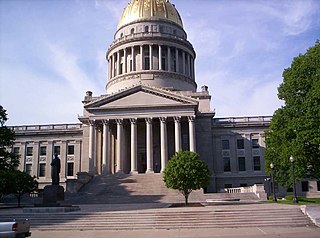
The Government of West Virginia is modeled after the Government of the United States, with three branches: the executive, consisting of the Governor of West Virginia and the other elected constitutional officers; the legislative, consisting of the West Virginia Legislature which includes the Senate and the House of Delegates; and the judicial, consisting of the West Virginia Supreme Court of Appeals and lower courts.
The Unified Judicial System of Pennsylvania is the unified state court system of the Commonwealth of Pennsylvania.
The West Virginia Circuit Courts are the West Virginia state trial courts of general jurisdiction. They are the only state trial courts in West Virginia that are courts of record. West Virginia's 55 counties are divided into 31 circuits, each comprising anywhere from one to four counties. Different circuits have different numbers of judges; 11 circuits have only a single judge.
The Judiciary of Virginia is defined under the Constitution and law of Virginia and is composed of the Supreme Court of Virginia and subordinate courts, including the Court of Appeals, the Circuit Courts, and the General District Courts. Its administration is headed by the Chief Justice of the Supreme Court, the Judicial Council, the Committee on District Courts, the Judicial Conferences, the Judicial Inquiry and Review Commission, and various other offices and officers.
Elizabeth D. "Beth" Walker is a Justice of the West Virginia Supreme Court of Appeals. She was elected in the non-partisan election on May 10, 2016. She began a 12-year term in January 2017. Walker was named in articles of impeachment passed by the West Virginia House of Delegates on August 13, 2018, was "reprimanded and censured" on October 2, 2018, but allowed to remain in office after being tried in the West Virginia Senate. Walker is the 77th justice to serve on the West Virginia Supreme Court of Appeals. She was an unsuccessful candidate for the same office in 2008.
Magistrate judge, in U.S. state courts, is a title used for various kinds of judges, typically holding a low level of office with powers and responsibilities more limited than state court judges of general jurisdiction.
In the United States, there is no consistent use of the office of constable throughout the states; use may vary within a state. A constable may be an official responsible for service of process: such as summonses and subpoenas for people to appear in court in criminal and/or civil matters. They can also be fully empowered law enforcement officers. Constables may have additional specialized duties unique to the office. In some states, a constable may be appointed by the governor or a judge or magistrate of the court which he or she serves; in others, the constable is an elected or appointed position at the state or local level of local government. Their jurisdiction can vary from statewide to county/parish and local township boundaries based on the state's laws.
References
- ↑ "Kanawha County Court Information - West Virginia Judiciary". www.courtswv.gov. Retrieved 14 June 2017.
- ↑ WV Code 50-2-1 Civil Jurisdiction. (West Virginia Code (2017 Edition ))
- ↑ webmaster@wvlegislature.gov. "West Virginia Code". www.legis.state.wv.us.