Mahe Nao was a monthly literary magazine published by the Department of Publications of the Government of Pakistan.

Mahe Nao was a monthly literary magazine published by the Department of Publications of the Government of Pakistan.
The magazine was founded in April 1949 by the Department of Publications of the Government of Pakistan. The first five issues were published in Karachi but starting from the sixth they were published in Dhaka. The magazine was pro-Pakistan with a nationalistic editorial stand that called for united between East and West Pakistan. The magazine was published in Bengali language but it used loan words from Arabic, Persian, Turkish, and Urdu languages that was different from Standard Bengali. The founding editor was Abdur Rashid. After him the magazine was subsequently edited by Abdul Quadir, Mizanur Rahman, Muhammad Mansuruddin, and Talim Hossain. The magazine published the writings of notable Bengali writers in East Pakistan. It stopped publication in November 1971 during the Bangladesh Liberation war and did not resume after the Independence of Bangladesh. [1]

Sheikh Mujibur Rahman, popularly known by the honorific prefix Bangabandhu, was a Bangladeshi politician, revolutionary, statesman, activist and diarist. As a politician, Mujib had held continuous positions either as Bangladesh's president or as its prime minister from April 1971 until his assassination in August 1975. Mujib successfully led the Bangladeshi independence movement and restored Bengali sovereignty after over two centuries following the Battle of Plassey in 1757, for which he is honoured as the 'Father of the Nation' in Bangladesh. In 2011, the fifteenth constitutional amendment in Bangladesh referred to Sheikh Mujib as the Father of the Nation who declared independence; these references were enshrined in the fifth, sixth, and seventh schedules of the constitution. His Bengali nationalist ideology, socio-political theories, and political doctrines are sometimes called Mujibism.

The Bangladesh Awami League, often simply called the Awami League or AL, is one of the major political parties in Bangladesh. The oldest existing political party in the country, the party played a large role in achieving Bangladeshi independence both before and after the Bangladesh Liberation War. As one of the two most dominant parties in the country, along with its archrival Bangladesh Nationalist Party, it has been the ruling party since 2009, and has since been described as authoritarian.

The Bangladesh Liberation War, also known as the Bangladesh War of Independence and known as the Liberation War in Bangladesh, was an armed conflict sparked by the rise of the Bengali nationalist and self-determination movement in East Pakistan, which resulted in the independence of Bangladesh. The war began when the Pakistani military junta based in West Pakistan—under the orders of Yahya Khan—launched Operation Searchlight against the people of East Pakistan on the night of 25 March 1971, initiating the Bangladesh genocide.

The Bengali language movement was a political movement in former East Bengal in 1952 advocating the recognition of the Bengali language as a co-lingua franca of the then-Dominion of Pakistan to allow its use in government affairs, the continuation of its use as a medium of education, its use in media, currency and stamps, and to maintain its writing in the Bengali script.

Independence of Bangladesh was declared on 26 March 1971, celebrated as Independence Day, from Pakistan. The Independence Day of Bangladesh is celebrated on 26 March when Sheikh Mujibur Rahman declared the independence of Bangladesh. The Bangladesh Liberation War started on 26 March and lasted till 16 December 1971 which is celebrated as Victory Day in Bangladesh. There is a dispute along partisan line on who declared the Independence of Bangladesh. The Awami League claim Sheikh Mujibur Rahman while the Bangladesh Nationalist Party claim it was Ziaur Rahman.

Notre Dame College, Dhaka, also known as NDC, is a higher secondary and degree level educational institution founded and managed by the priests of the Congregation of Holy Cross located in Dhaka, the capital of Bangladesh. Upon the invitation of the then East Pakistan government after the partition of India, St. Gregory's College was founded on 3 November 1949, as an expanded iteration of St. Gregory's High School in Laxmibazar, Dhaka. This was undertaken by the Roman Catholic priest community at the initiative of Archbishop Lawrence Graner and the decision of the Congregation of Holy Cross. In 1954, the college relocated to Arambagh near Kamalapur railway station under the jurisdiction of the Motijheel Thana, and was dedicated to Mary, the mother of Jesus Christ, being named Notre Dame College. The French phrase "Notre Dame" signifies Our Lady, yet Notre Dame College has remained an all-boys institution since its establishment.

The Daily Ittefaq is a Bengali-language daily newspaper. Founded in 1953, it is the oldest newspaper, and one of the most circulated newspapers in Bangladesh. The newspaper format is broadsheet and it is printed by Ittefaq Group of Publications Limited.
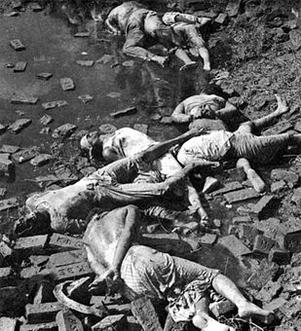
The Bangladesh genocide was the ethnic cleansing of Bengalis, especially Bengali Hindus, residing in East Pakistan during the Bangladesh Liberation War, perpetrated by the Pakistan Armed Forces and the Razakars. It began on 25 March 1971, as Operation Searchlight was launched by West Pakistan to militarily subdue the Bengali population of East Pakistan; the Bengalis comprised the demographic majority and had been calling for independence from the Pakistani state. Seeking to curtail the Bengali self-determination movement, erstwhile Pakistani president Yahya Khan approved a large-scale military deployment, and in the nine-month-long conflict that ensued, Pakistani soldiers and local pro-Pakistan militias killed between 300,000 and 3,000,000 Bengalis and raped between 200,000 and 400,000 Bengali women in a systematic campaign of mass murder and genocidal sexual violence. In their investigation of the genocide, the Geneva-based International Commission of Jurists concluded that Pakistan's campaign involved the attempt to exterminate or forcibly remove a significant portion of the country's Hindu populace.

East Bengal was a non-contiguous province of the Dominion of Pakistan. Geographically eastern part of the Bengal region, East Bengal existed from 1947 until 1955, when it was renamed East Pakistan. Today, the area is an independent country, Bangladesh. With its coastline on the Bay of Bengal, it bordered India and Burma. It was located close to, but did not share a border with, Nepal, Tibet, the Kingdom of Bhutan and the Kingdom of Sikkim. Its capital was Dacca, now known as Dhaka.
Syed Ali Ahsan was a Bangladeshi poet, writer and university academic. He was awarded Ekushey Padak (1982) and Independence Day Award (1987) by the Government of Bangladesh. In 1987, he was selected as the National Professor of Bangladesh. He was credited as the official English translator of the National Anthem of Bangladesh.

Syed Mujtaba Ali was a Bengali writer, journalist, travel enthusiast, academic, scholar and linguist. He lived in Bangladesh, India, Germany, Afghanistan and Egypt.
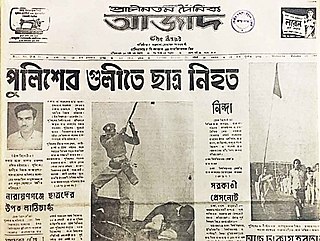
The Azad was a Bengali-language daily newspaper published from 1936 to 1992. The Azad became Dhaka's first daily newspaper. The newspaper, while based in Dhaka, played an important role during the Bengali Language Movement for its advocacy of Bengali.
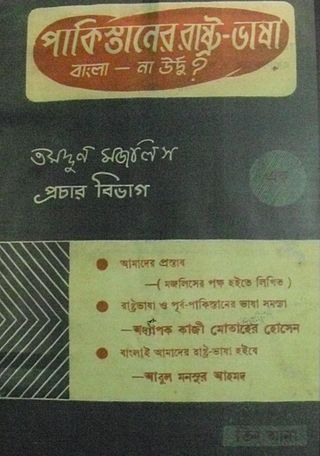
The Tamaddun Majlish, formerly Pakistan Tamaddun Majlish, is an Islamic cultural organization in Bangladesh, established in 1947 by Principal Abul Kashem in the former East Pakistan. It was one of the founding organizations of the Bengali Language Movement.

Bengali nationalism is a form of nationalism that focuses on Bengalis as a single ethnicity by rejecting imposition of other languages and cultures while promoting its own in Bengal. Bengalis speak the Bengali language and mostly live across Bangladesh and the Indian states of West Bengal, Tripura and Assam. Bengali nationalism is one of the four fundamental principles according to the Constitution of Bangladesh and was the main driving force behind the creation of the independent nation state of Bangladesh through the 1971 liberation war. Bengali Muslims make up the majority (90%) of Bangladesh's citizens (Bangladeshis), and are the largest minority in the Indian states of Assam (29%) and West Bengal (27%), whereas Bengali Hindus make up the majority (60%) of India's citizens (Indians) in Indian state of West Bengal, and are the largest minority in the Indian states of Assam (28%) and Jharkhand (8%) and the independent state of Bangladesh (8%).

The East Pakistan Renaissance Society was a political organisation formed to articulate and promote culturally and intellectually the idea for a separate Muslim state for Indian Muslims and specifically for the Muslims of Bengal. The organisation's founders and leaders included Abul Kalam Shamsuddin, the society president, Habibullah Bahar Chowdhury and Mujibur Rahman Khan.
Muhammad Wajed Ali was an East Pakistani Writer and Journalist.
Khalekdad Chowdhury, also known by pen names Shahadat Chowdhury and Atashbaz, is a reputed Bangladeshi writer, playwright and novelist. In recognition of his contribution to Bengali language and literature, the government of Bangladesh posthumously awarded him the country's second highest civilian award Ekushey Padak in 2018.

Dhakaiya Urdu, sometimes unofficially and mythically concocted referred to as Sobbasi Language or Khosbasi Language, is a distinct Bengalinized dialect of Urdu that is native to Old Dhaka beside Dhakaiya Kutti a dialect of Bangla, in Dhaka, Bangladesh. It is being spoken by the city's Sobbas community, Khusbas community, Nawab Family, other native communities such as Shia community and aristocratic families. Sobbasi / Khosbasi is not the name of any language but the adjective and identifies some communities as referred by Hakim Habibur Rahman in Dhaka Pachas Baras Pahle. The usage of this language is gradually declining due to negative perceptions following it being forced upon the people of erstwhile East Bengal. However, at present, with the patronage and sole efforts of the cultural and social activists of the Dhakaiya Urdu language group, Dhakaiya Urdu is rapidly blossoming and expanding again.Today, Dhakaiya Urdu is one of the two dialects of Urdu spoken in Bangladesh; the other one being the Urdu spoken by the Biharis and Stranded Pakistanis in Bangladesh.
Muhammad Abdullah al-Baqi was a Bengali Islamic scholar, writer and politician. As a member of the Central Legislative Assembly, he played an active role in the Indian independence movement. He was a prominent leader of the Ahl-i Hadith movement in North Bengal, and played a significant roles in pre-partition Ahl-i Hadith conferences.
 | This article about a literary magazine published in Asia is a stub. You can help Wikipedia by expanding it. See tips for writing articles about magazines. Further suggestions might be found on the article's talk page. |