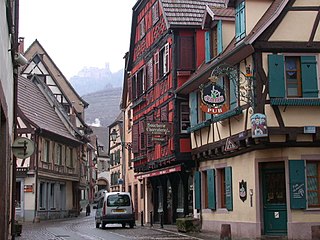
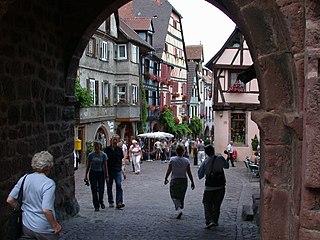
Riesling is a white grape variety which originated in the Rhine region. Riesling is an aromatic grape variety displaying flowery, almost perfumed, aromas as well as high acidity. It is used to make dry, semi-sweet, sweet, and sparkling white wines. Riesling wines are usually varietally pure and are seldom oaked. As of 2004, Riesling was estimated to be the world's 20th most grown variety at 48,700 hectares, but in terms of importance for quality wines, it is usually included in the "top three" white wine varieties together with Chardonnay and Sauvignon blanc. Riesling is a variety which is highly "terroir-expressive", meaning that the character of Riesling wines is greatly influenced by the wine's place of origin.

German wine is primarily produced in the west of Germany, along the river Rhine and its tributaries, with the oldest plantations going back to the Roman era. Approximately 60 percent of the German wine production is situated in the federal state of Rhineland-Palatinate, where 6 of the 13 regions (Anbaugebiete) for quality wine are situated. Germany has about 102,000 hectares of vineyard, which is around one tenth of the vineyard surface in Spain, France or Italy. The total wine production is usually around 9 million hectoliters annually, corresponding to 1.2 billion bottles, which places Germany as the eighth largest wine-producing country in the world. White wine accounts for almost two thirds of the total production.

The German wine classification system puts a strong emphasis on standardization and factual completeness, and was first implemented per the German Wine Law of 1971. Almost all of Germany's vineyards are delineated and registered as one of approximately 2,600 Einzellagen, and the produce from one can be used to make German wine at any quality level, depending not on yields but on the ripeness, or must weight of the grapes.
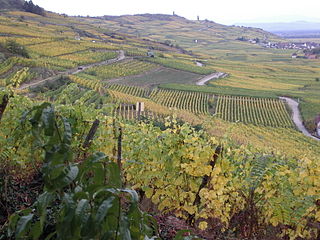
Alsace wine or Alsatian wine is produced in the Alsace region in France and is primarily white wine. Because of its Germanic influence, it is the only Appellation d'Origine Contrôlée region in France to produce mostly varietal wines, typically from similar grape varieties to those used in German wine. Along with Austria and Germany, it produces some of the most noted dry Rieslings in the world as well as highly aromatic Gewürztraminer wines. Wines are produced under three different AOCs: Alsace AOC for white, rosé and red wines, Alsace Grand Cru AOC for white wines from certain classified vineyards and Crémant d'Alsace AOC for sparkling wines. Both dry and sweet white wines are produced.

Sylvaner or Silvaner is a variety of white wine grape grown primarily in Alsace and Germany, where its official name is Grüner Silvaner. While the Alsatian versions have primarily been considered simpler wines, it was recently (2006) included among the varieties that can be used to produce Alsace Grand Cru wine together with the four 'noble grapes' of Alsace, although only in one vineyard, Zotzenberg.

De Bortoli Wines is one of the larger privately owned companies in Australia. De Bortoli makes a wide range of wines including the sweet white Noble One.

Crémant d'Alsace is an Appellation d'Origine Contrôlée for sparkling wines made in the Alsace wine region of France. Produced since 1900, the Crémant d'Alsace AOC was recognized in 1976 by the INAO and the designation Crémant regulated by the European Parliament in 1996.

The Hessische Bergstraße is a defined region (Anbaugebiet) for wine in Germany located in the state of Hesse among the northern and western slopes of the Odenwald mountain chain. With only 439 hectares of vineyards it is the smallest of the 13 German quality wine regions. At 21% red grape varieties and 79% white varieties, it is planted with primarily Riesling and Spätburgunder. Hessische Bergstraße is divided into two districts (Bereiche) - Umstadt and Starkenburg - three collective vineyard sites and 24 individual vineyard sites.
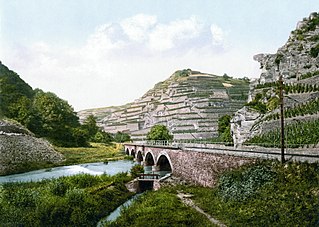
Ahr is a wine region (Anbaugebiet) for quality wine in Germany, and is located in the valley of the river Ahr, a tributary of Rhine, and is situated in the federal state of Rhineland-Palatinate. With only 558 hectares of vines as of 2008, it is one of smaller of Germany's 13 regions. Despite its northern location it primarily produces red wines, and red grape varieties account for 86% of the vineyard area, which is more than in any other German wine region.
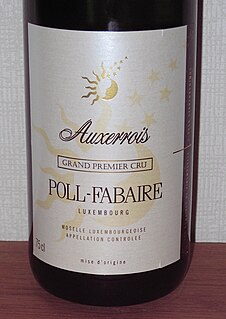
Luxembourg wine is primarily produced in the southeastern part of the Grand Duchy of Luxembourg, with vineyards overlooking the Moselle River. Along this river, which for 42 km makes up part of the border between Luxembourg and Germany, wine is made in three countries. There is a continuous history of winemaking along Moselle and in Luxembourg going back to Ancient Roman times. Wine production in 2006/07 was 123,652 hectoliter from 1,237 hectares of vineyards. Out of total wine exports of 87,776 hectoliter in 2005/06, 71,726 hectoliter or 82% was exported to nearby Belgium. Exports to Germany was the second largest at 8,168 hectoliter, or 9%, and is to a large extent made up of base wine in bulk for the production of blended Sekt rather than being sold bottled with "Luxembourg" anywhere on the label. Therefore, very little Luxembourg wine is seen outside Luxembourg and Belgium.

Inniskillin is a Canadian winery located in Niagara-on-the-Lake, Ontario. Inniskillin, which is mainly noted for its icewine production, has played an important pioneering role in the modern Canadian wine industry. Since 1994, Inniskillin also operates a winery in Okanagan, British Columbia in addition to its original location.

Schloss Vollrads is a castle and a wine estate in the Rheingau wine-growing region in Germany, that has been making wine for over 800 years.
Foris Vineyards Winery is an American winery located near Cave Junction, Oregon in the Illinois Valley region of the Rogue Valley AVA of Southern Oregon. As one of Oregon's pioneering grape growers, Ted Gerber planted his first vineyard in 1974. For 15 years, Gerber provided quality fruit to other winemakers, until 1986 when the winery was founded by Ted and Meri Gerber and the Foris label was launched.

Reif Estate Winery is located in Niagara-on-the-Lake in Ontario, Canada. Reif Estate is primarily known for playing an important in role pioneering the Ontario wine Industry, as well as planting some of the first Vitis vinifera vines in the Niagara region.
Steinberg is a 32.4 hectares wall-enclosed vineyard near Hattenheim in the Rheingau. It is the largest wall-enclosed vineyard in Germany.
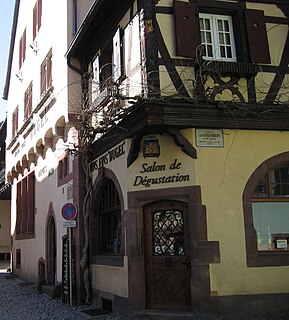
Hugel & Fils is a winery in Riquewihr, Alsace, France. Hugel & Fils is one of the major producers of Alsace wine, and has been an important force in the Alsace wine industry in its developments during the second half of the 20th century.

Domaine Zind-Humbrecht is a winery located in Turckheim, Alsace, France.
Pewsey Vale vineyard was founded in Eden Valley, South Australia during 1847 by Englishman, Joseph Gilbert. It is currently part of S.Smith and son. It was the first vineyard established in what is now the Eden Valley wine region and the first to plant Riesling vines in Australia. Pewsey Vale has become one of Australia’s leading producers of commercial riesling, with its signature wine being the Contours Riesling.

Mount Salem Vineyards is a boutique winery in the Pittstown section of Alexandria Township in Hunterdon County, New Jersey, United States. Formerly a produce, grain, and dairy farm, the vineyard was first planted in 2005, and opened to the public in 2010. Peter Leiter, the proprietor of Mount Salem, founded the Appalachian Highlands Vinifera Society, whose mission is to enhance the quality of wine grape growing and winemaking in Northern New Jersey. Mount Salem has 7 acres of grapes under cultivation, and produces 1,000 cases of wine per year. The winery is located at over 600 feet above sea level on Mount Salem, the mountain for which the farm is named.