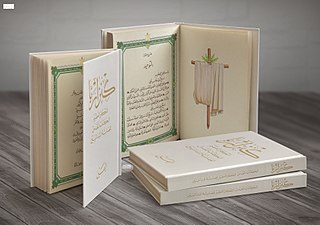
The Ginza Rabba, Ginza Rba, or Sidra Rabba, and formerly the Codex Nasaraeus, is the longest and the most important holy scripture of Mandaeism.
Mandean or Mandaean may refer to:
The Jordan River is a river in the Middle East draining into the Dead Sea.
Artabanus may refer to various rulers/monarchs of ancient Persia and Parthia:

Mandaic, or more specifically Classical Mandaic, is the liturgical language of Mandaeism and a South Eastern Aramaic variety in use by the Mandaean community, traditionally based in southern parts of Iraq and southwest Iran, for their religious books. Mandaic, or Classical Mandaic is still used by Mandaean priests in liturgical rites. The modern descendant of Mandaic or Classical Mandaic, known as Neo-Mandaic or Modern Mandaic, is spoken by a small group of Mandaeans around Ahvaz and Khorramshahr in the southern Iranian Khuzestan province.
Neo-Mandaic, also known as Modern Mandaic, sometimes called the "ratna", is the modern reflex of the Mandaic language, the liturgical language of the Mandaean religious community of Iraq and Iran. Although severely endangered, it survives today as the first language of a small number of Mandaeans in Iran and in the Mandaean diaspora. All Neo-Mandaic speakers are multilingual in the languages of their neighbors, Arabic and Persian, and the influence of these languages upon the grammar of Neo-Mandaic is considerable, particularly in the lexicon and the morphology of the noun. Nevertheless, Neo-Mandaic is more conservative even in these regards than most other Neo-Aramaic languages.
The Mandaic alphabet is a writing system primarily used to write the Mandaic language. It is thought to have evolved between the second and seventh century CE from either a cursive form of Aramaic or from Inscriptional Parthian. The exact roots of the script are difficult to determine. It was developed by members of the Mandaean faith of Lower Mesopotamia to write the Mandaic language for liturgical purposes. Classical Mandaic and its descendant Neo-Mandaic are still in limited use. The script has changed very little over centuries of use.

The Qolastā, Qulasta, Qolusta, or the Canonical Prayerbook is, as the name suggests, a canonical prayer book of the Mandaeans, a Gnostic ethnoreligious group from Iraq and Iran. The Mandaic word qolastā means "collection". The prayerbook is a collection of Mandaic prayers regarding baptisms (masbuta) and other sacred rituals involved in the ascension of the soul (masiqta).
Rahma most commonly refers to an Arabic name, which may refer to:
Mandaic is a Unicode block containing characters of the Mandaic script used for writing the historic Eastern Aramaic, also called Classical Mandaic, and the modern Neo-Mandaic language.
In Mandaeism, Ptahil also known as Ptahil-Uthra, is the Fourth Life, the third of three emanations from the First Life, Hayyi Rabbi, after Yushamin and Abatur. Ptahil-Uthra alone does not constitute the demiurge but only fills that role since he is viewed as the creator of the material world in the Ginza Rabba, often holding an inherently malicious character.
The Alma Rišaia Zuṭa is a Mandaean religious text. The text is used for Mandaean priestly initiation ceremonies. It is written as a scroll. The Alma Rišaia Zuṭa complements the Alma Rišaia Rba, or "The Greater Supreme World", a related Mandaic text used for priestly rituals.
A Mandaean priest or Rabbi refers to an ordained religious leader in Mandaeism.
In Mandaeism, a ʿniana prayer is recited during rituals such as the masiqta and priest initiation ceremonies. There is a total of 26 ʿniana prayers. They form part of the Qolasta.
Ziwa is an Aramaic term that is typically translated as 'radiance' or 'splendor.' It is frequently used as an epithet for celestial beings and manifestations of God in Gnostic religions such as Mandaeism and Manichaeism.
Mandaean names can include both birth names and baptismal names, called malwasha (ࡌࡀࡋࡅࡀࡔࡀ) in Mandaic.
In Mandaeism, misha is anointing sesame oil used during rituals such as the masbuta (baptism) and masiqta, both of which are performed by Mandaean priests.
This page is based on this
Wikipedia article Text is available under the
CC BY-SA 4.0 license; additional terms may apply.
Images, videos and audio are available under their respective licenses.
