External links
| International | |
|---|---|
| Other | |

  | This biographical article related to association football in Italy, about a goalkeeper, is a stub. You can help Wikipedia by expanding it. |
| Personal information | |||
|---|---|---|---|
| Date of birth | 21 August 1966 | ||
| Place of birth | Rimini, Italy | ||
| Height | 1.78 m (5 ft 10 in) | ||
| Position(s) | Goalkeeper | ||
| Senior career* | |||
| Years | Team | Apps | (Gls) |
| 1983–1986 | Rimini | 37 | (0) |
| 1986–1994 | Parma | 79 | (0) |
| 1991–1992 | → Avellino (loan) | 10 | (0) |
| 1994–1995 | Forlì | 14 | (0) |
| *Club domestic league appearances and goals | |||
Marco Ferrari (born 21 August 1966 in Rimini) is a retired Italian professional footballer who played as a goalkeeper.
| International | |
|---|---|
| Other | |
| | This biographical article related to association football in Italy, about a goalkeeper, is a stub. You can help Wikipedia by expanding it. |

The Union of European Football Associations is one of six continental bodies of governance in association football. It governs football, futsal and beach football in Europe and the transcontinental countries of Turkey, Azerbaijan, Georgia and Kazakhstan, as well as the West Asian countries of Cyprus, Armenia and Israel. UEFA consists of 55 national association members. Since 2022, due to the Russian invasion of Ukraine, FIFA and UEFA suspended all Russian national teams and clubs from any FIFA and UEFA competitions.

The UEFA Champions League is an annual club association football competition organised by the Union of European Football Associations (UEFA) that is contested by top-division European clubs. The competition begins with a round robin league phase to qualify for the double-legged knockout rounds, and a single-leg final. It is the most-watched club competition in the world and the third most-watched football competition overall, behind only the UEFA European Championship and the FIFA World Cup. It is one of the most prestigious football tournaments in the world and the most prestigious club competition in European football, played by the national league champions of their national associations.

The UEFA Cup Winners' Cup was a European football club competition contested annually by the winners of domestic cup competitions. The cup was, chronologically, the second seasonal inter-European club competition organised by UEFA. The tournament ran for 39 seasons, with the final edition held in 1998–99, after which it was discontinued.

The UEFA Europa League, abbreviated as UEL, is an annual football club competition organised since 1971 by the Union of European Football Associations (UEFA) for eligible European football clubs. It is the second-tier competition of European club football, ranking below the UEFA Champions League and above the UEFA Conference League.

The UEFA Super Cup is an annual super cup football match organised by UEFA and contested by the winners of the two main European club competitions: the UEFA Champions League and UEFA Europa League. The competition's official name was originally the Super Competition, and later the European Super Cup. It was renamed the UEFA Super Cup in 1995, following a policy of rebranding by UEFA.

The UEFA Intertoto Cup, originally called the International Football Cup, was a summer football competition between European clubs. The competition was discontinued after the 2008 tournament.

The 1999–2000 UEFA Cup season was the 29th edition of the UEFA Cup competition. The final took place at Parken Stadium in Copenhagen and was won by Galatasaray, who defeated Arsenal in the final. The game was scoreless through the first ninety minutes and stayed that way through thirty minutes of extra time. The match went on to penalty kicks in which Gheorghe Popescu scored the winning goal to win the cup. Galatasaray won the cup without losing a single game. The competition was marred by violence involving Turkish and English hooligans in the semi-finals and the final, in particular the fatal stabbings of Leeds United fans Kevin Speight and Christopher Loftus by Galatasaray fans in Istanbul.

The 2005–06 UEFA Cup, the 35th edition of the UEFA Cup, was won by Sevilla, beating Middlesbrough in the final. It was the first victory for Sevilla in a European competition, and the first appearance by Middlesbrough in a European final. The final took place at Philips Stadion, in Eindhoven, Netherlands. The match was refereed by Herbert Fandel. Middlesbrough sealed their place in the final on the back of two dramatic comebacks. In the quarter-finals they beat FC Basel of Switzerland 4–3 on aggregate, this put them into the semi–final to face Steaua București. The first leg finished 1–0 to Steaua, and the second leg finished 4–2. Sevilla went on to defend the trophy the following year.

The 2003–04 UEFA Cup was won by Valencia in the final against Marseille. It wrapped up a league and UEFA Cup double for Valencia.

The 2004–05 UEFA Cup was the 34th edition of the UEFA Cup. The format of the competition had changed from previous seasons, replacing that from the previous one after the abolition of the Cup Winners' Cup in 1999; an extra qualifying round was introduced, as was a group phase after the first round. The group stage operated in a single round-robin format consisting of eight groups of five teams, each team plays two games at home and two away and the top three finishers of each group progress to the knock-out round, joining the eight third-placed teams from the UEFA Champions League group stage.

The 2000–01 UEFA Cup was the 30th edition of the UEFA Cup competition. Liverpool won the final with a golden goal in against Alavés for their third title in the competition. It completed a cup treble for the club, as they also won the FA Cup and the League Cup that season. The conclusion of the tournament by a golden goal is the only instance in any of the major European club cup competitions until the abolition of the rule in 2002.

The 2002–03 UEFA Cup was the 32nd edition of the UEFA Cup, the second-tier European club football tournament organised by UEFA. The final was played between Portuguese side Porto and Scottish side Celtic at the Estadio Olímpico de Sevilla, Seville, on 21 May 2003. Porto won 3–2 after silver goal extra time and became the first Portuguese team to win the competition.

The Finalissima, formerly known as European/South American Nations Cup and also called Artemio Franchi Cup, is an intercontinental football match organised by CONMEBOL and UEFA and contested by the winners of the Copa América and UEFA European Championship. Organised as an occasional one-off match, it is a national team equivalent to the defunct Intercontinental Cup between the club champions of Europe and South America. The competition was held twice, in 1985 and 1993, before being discontinued. It was relaunched in 2022, after the signing of a memorandum of understanding between CONMEBOL and UEFA.

The 1997 UEFA Cup Winners' Cup Final was a football match contested between Barcelona of Spain and the cup holders Paris Saint-Germain of France, to determine the winner of the 1996–97 UEFA Cup Winners' Cup and the 37th overall Cup Winners' Cup final. It was held at Feijenoord Stadion in Rotterdam on 14 May 1997. Barcelona won the match 1–0 thanks to a Ronaldo penalty. The final saw the last instance of the Cup Winners' Cup "jinx" that no club had successfully retained the cup in successive seasons — with Paris Saint-Germain failing to defend the trophy that they won in 1996.

The 2008–09 UEFA Cup was the 38th season of the UEFA Cup football tournament. The final was played at the Şükrü Saracoğlu Stadium, home ground of Fenerbahçe, in Istanbul on 20 May 2009. It was the final season to use the UEFA Cup format; starting in 2009, the competition was known as the UEFA Europa League. Ukraine's Shakhtar Donetsk beat Werder Bremen 2–1 after extra time to win their first European title. Zenit Saint Petersburg were the defending champions but were eliminated by Udinese in the Round of 16.
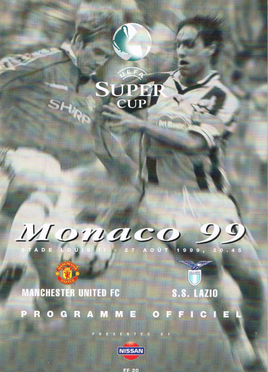
The 1999 UEFA Super Cup was a football match played on 27 August 1999 between the 1998–99 UEFA Champions League winners, Manchester United, and Lazio, winners of the 1998–99 UEFA Cup Winners' Cup.

The UEFA Nations League is an international football competition played by the senior men's national teams of the member associations of UEFA, the sport's European governing body.
The 2026 FIFA World Cup qualification will decide the 45 teams that will join hosts Canada, Mexico, and the United States at the 2026 FIFA World Cup.
The European section of the 2022 FIFA World Cup qualification acted as qualifiers for the 2022 FIFA World Cup, to be held in Qatar, for national teams that are members of the Union of European Football Associations (UEFA). A total of 13 slots in the final tournament were available for UEFA teams.