A turnkey, a turnkey project, or a turnkey operation is a type of project that is constructed so that it can be sold to any buyer as a completed product. This is contrasted with build to order, where the constructor builds an item to the buyer's exact specifications, or when an incomplete product is sold with the assumption that the buyer would complete it.

The IBM Series/1 is a 16-bit minicomputer, introduced in 1976, that in many respects competed with other minicomputers of the time, such as the PDP-11 from Digital Equipment Corporation and similar offerings from Data General and HP. The Series/1 was typically used to control and operate external electro-mechanical components while also allowing for primitive data storage and handling.
The Navy/Marine Corps Intranet (NMCI) is a United States Department of the Navy program which was designed to provide the vast majority of information technology services for the entire Department, including the United States Navy and Marine Corps.

The Landing Craft Air Cushion (LCAC) is a class of air-cushioned landing craft (hovercraft) used by the United States Navy and the Japan Maritime Self-Defense Force (JMSDF). They transport weapons systems, equipment, cargo and personnel from ship to shore and across the beach. It is to be replaced in US service by the Ship-to-Shore Connector (SSC).
Purchasing is the process a business or organization uses to acquire goods or services to accomplish its goals. Although there are several organizations that attempt to set standards in the purchasing process, processes can vary greatly between organizations.

Multibus is a computer bus standard used in industrial systems. It was developed by Intel Corporation and was adopted as the IEEE 796 bus.

M320 Grenade Launcher Module (GLM) is the U.S. military's designation for a new single-shot 40 mm grenade launcher system to replace the M203 for the U.S. Army, while other services initially kept using the older M203. The M320 uses the same High-Low Propulsion System as the M203.
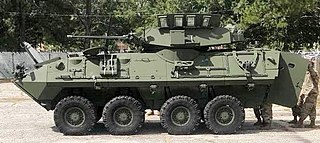
The LAV-25 is a member of the LAV II family. It is an eight-wheeled amphibious armored reconnaissance vehicle built by General Dynamics Land Systems and used by the United States Marine Corps and the United States Army.

CAP Scientific Ltd was a British defence software company, and was part of CAP Group plc. In 1988, CAP Group merged with the French firm Sema-Metra SA in 1988 as Sema Group plc. In 1991 Sema Group put most of its defence operations into joint venture with British Aerospace called BAeSEMA, which British Aerospace bought out in 1998. Parts of the former CAP Scientific are now BAE Systems (Insyte).
In the United States, the processes of government procurement enable federal, state and local government bodies in the country to acquire goods, services, and interests in real property.
SMCS, the Submarine Command System, was first created for the Royal Navy of the United Kingdom's Vanguard-class submarines as a tactical information system and a torpedo weapon control system. Versions have now also been installed on all active Royal Navy submarine classes.
Integral Systems, Inc. was a manufacturer of satellite ground systems founded in 1982, and based in Columbia, Maryland in the United States. The company had supported over 205 satellite missions for communications, science, meteorological and earth resource applications. Integral's customers included government/commercial satellite operators, spacecraft/payload manufacturers and aerospace systems integrators. The company offered a commercial off-the-shelf (COTS) software product line for command and control, and employed approximately 769 people in the United States and Europe. On July 27, 2011, California Kratos Defense and Security Solutions completed the acquisition of Integral System, with each outstanding share of Integral Systems common stock cancelled and converted into the right to receive (i) $5.00, in cash, without interest, and (ii) 0.588 shares of the Kratos Defense and Security Solutions common stock.
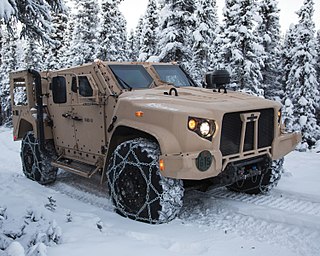
The Joint Light Tactical Vehicle (JLTV) is a U.S. Army, U.S. Marine Corps and Special Operations Command program to partially replace the Humvee fleet with a family of more survivable vehicles having a greater payload. Early studies for the JLTV program were approved in 2006. The JLTV program incorporates lessons learned from the earlier Future Tactical Truck Systems program and other associated efforts.
The Standard Procurement System (SPS) is a software suite providing front-office business services to Acquisition professionals in the United States Department of Defense.
In U.S. Federal government contracting, IDIQ is an abbreviation of the term indefinite delivery/indefinite quantity. This is a type of contract that provides for an indefinite quantity of supplies or services during a fixed period of time. The legal origin of IDIQ contracts is the Federal Acquisition Regulation (FAR) section 16.504(a). IDIQs are also sometimes called "Task Orders" or "Delivery Order Contracts." IDIQ contracts are a subtype of Indefinite Delivery Contract (IDC), which is a "vehicle that has been awarded to one or more vendors to facilitate the delivery of supply and service orders."

The M1161 Growler is officially the Internally Transportable Light Strike Vehicle (ITV-LSV) designed specifically for use with the V-22 Osprey tiltrotor aircraft. The M1161 and M1163 are the only tactical vehicles certified to fly in the V-22. Fulfilling multiple roles of light utility, light strike and fast attack vehicle, the M1161 Growler is smaller than most international vehicles in the same role. It has taken over duties of the M151 jeep-type variants and replaced the Interim Fast Attack Vehicle (IFAV).
The Integrated Soldier System Project (ISSP) is Canada's program to equip dismounted soldiers with state-of-the-art equipment, using a combination of commercial, off-the-shelf technologies (COTS) and current-issue military gear. The equipment is designed to improve command execution, target acquisition and situational awareness by:

The Marine Personnel Carrier (MPC) is a wheeled armored personnel carrier under development for acquisition by the United States Marine Corps. The program was canceled in 2013 but resurrected in 2014 as part of phase one of the Amphibious Combat Vehicle.
Army CHESS (Computer Hardware Enterprise Software and Solutions) is the main provider of commercial enterprise information technology (IT) solutions, computer software, and hardware for the United States Army. CHESS allows authorized U.S. Army and other Federal Agency commissioners to easily procure a wide array of IT hardware and services through various contracting vessels. CHESS promotes competition amongst vendors in order to provide the best pricing as well as standardized hardware requirements mandated by the U.S. Army.

PacStar, part of Curtiss-Wright Corporation's Defense Solutions Division, is a developer and manufacturer of tactical communication and information technology infrastructure hardware and software based in Portland, Oregon. The company was founded in 2000 in Oregon as a reseller of advanced networking and communication equipment and in 2005 began manufacturing communications systems of its own design. The company has multi-million dollar deals with several branches of the US military and also supplies rugged networking equipment to commercial industries. The formerly privately held company was acquired by Curtiss-Wright in late 2020.


